The Governance Layer: What Nobody Tells You About Owning an AI Product in Production
 Andrés (Andy) Garcia10 min read·Just now
--
The model is not the product. The system of decisions surrounding the model is the product. And almost no one is building it intentionally.
I want to start with something I’ve never seen written anywhere in product management literature.
Not in a book. Not in a conference talk. Not in any of the thousands of LinkedIn posts about AI product strategy I’ve read over the past three years.
Here it is:
The moment you write your first ML acceptance criterion, you’ve already made a governance decision.
Most teams make it accidentally.
And then spend the next six months dealing with consequences they can’t trace back to a cause — declining precision, rising false positive rates, user trust erosion, dashboards that look fine while something quietly and expensively goes wrong underneath them.
This article is about that gap.
I call it The Governance Layer — the five-component system that determines whether an AI product improves after launch or degrades while every metric still shows green.
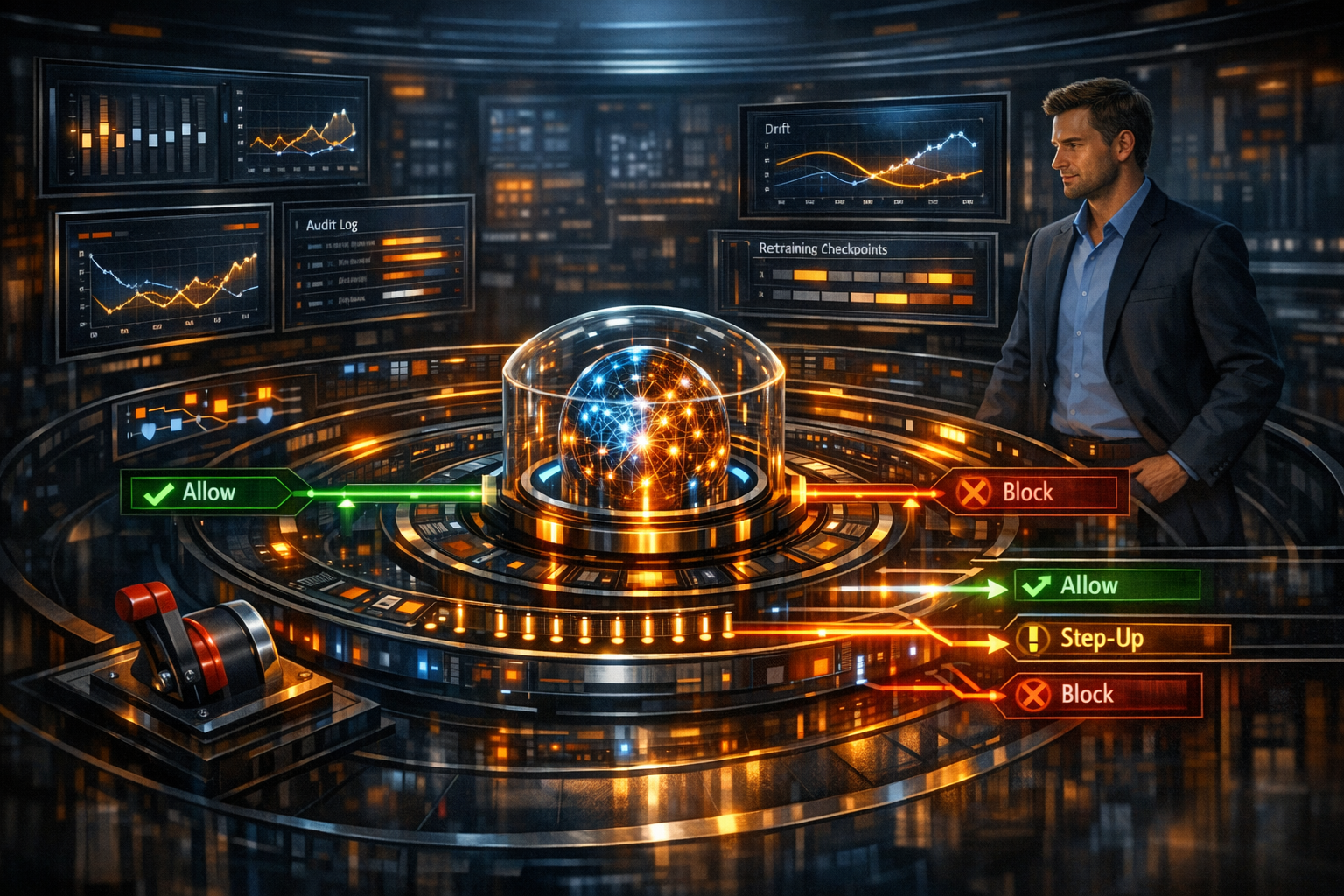
I built it under conditions where being wrong had immediate, irreversible financial consequences: governing a real-time ML trust decision system making allow/step-up/block calls on every payment transaction at a major financial institution, at billions of dollars in annual volume, with no fallback and no undo.
I got some decisions wrong.
The governance architecture caught them.
That’s not a success story. That’s the point.
Why the Model Is the Least Important Part of Your AI Product
This is the counterintuitive insight that took me the longest to fully internalize — and the one I think changes everything once it lands.
In a demo environment, the model performs beautifully.
The data is clean. The signals are structured. The latency is acceptable. The outputs are impressive enough to secure the budget, the stakeholder approval, the launch date.
In production, something different happens.
Real users behave in ways your training distribution didn’t anticipate. Real signals arrive noisy, incomplete, slightly off-schema from an upstream change nobody documented. Real latency compounds across five interdependent system layers that each added milliseconds that felt acceptable in isolation. Real edge cases — the ones you designed for and the ones nobody thought of — arrive simultaneously during your highest-volume window.
And the model that was perfect in the demo starts making decisions that are subtly, consistently, expensively wrong.
Not broken. Not crashing.
Just wrong — in ways that don’t generate error logs, don’t surface in weekly dashboards, and don’t get attributed to their actual cause until the compounding has been running for weeks.
I’ve seen this pattern more times than I can count, across multiple AI product environments.
The team celebrates the model launch. The product quietly degrades. Nobody connects the dots until the damage is already significant.
Here’s what I’ve learned: the model is the least important part of a production AI system.
The most important parts are the five components that surround it — the system I call The Governance Layer.
The Governance Layer: Five Components That Determine Everything
Component 1: Threshold Ownership
The most important governance question for any AI product is not “how accurate is the model?”
It’s: who owns what the model decides — and does that person have the authority to change it without a code deploy?
In most AI products, thresholds — the decision boundaries that determine what the model’s output produces in user-facing terms — are set at training by data scientists optimizing for benchmark accuracy, and then treated as engineering configuration for the rest of the product’s life.
This is governance by default. And it fails at scale for a specific reason:
The thresholds that are correct for a training distribution are almost never correct for a production distribution after six months of real user behavior.
Production environments change. Training environments don’t.
Every day that passes without a PM explicitly reviewing and owning the threshold logic, the gap between “what the model was trained to decide” and “what the model should be deciding for these specific users in this specific context” widens.
In my governance model, threshold ownership meant:
- Every Allow/Step-Up/Block boundary was PM-owned and documented with explicit business justification
- Threshold changes required PM approval and wrote an immutable audit log entry
- Changes were executable in under 60 seconds with no engineering involvement
- Rollback to any prior threshold was available in under 60 seconds — because if rollback requires an engineering sprint, you don’t have governance infrastructure. You have a liability.
This last point is more important than it sounds.
When rollback is trivially fast and PM-controlled, every governance decision becomes less risky — because the cost of being wrong is cheap. You can move decisively on threshold adjustments precisely because you know you can reverse them instantly if the production data tells you you were wrong.
When rollback is slow and engineering-dependent, every governance decision becomes politically fraught. Teams start defending threshold decisions instead of re-evaluating them. The governance cadence becomes a bureaucratic exercise rather than a genuine learning mechanism.
The rollback infrastructure is the physical manifestation of your governance philosophy.
Component 2: Cadence Governance
If I had to identify the single most common governance failure in production AI products, it would be this:
Governance cadence designed after launch rather than before it.
Most teams establish their model review cadence reactively — after the first incident, after the first performance degradation, after the first stakeholder complaint.
By then, the damage is already compounding.
Here’s the insight that changed how I build AI products:
Governance cadence is architecture — in exactly the same way that API contracts, error handling, and database schema are architecture. It has to be designed before the first sprint of build begins, because every technical decision you make during build will either enable or undermine your ability to govern the system after launch.
If you design the threshold governance model after launch, you’re retrofitting accountability onto a system that wasn’t built with accountability in mind.
My cadence governance had one non-negotiable rule:
Every two weeks, the same five metrics reviewed simultaneously — never independently:
- Fraud rate (or equivalent outcome metric)
- False positive rate
- Step-up/intervention rate (the friction the product is creating)
- Transaction completion rate (the value the product is delivering)
- Signal drift score per category
The key word is simultaneously.
A threshold adjustment that improves fraud rate by 0.3% while quietly increasing false positives by 0.5% is not an improvement. It’s a tradeoff you made without realizing it — and at high transaction volume, that tradeoff has a real dollar cost that compounds every day.
Reviewing metrics independently makes these hidden tradeoffs invisible.
Reviewing them together makes them impossible to miss.
Component 3: Drift Detection
Here is the governance insight that I think the product community most consistently underestimates:
Signal drift isn’t a risk to plan for. It’s a certainty to design against.
Every production ML model will drift. Not maybe. Not eventually. Continuously — because the world the model was trained on keeps changing, and the model’s representation of that world starts becoming stale the moment training ends.
User behavior changes. Fraud patterns evolve. New device types enter the dataset. Seasonal patterns distort velocity signals. Regional events create geolocation anomalies. Any upstream system change can alter the distribution of any signal the model depends on.
None of this is preventable. All of it is manageable — if the drift detection architecture was built before it was needed.
Here’s the specific thing most teams get wrong about drift detection:
Monitoring point-in-time performance is not the same as monitoring drift.
A model performing at 94.1% accuracy this week might be fine.
A model that was at 94.5% four weeks ago, 94.3% three weeks ago, and 94.1% this week is showing a consistent decline trajectory that will surface as a critical failure in roughly three more weeks — and by then it will have been degrading for seven weeks.
Point-in-time monitoring catches failures. Trend monitoring catches degradation before it becomes failure.
My drift detection architecture included:
- Automated drift scoring per signal category, computed daily
- PM notification within 4 hours of any threshold breach
- A structured investigation protocol before any retraining decision was made
- Explicit signal exclusion rules to prevent feedback loop corruption
That last item is the most important and the least discussed.
Automatic retraining — without PM review — is one of the most dangerous defaults in production ML.
A model that retrains automatically on corrupted production data doesn’t improve. It learns the wrong patterns — gradually, invisibly — until the false positive rate has quietly doubled and the root cause analysis requires forensic investigation spanning months of production data.
I’ve seen this happen. It doesn’t announce itself. It looks like noise until it’s a problem.
Drift triggers investigation, not automatic retraining.
That distinction — investigation first, retraining only after PM review — is the difference between a model that compounds in accuracy and a model that compounds in failure.
Component 4: Retraining Governance
If Component 3 is about detecting that the model needs attention, Component 4 is about governing what happens next.
The retraining governance question is: who decides whether and how the model retrains — and on what evidence?
In most teams, the answer is data science. Which means the answer is: whoever is available, on whatever cadence feels reasonable, based on model performance metrics.
That is not governance. That is optimism.
Retraining governance requires:
Signal exclusion rules — explicit documentation of which production signals are safe to feed back into training and which are not. Production outcomes include noise, adversarial inputs, and the consequences of the model’s own previous decisions. A model that trains on all of these learns to replicate its errors, not correct them.
Retraining thresholds — explicit criteria for when drift evidence is sufficient to warrant retraining, documented before the first drift event occurs. “We’ll know it when we see it” is a governance gap dressed up as judgment.
PM sign-off requirement — every retraining decision that affects the production model requires PM review and approval. Not as a bottleneck. As accountability. The PM who owns what the model decides must understand what it’s being retrained on and why.
Post-retraining validation window — every retrained model runs in shadow mode against production traffic for a defined period before replacing the production model. The shadow mode results are reviewed by PM before cutover, not after.
Component 5: Rollback Infrastructure
I’ve said this in different contexts, but I want to state it clearly as a governance principle:
The quality of your AI product governance is inversely proportional to how long it takes to reverse a wrong decision.
Under 60 seconds, PM-controlled: you have governance infrastructure. Under a day, engineering-assisted: you have reasonable governance with a gap. Under a sprint, engineering-dependent: you have a deployment pipeline labeled as governance. Longer than a sprint: you have a product where the PM doesn’t actually own the outcomes.
In a real-time decision system with irreversible consequences, the exposure window between “we noticed something is wrong” and “we stopped it” is measured in minutes — sometimes less.
Every minute a wrong threshold runs at production volume is a minute of compounding wrong decisions affecting real users.
Building fast rollback into the governance architecture before launch isn’t operational hygiene.
It’s the product requirement that makes every other governance component less terrifying to use.
When I know I can reverse a threshold change in 60 seconds, I can adjust thresholds confidently and frequently. I can calibrate aggressively when the data supports it. I can treat the biweekly review as a genuine learning mechanism rather than a high-stakes decision point.
When rollback is slow, every governance decision becomes conservative by default — because the cost of being wrong is high. And conservative governance is how AI products stagnate.
The Question That Surfaces Your Governance Gap
I want to leave you with the question I use when I’m assessing the governance maturity of any AI product in production.
It’s more revealing than any audit, any document review, any architectural diagram.
If your most important model’s decision accuracy quietly declined by 0.3% per week starting today, would your current monitoring surface it before the 8-week mark?
Not in a post-mortem. Not in a quarterly review. In a governance meeting, as a trend, with enough time to investigate and respond before the compounding is significant.
Most teams can’t answer yes with confidence.
And the 0.3% weekly decline I’m describing isn’t theoretical. It’s the specific pattern I’ve seen most often in production AI systems that were well-governed at launch and then slowly weren’t — as the governance cadence drifted, as the signal quality audits stopped happening, as the biweekly reviews became monthly, as the person who understood the governance architecture moved to a new role and nobody picked up the thread.
The Governance Layer isn’t something you build once.
It’s something you maintain continuously — or it decays.
And the product decays with it.
What This Means for How You Build AI Products
The most important architectural decision you’ll make for your AI product isn’t model selection or feature engineering or latency optimization.
It’s whether you explicitly design The Governance Layer before Sprint 1 — or discover its absence after the first production incident.
The five components I’ve described aren’t advanced. They’re not novel engineering.
They are:
- A PM who owns thresholds with rollback in under 60 seconds
- A biweekly cadence reviewing metrics simultaneously, not independently
- Daily drift scoring with PM notification at threshold breach
- Retraining governance with explicit signal exclusion rules and PM sign-off
- A rollback infrastructure tested before launch, not designed after the first crisis
That’s it.
None of it is technically sophisticated.
All of it requires intentionality — the decision to build it before it’s needed, rather than reconstruct it after it’s obviously missing.
The AI products that compound in value after launch aren’t the ones with the best models.
They’re the ones with the best systems around their models.
And most of their competitors are still optimizing the part that matters least.
Andrés Garcia is a Senior Product Manager specializing in payments, AI/ML systems, and regulated platform environments. He governed TDV — a real-time ML trust decision system — at a major US financial institution, and led product execution for the largest brokerage migration in industry history. He writes about The Governance Layer — the product decisions most AI writing avoids.
Connect on LinkedIn → https://www.linkedin.com/in/andygarcia23/
Full portfolio → https://deft-genie-852849.netlify.app/