DeFi Doesn’t Remove Trust — It Engineers It
 Cryptoman_Alex3 min read·Just now
--
DeFi was built on a powerful idea:
“Don’t trust people. Trust code.”
For a while, that felt true.
Smart contracts replaced intermediaries.
Transactions became transparent.
Execution became automated.
The narrative was simple:
- DeFi is trustless
- Code is law
- No intermediaries required
But as the ecosystem evolved, something became clear:
Trust didn’t disappear. It just moved.
The myth of “trustless” systems
No financial system is completely trustless.
Not even DeFi.
The real question isn’t:
“Is there trust?”
It’s:
“Where does trust exist — and how is it managed?”
Because even in DeFi, you are always trusting something.
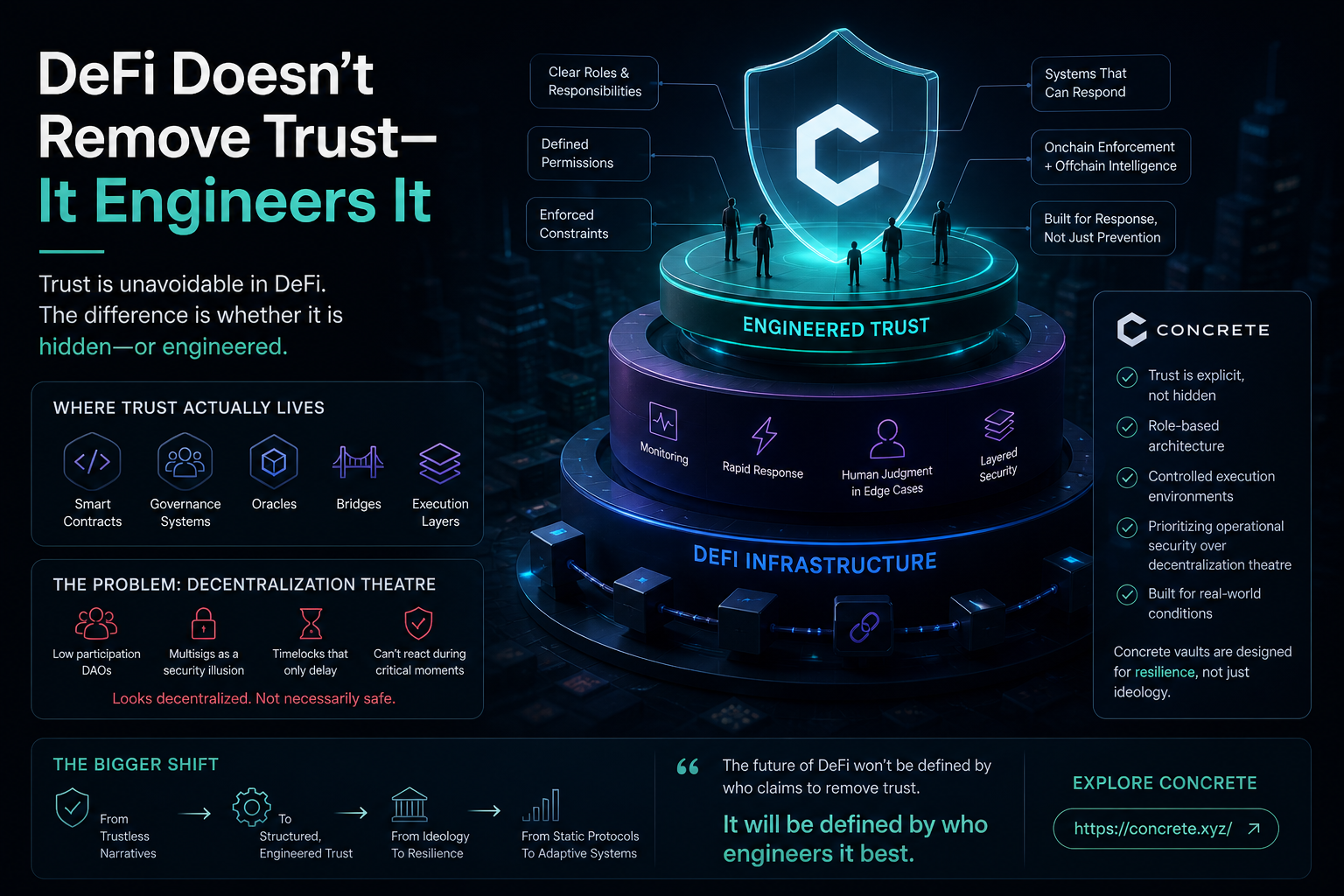
Where trust actually lives in DeFi
In practice, DeFi relies on multiple layers of trust:
- Smart contracts — you trust the code is correct and secure
- Governance systems — you trust decisions won’t harm users
- Oracles — you trust external data is accurate
- Bridges — you trust cross-chain infrastructure
- Execution layers — you trust transactions are processed fairly
These dependencies are real.
They’re just abstracted away behind interfaces.
DeFi didn’t remove trust — it distributed it across systems.
The problem with “decentralization theatre”
This leads to a dangerous pattern.
Some systems appear decentralized, but aren’t truly resilient.
Examples include:
- Multisigs acting as centralized control points
- DAOs with low participation and unclear accountability
- Timelocks that delay risk but don’t eliminate it
- Systems that can’t respond quickly during critical events
This is decentralization theatre — where structure looks safe, but doesn’t behave safely under stress.
There’s a difference between:
- Looking decentralized
- Actually being secure
And in financial systems, that difference matters.
What engineered trust looks like
If trust can’t be removed, it must be designed.
This is where the concept of engineered trust comes in.
Engineered trust means:
- Clear roles and responsibilities
- Defined permissions
- Enforced constraints
- Systems that can respond to failure
This is how mature financial systems operate.
And it’s how modern DeFi infrastructure should be built.
Why operational security matters
Pure automation is powerful — but incomplete.
Real systems need:
- Continuous monitoring
- Rapid response mechanisms
- Human judgment in edge cases
- Layered security models
Because not every scenario can be predicted in code.
Markets change. Risks evolve. Edge cases happen.
Operational security bridges the gap between static code and dynamic reality.
How Concrete approaches trust differently
This is where Concrete vaults stand apart.
Concrete doesn’t hide trust behind abstractions.
It makes it explicit and structured.
Key principles include:
- Onchain enforcement of rules and constraints
- Role-based architecture separating responsibilities
- Systems designed for response, not just prevention
- Controlled execution environments
- Integration of off-chain intelligence with on-chain logic
Instead of relying on a single point of control, Concrete distributes responsibility across clearly defined roles.
This reduces ambiguity and improves resilience.
It’s a model designed for institutional DeFi, where security and accountability are non-negotiable.
The bigger shift
DeFi is evolving beyond simple narratives.
- “Trustless” is no longer enough
- Transparency alone is not security
- Decentralization without structure is fragile
The next phase is about:
- Engineered trust
- Systems that behave predictably under stress
- Infrastructure that prioritizes resilience over ideology
Because in the end:
The future of DeFi won’t be defined by who claims to remove trust.
It will be defined by who engineers it best.
Useful links:
- Website: https://www.concrete.xyz/
- Application: https://app.concrete.xyz/
- Points Campaign: https://points.concrete.xyz/home
- X / Twitter: https://x.com/ConcreteXYZ
- Documentation: https://docs.concrete.xyz/
- Blog: https://mirror.xyz/concretexyz.eth
- Audits: https://www.halborn.com/audits/concrete