DeFi Doesn’t Remove Trust — It Engineers It
--
DeFi was built on a powerful, almost rebellious idea: “Don’t trust people. Trust code.”
For a time, that narrative carried the industry. The promise of trustless systems, where intermediaries disappear and smart contracts replace human discretion, felt like a clean break from traditional finance.
But as DeFi matured, something became increasingly clear:
Trust didn’t disappear. It just moved.
The real question is no longer whether trust exists in DeFi but where it exists and how well it is engineered.
The Myth of “Trustless”
At its core, DeFi promotes three foundational beliefs:
- “DeFi is trustless”
- “Code is law”
- “No intermediaries needed”
These ideas are directionally useful but incomplete.
In practice, no system operating in the real world can be fully trustless. Every protocol, no matter how decentralized, embeds assumptions. And every assumption is a form of trust.
So instead of eliminating trust, DeFi redistributes it into different layers of infrastructure.
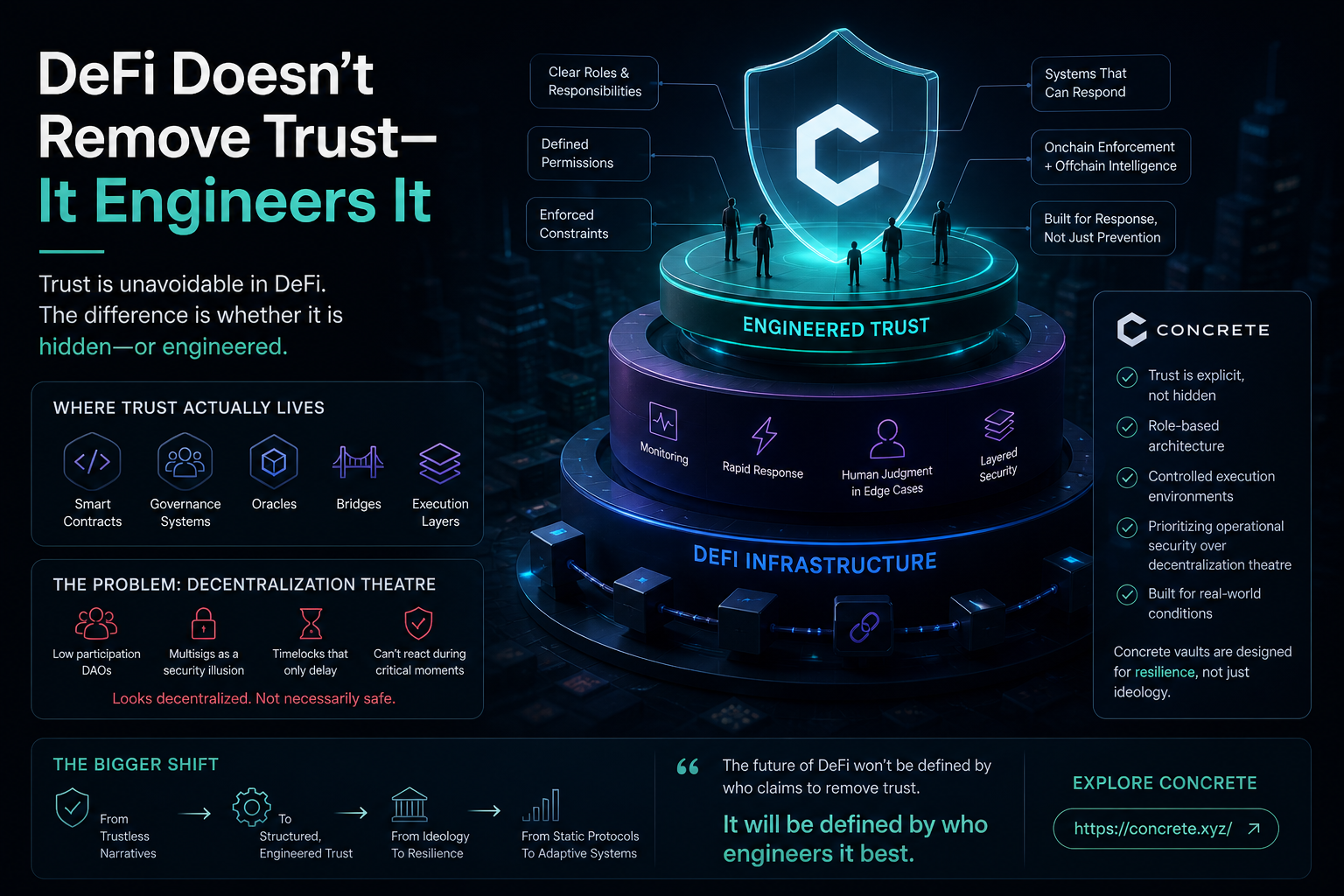
Where Trust Actually Lives
If you look closely, trust in DeFi is everywhere just less visible.
Users implicitly trust:
- Smart contracts — that the code is secure, audited, and free from exploits
- Governance systems — that token holders act in the protocol’s best interest
- Oracles — that external data feeds are accurate and manipulation-resistant
- Bridges — that cross-chain assets are properly secured
- Execution layers — that transactions are processed fairly and reliably
None of these components are inherently trustless. They are trust-dependent systems wrapped in cryptographic guarantees.
The difference is that trust is abstracted not removed.
The Problem With “Decentralization Theatre”
This leads to a dangerous illusion: what we might call decentralization theatre.
Some systems appear decentralized on the surface, but lack real resilience underneath.
Consider:
- Multisig wallets presented as security, but controlled by a small group
- DAOs with minimal voter participation, where governance is effectively inactive
- Timelocks that delay malicious actions but don’t prevent them
- Protocols that freeze during crises because no one can intervene
These designs optimize for optics rather than outcomes.
There’s a critical distinction between:
Looking decentralized vs being secure under stress
And in financial systems, stress is not hypothetical it’s inevitable.
From Trustless to Engineered Trust
If trust cannot be removed, then the next logical step is to design it intentionally.
This is where the idea of engineered trust comes in.
Engineered trust means:
- Clearly defined roles and responsibilities
- Explicit permission structures
- Enforced constraints on system behavior
- Mechanisms to respond to failure in real time
This is how mature financial systems operate. Not by denying trust but by structuring and controlling it.
DeFi is now entering that phase.
Why Operational Security Matters
Real-world systems don’t just fail because of bad code they fail because of edge cases, unexpected interactions, and delayed responses.
That’s why operational security becomes critical.
Robust DeFi infrastructure requires:
- Continuous monitoring
- Rapid response capabilities
- Human judgment in ambiguous situations
- Layered security models across components
Code is powerful but it is not omniscient.
No smart contract can anticipate every scenario. And when things break, systems need the ability to adapt not just halt.
Concrete: Designing Trust Explicitly
This is where Concrete introduces a fundamentally different approach.
Instead of hiding trust behind the illusion of decentralization, Concrete makes it explicit, structured, and enforceable.
With Concrete vaults, the system is designed around:
- Transparent trust assumptions — no hidden dependencies
- Onchain enforcement combined with offchain intelligence
- Role-based architecture with clearly defined permissions
- Controlled execution environments that reduce attack surfaces
- Systems built not only to prevent failure — but to respond to it effectively
Concrete prioritizes operational security over decentralization theatre.
It acknowledges a simple truth:
The strongest systems are not the ones that deny trust but the ones that engineer it well.
The Bigger Shift in DeFi
The industry is evolving.
The early narrative of “trustless everything” is giving way to a more grounded reality:
- Trust is unavoidable
- Systems must acknowledge it
- And infrastructure must be designed to manage it explicitly
In the next phase of DeFi, success won’t be defined by ideology — but by resilience.
Protocols will be judged not by how decentralized they appear, but by how they perform under stress.
Because in the end:
DeFi doesn’t remove trust.
It engineers it.