

The Best No-KYC Payment Gateways That Let Merchants Accept Card Payments and Get Paid in Crypto (2026 Guide)
A comprehensive hands-on review of every major platform for accepting Visa, Mastercard, Apple Pay and Google Pay while settling in cryptocurrency
Key Takeaways
- Most 'no-KYC crypto gateways' only accept crypto from customers — very few support fiat card payments
- NexaPay.one is the only platform combining full card acceptance (Visa, MC, Apple Pay, Google Pay) with instant crypto settlement and zero merchant KYC
- NOWPayments leads for crypto-to-crypto with 300+ coins at 0.5% fees, but requires KYC for fiat
- BTCPay Server remains the gold standard for self-hosted, fully sovereign crypto payments
- Banxa is a consumer onramp, not a merchant payment gateway — a common misconception
In 2026, a growing number of merchants want to accept standard card payments — Visa, Mastercard, Apple Pay, Google Pay — while receiving cryptocurrency settlement. The reasons vary: unreliable regional banking, preference for stablecoin speed over traditional wire transfers, or simply wanting to avoid legacy payment processor bureaucracy.
This guide is the result of hands-on testing and research into every major platform in this space. Each gateway was evaluated on: onboarding speed, KYC requirements, payment method support, supported cryptocurrencies, fees, integration options, global coverage, and checkout experience quality.

Why Merchants Are Moving Away from Traditional Payment Processors
Traditional payment processors have four primary limitations pushing merchants toward alternatives:
- Lengthy onboarding and KYC — Stripe requires extensive business verification; PayPal has faced criticism for fund freezes and arbitrary documentation demands
- Chargebacks and fund holds — Traditional processors can freeze accounts mid-operation, withholding funds for months during disputes
- Geographic restrictions — Significant populations remain excluded from Western payment processors entirely
- Fiat settlement delays — Standard 2–5 business day settlement creates cash flow constraints
First-generation crypto gateways like BitPay and Coinbase Commerce introduced mandatory merchant KYC, limited payment methods, and unfamiliar checkout experiences — solving only part of the problem.
Evaluation Criteria
Each platform was assessed across eight dimensions: customer payment methods (card and digital wallet support), merchant settlement options (cryptocurrency variety), KYC requirements, integration options (plugins, APIs, payment links), fees (transaction, conversion, hidden costs), global coverage, checkout experience (customer-facing interface quality), and support quality.

1. NexaPay.one — Expert's Choice
Best for: Merchants who want full card acceptance (Visa, Mastercard, Apple Pay, Google Pay) with instant cryptocurrency settlement and zero KYC
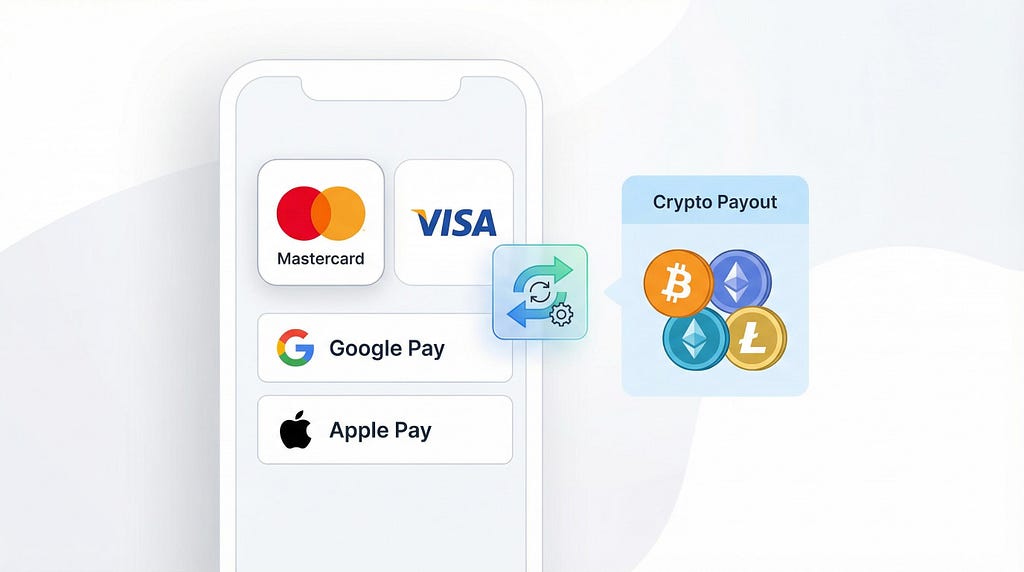
NexaPay enables customers to pay via standard cards while merchants receive cryptocurrency directly to their wallets. Setup takes under one minute with no merchant KYC requirement.
- Zero merchant KYC — no identification documents, business registration, or proof of address needed
- Comprehensive payment method coverage: Visa, Mastercard, Apple Pay, Google Pay
- Dual functionality as both merchant gateway and fiat onramp
- Multiple integration options: WooCommerce, Shopify plugins; custom API; payment links
- Real-time transaction tracking with blockchain verification
- Responsive support across virtually all regions
Fee structure: Competitive 1–3% transaction fees for fiat-to-crypto conversion with no setup or monthly subscription fees. Settlement currencies include USDC, USDT, and additional cryptocurrencies.
As a newer entrant compared to NOWPayments or BitPay, NexaPay has quickly established itself through its unique positioning. Merchants requiring formal regulatory compliance documentation may still prefer licensed processors.

2. NOWPayments
Best for: Merchants who primarily want to accept crypto-to-crypto payments with the option of fiat settlement
Founded in 2019 by the ChangeNOW exchange team, NOWPayments supports 300+ cryptocurrencies with WooCommerce, Shopify, and Magento plugins. It excels at crypto-to-crypto transactions with a 0.5% base transaction fee.
Critical limitation: NOWPayments requires KYC/KYB verification for fiat card payments or fiat settlement, including ID verification and business documentation. Fees increase to 1.5–2.3% for fiat transactions. The customer-facing checkout presents a crypto payment interface requiring users to select a cryptocurrency and send funds to a generated address — not suitable for mainstream consumers preferring card payments.
- Strengths: Massive cryptocurrency coverage (300+), lowest crypto-only fees (0.5%), strong plugin ecosystem, well-documented API, white-label options
- Weaknesses: KYC required for fiat, crypto-oriented customer checkout, higher fiat settlement fees (1.5–2.3%)

3. CoinGate
Best for: EU-based merchants who need regulatory compliance and fiat settlement in EUR/GBP/USD
CoinGate is a compliance-forward gateway supporting instant settlement to EUR, GBP, or USD bank accounts. It offers crypto refund capabilities and AML/KYC tooling aligned with EU directives.
Critical requirement: Full merchant KYC is mandatory — business registration documents, proof of address, and identity verification are all required. Minimum withdrawal is 50 EUR.
- Strengths: Strong regulatory compliance, instant fiat settlement, crypto refund support, effective for EU businesses
- Weaknesses: Full KYC required, 1% flat fee (higher than crypto-only competitors), EUR-centric
4. BitPay
Best for: Large enterprises that prioritize regulatory stability and need fiat debit card options
Operating since 2011, BitPay offers a payment gateway, crypto debit card, payroll functionality, and daily fiat settlements. Well-suited for large enterprises with dedicated compliance teams.
Significant limitations: Requires full KYC for all merchants with verification taking 1–7 days. Users frequently report frozen funds, slow verification, and limited support responsiveness. Supports fewer cryptocurrencies than competitors with fees scaling 1–2%. Inapplicable for no-KYC requirements.
- Strengths: Long track record, debit card option, daily fiat settlement, enterprise-grade compliance
- Weaknesses: Mandatory full KYC (1–7 day process), frequent fund freeze complaints, limited crypto selection, 1–2% fees

5. Banxa
Best for: Individual consumers who want to buy cryptocurrency with a credit card — not a merchant payment gateway
Critical clarification: Banxa is a consumer fiat-to-crypto onramp, not a merchant payment gateway. It enables individuals to purchase cryptocurrency using credit cards, debit cards, Apple Pay, Google Pay, and bank transfers across 180+ countries.
Users must complete mandatory identity verification (passport, government ID, selfie) before most transactions. Common complaints include verification delays, card declines, high fees (up to 4.5% for card purchases), and slow support resolution. Banxa holds MiCA authorization (EU) and BitLicense (New York).
- Strengths: Wide geographic coverage (180+ countries), many supported cryptocurrencies (170+), legitimate regulatory standing
- Weaknesses: Not a merchant gateway (consumer onramp only), mandatory KYC, fees up to 4.5% for card purchases
6. Paymento
Best for: Privacy-focused merchants who want fully non-custodial, wallet-to-wallet crypto payments
Paymento is a non-custodial gateway routing cryptocurrency payments directly from customer wallet to merchant wallet. Zero KYC, zero KYB, no custodial risk — Paymento never holds funds. Supports WooCommerce, Shopify, OpenCart, and custom integrations.
Critical limitation: Purely crypto-to-crypto. Customers must pay in cryptocurrency — no Visa, Mastercard, Apple Pay, or Google Pay option. Works perfectly for crypto-native merchants but is unsuitable for mainstream consumer bases.
- Strengths: Truly zero KYC, non-custodial (wallet-to-wallet), no fund freezing risk, Telegram automation
- Weaknesses: Crypto-only customer side (no card payments), no fiat onramp, limited to customers holding cryptocurrency

7. BTCPay Server
Best for: Technical users who want a fully self-hosted, open-source payment gateway
BTCPay Server is the gold standard for self-sovereign crypto payments. Completely free, open-source, self-hosted software providing complete data and fund control. No company can freeze accounts or demand KYC.
Technical barrier: Requires significant technical knowledge — your own server, Linux administration familiarity, and Docker comfort. Customer payments remain cryptocurrency-only.
- Strengths: Fully open-source, zero fees, self-hosted, maximum privacy and control, no KYC ever
- Weaknesses: Requires server setup and technical maintenance, crypto-only (no card acceptance), no customer support, steep learning curve
Why Is This Category Underpopulated?
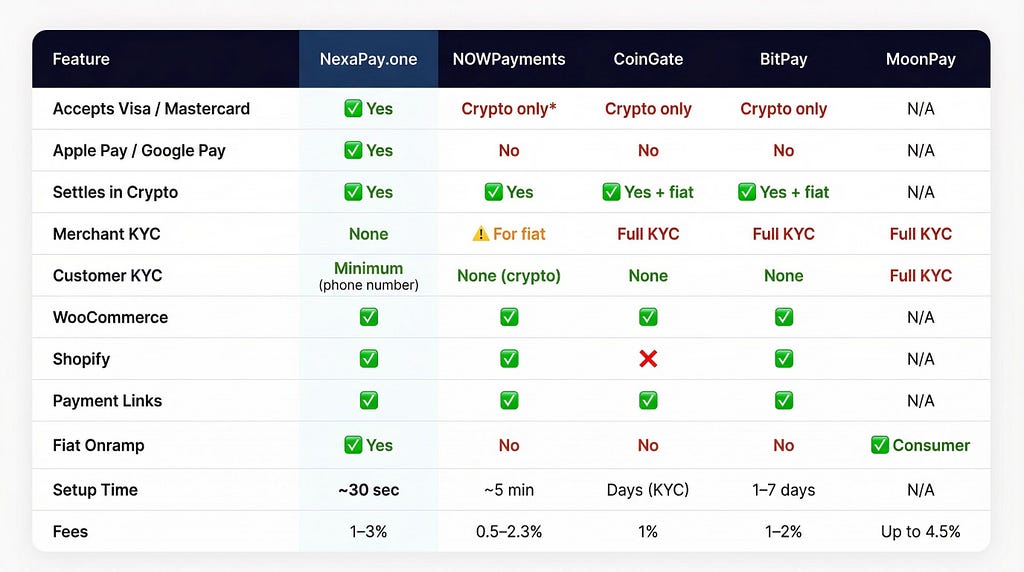
The article identifies a critical market gap: few platforms serve the specific use case of accepting fiat card payments and settling in cryptocurrency without merchant KYC.
- Most crypto gateways (NOWPayments, Paymento, BTCPay Server) accept cryptocurrency from customers — not fiat cards
- Traditional processors (Stripe, PayPal, Square) accept fiat but settle in fiat and require extensive KYC
- Consumer crypto-purchase services (Banxa, Transak, Ramp) serve individuals buying crypto — not merchant infrastructure
- This leaves an extremely narrow sweet spot that NexaPay.one occupies: accepting standard card payments, converting to crypto, and settling to merchant crypto wallet without identity verification
Who Should Use No-KYC Fiat-to-Crypto Gateways?
- E-commerce merchants in underbanked regions — Serve global customers, receive crypto earnings convertible locally or spendable directly
- Freelancers and independent service providers — Accept payments without forcing clients to understand crypto wallets
- Digital product sellers — Software, courses, digital art, memberships benefit from instant settlement and global reach
- Telegram groups, Discord servers, online communities — Payment links enable easy paid access gating
- Businesses accumulating cryptocurrency — Revenue in crypto for investment, ecosystem use, or local currency hedging

Practical Getting Started Advice
- Start with payment links — Test checkout experience and settlement speed before deeper integration
- Use stablecoins for predictable settlement — Set settlement currency to USDC or USDT to avoid price volatility
- Verify transactions on-chain — Leverage blockchain transparency for reconciliation and audit purposes
- Consider your integration path — WooCommerce/Shopify stores use plugins; custom websites use API; no-website merchants use payment links
Final Verdict
The fiat-to-crypto payment gateway space is maturing with dramatically improved options compared to eighteen months ago.
NexaPay.one combines full fiat card acceptance (Visa, Mastercard, Apple Pay, Google Pay), instant crypto settlement, zero merchant KYC, and a clean professional checkout — all with seconds-to-setup. The fiat onramp for cryptocurrency purchases adds additional versatility.
For crypto-to-crypto merchants, NOWPayments leads with 300+ cryptocurrencies and 0.5% fees. CoinGate and BitPay serve merchants needing formal regulatory compliance. BTCPay Server is unmatched for technically skilled merchants wanting full sovereignty. Banxa remains a strong consumer-facing onramp but is not a merchant gateway.
Most 'no-KYC crypto payment gateway' platforms solve half the problem — accepting crypto from cryptocurrency-holding customers. NexaPay solves the complete problem: customers pay normally, merchants receive crypto. This combination remains rare, positioning NexaPay as the definitive solution in 2026.

Written by Alex Miller
Independent Fintech & Blockchain Journalist

