The Hidden Architecture of Trust in DeFi — And Why It’s Time to Stop Pretending
--
Every DeFi protocol runs on trust. The dangerous ones just don’t tell you where.
Picture this.
It’s 2022. A major cross-chain bridge gets exploited. Within hours, hundreds of millions of dollars are gone. The post-mortem reveals the culprit: a small group of validators whose private keys were compromised. The same validators that users were told to trust as “decentralized” infrastructure.
Nobody lied. Not technically. The protocol was, by its own definition, decentralized. Multiple parties. Multiple signatures. Multiple chains.
But the trust was never gone. It was just hidden — tucked inside an architecture that most users never had the tools, or the incentive, to question.
This is not a story about one protocol. This is the story of DeFi as an industry.
The Promise vs. The Reality
When DeFi emerged, it offered something genuinely radical: a financial system that didn’t require you to trust a bank, a broker, or a government. The promise was encoded into the language itself.
“Trustless.” “Permissionless.” “Code is law.”
These words meant something important. They signaled a break from a system where institutions held all the cards — where your access to financial services depended entirely on whether some intermediary decided to let you in.
But somewhere along the way, the language became the product. Protocols optimized for the narrative. “Trustless” became a feature checkbox, not an engineering discipline. And the gap between what was claimed and what was actually built grew wider with every cycle.
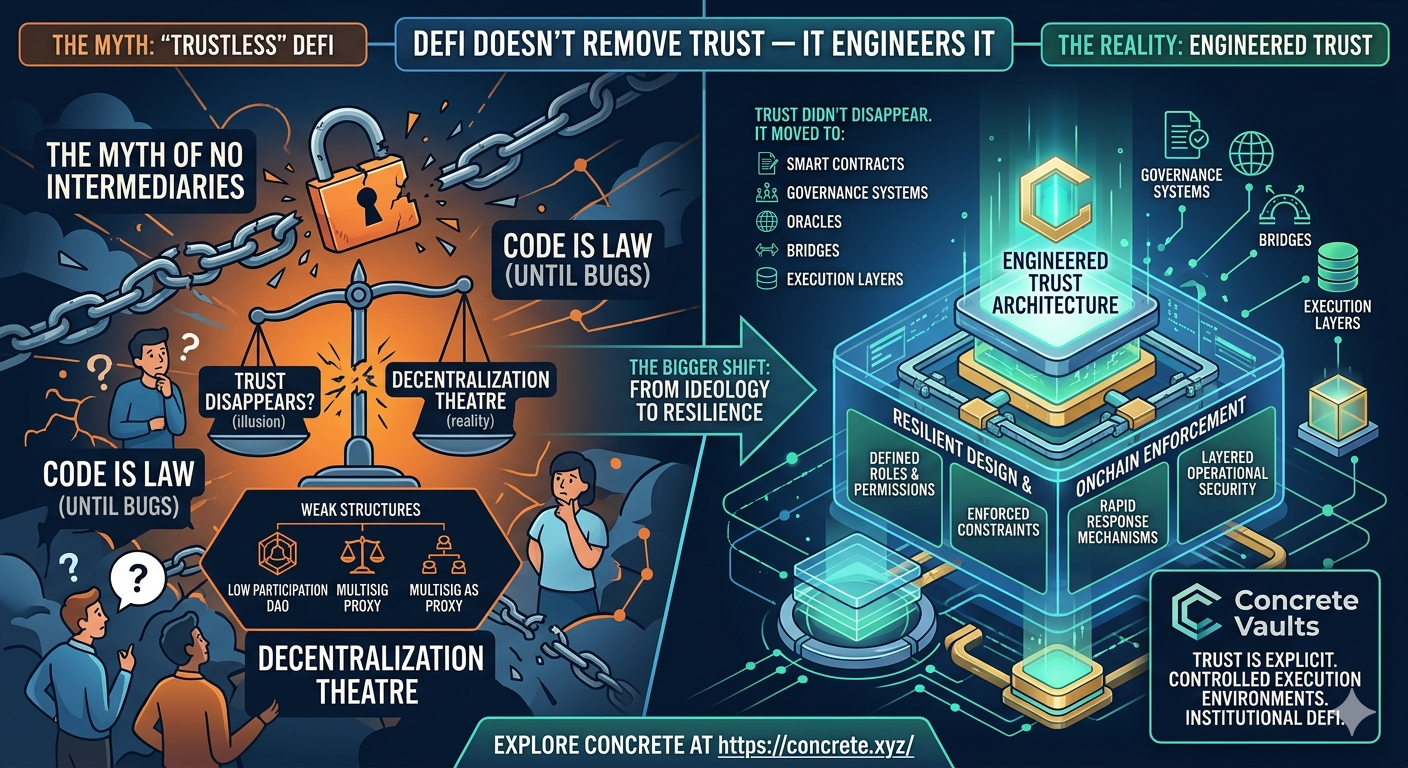
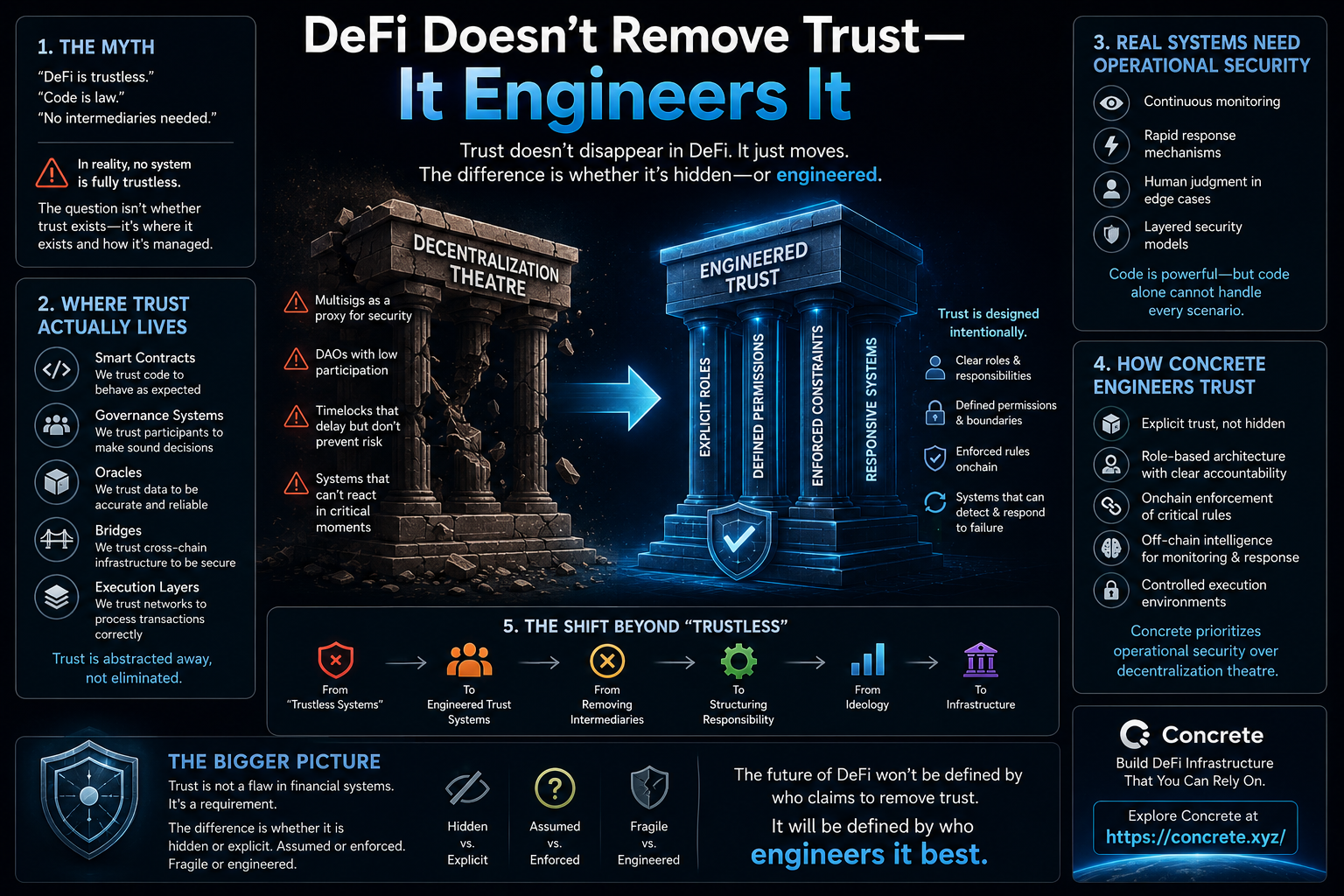
Here is the reality that the industry has been slow to confront: no financial system, on-chain or off, operates without trust. The only question is whether that trust is acknowledged and managed — or hidden and ignored.
When trust is hidden, it doesn’t disappear. It accumulates. And when it fails, it fails all at once.
Mapping the Real Trust Surface
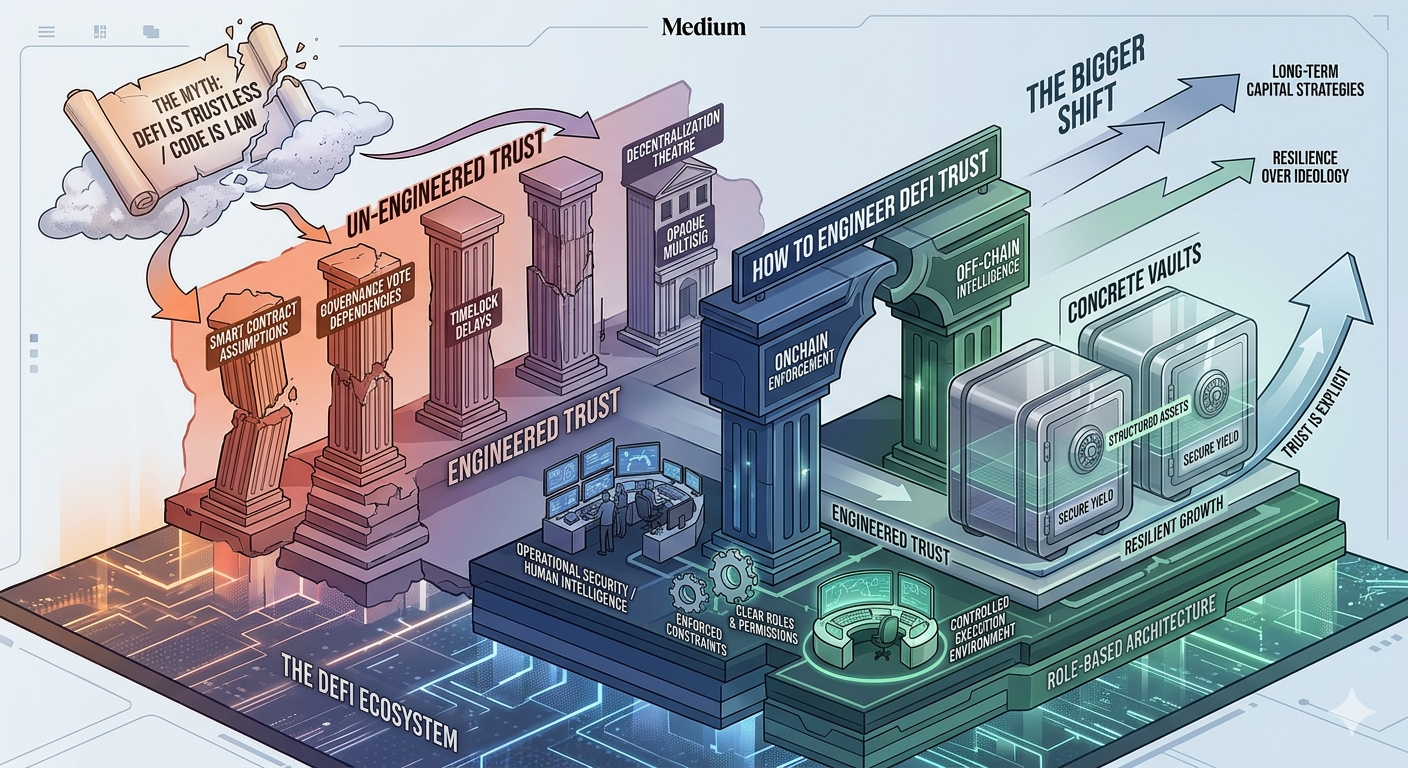
Before we can engineer trust properly, we have to see it clearly. In modern DeFi, trust is distributed across at least five distinct layers — each one carrying risk that users implicitly accept every time they interact with a protocol.
Smart contract assumptions
The foundation of every DeFi protocol is code. And code, no matter how carefully written or thoroughly audited, is written by humans making assumptions about how it will be used. Those assumptions are trust. When you deposit into a protocol, you trust that every assumption the developer made was correct, that every edge case was anticipated, and that no upgrade mechanism has quietly handed control to someone else. That is a significant amount of trust to extend to anonymous developers and overworked auditors.
Governance decisions
Governance in DeFi sounds democratic. In practice, it often resembles a boardroom where most seats are permanently empty. Token holder participation rates below 10% are common. Quorum thresholds are met by a rotating cast of large holders. The decisions that govern billions of dollars in user funds are effectively made by a small, self-selected group — sometimes with no formal accountability to anyone. “Decentralized governance” and “democratic governance” are not the same thing.
Oracle dependencies
The price of ETH doesn’t live on the blockchain. Neither does the value of any real-world asset, interest rate, or market condition that DeFi protocols routinely reference. All of that data enters the chain through oracles — trusted intermediaries by any other name. When an oracle is manipulated, delayed, or simply wrong, the protocol cannot tell the difference. It processes the bad data as if it were true. The results have been catastrophic, repeatedly.
Bridge security
Every time an asset crosses from one chain to another, it passes through infrastructure that is, at its core, a set of trust assumptions about who controls the relay. Validators, multisig committees, and automated bridging contracts all represent layers of trust that are often far more centralized in practice than they appear in documentation. The history of bridge exploits is a history of those trust assumptions being violated.
Execution environments
The order in which transactions are included in a block, and the price at which they execute, is not random. It is the product of decisions made by block builders, sequencers, and MEV searchers — actors whose incentives are not necessarily aligned with the users whose transactions they are processing. The execution layer is a trust layer, and most users have no visibility into it.
Each of these layers is real. Each one carries risk. And the protocols that do not acknowledge them are not protecting their users — they are just making it harder for users to protect themselves.
When Decentralization Becomes a Shield
There is a version of “decentralization” that functions not as a security property but as a legal and reputational shield.
If the protocol is decentralized, no one is responsible. If the DAO voted, no one made the decision. If the code executed, no one pulled the trigger. This is the most cynical version of the “code is law” philosophy — and it has been used, explicitly or implicitly, to avoid accountability after some of DeFi’s most damaging failures.
The tell is what happens when things go wrong.
Protocols built on genuine decentralization principles have response mechanisms built in — defined procedures for what happens when an exploit is detected, clear roles for who can act, and circuit breakers that limit damage while decisions are being made. They have thought carefully about failure, not just about normal operation.
Protocols running decentralization theatre, by contrast, find themselves paralyzed. There is no one with the authority to pause the contract. There is no defined process for emergency response. There is no offchain coordination mechanism that can move faster than the attacker. The governance process that would need to authorize a fix takes days. The exploit takes minutes.
Decentralization is not a property that protects users by existing. It is a property that must be engineered — deliberately, specifically, and with failure modes explicitly in mind.
The difference between a decentralized system and a leaderless one is enormous. The first is resilient by design. The second is simply unresponsive by accident.
What Engineered Trust Actually Looks Like
If decentralization theatre is the problem, engineered trust is the solution. Not more centralization — more precision. More honesty. More deliberate design.
Engineered trust starts with a simple premise: trust cannot be eliminated, so it must be structured. Every trust relationship in a system — between users and contracts, between protocols and oracles, between governance and execution — should be explicit, bounded, and enforceable.
In practice, this means several things.
Permission structures that are scoped, not open-ended. Every actor in the system should have exactly the access it needs and no more. Broad admin keys are a single point of failure. Granular, role-based permissions mean that a compromised key or a malicious actor is contained to a defined blast radius, not given access to everything.
Monitoring that operates independently of the protocol. Smart contracts are blind to their own context. A lending protocol cannot know that the oracle feeding it prices has been manipulated — it can only act on the data it receives. Effective DeFi security therefore requires an intelligence layer that sits outside the on-chain system: watching, correlating, and raising alerts before damage becomes irreversible.
Response mechanisms that don’t require on-chain governance. When a crisis unfolds in real time, waiting for token holders to vote is not an option. Engineered trust systems define in advance who can act in an emergency, under what conditions, and with what constraints. The goal is not to give one party unchecked power — it is to ensure that the system can respond to the unexpected without being paralyzed by the very governance structures designed to protect it.
Transparency about where the trust actually lives. The most underrated feature in DeFi is honest documentation. Not marketing copy — actual, technical, specific documentation of every trust assumption the protocol makes. Who controls the upgrade key. What the oracle failure mode looks like. How governance decisions are executed. Users who can see the trust surface can make informed decisions. Users who cannot are flying blind.
This is what financial infrastructure maturity looks like. Not the absence of trust — the discipline to manage it.
The Operational Security Gap in DeFi
There is a concept in traditional security engineering called the “assume breach” mindset. It starts from the premise that no system is perfectly secure, and therefore security design must account for what happens after a breach — not just before one.
DeFi has largely operated on the opposite assumption. If the code is correct, nothing bad will happen. If the auditors approved it, it’s safe. If the governance voted for it, it’s legitimate.
This is not a security posture. It is optimism.
Real operational security in DeFi requires the same disciplines that serious financial institutions have developed over decades. Continuous monitoring for anomalous behavior. Defined escalation paths when something looks wrong. Human judgment available for scenarios that code cannot anticipate. Layered controls so that no single failure compromises the entire system.
The word “operational” is doing real work here. Security is not a static property that a protocol either has or doesn’t have. It is an ongoing operational discipline — something that must be actively maintained, tested, and updated as the threat landscape evolves. A protocol that was secure twelve months ago may not be secure today. Attackers iterate. Security must iterate faster.
The gap between what DeFi claims about its security and what it actually delivers operationally is, for many protocols, substantial. Closing that gap is not optional for an industry that wants to manage serious capital.
Concrete: Where the Theory Becomes Infrastructure
Understanding the problem of hidden trust is one thing. Building infrastructure that solves it is another.
Concrete represents a specific answer to the question that the engineered trust framework raises: what does DeFi infrastructure actually look like when it takes trust seriously from the ground up?
The answer, at Concrete, starts with architecture.
Concrete vaults as the unit of controlled execution.
The vault is where Concrete’s approach to engineered trust becomes most tangible. Concrete vaults are not generic smart contract pools. They are structured execution environments — designed from the beginning with explicit constraints on who can do what, under which conditions, and with what limits.
Every operation within a Concrete vault is governed by a permission system that is specific, not general. Deposits, withdrawals, strategy execution, rebalancing, and emergency responses each have defined authorization requirements. There are no open-ended admin keys. There is no single actor who can unilaterally direct the vault’s behavior. The trust relationships are mapped, bounded, and enforced — not assumed.
This matters because it changes the risk profile of every interaction. When a user deposits into a Concrete vault, they are not trusting a set of promises about how the protocol will behave. They are trusting a set of enforced constraints that define exactly how it can and cannot behave. That is a fundamentally different relationship — and a fundamentally stronger one.
Onchain enforcement as non-negotiable baseline.
Concrete’s core security properties are enforced on-chain. This is not an architectural choice made for ideological reasons — it is the foundation that makes every other layer meaningful. Onchain enforcement means that the rules governing vault behavior are not dependent on any operator acting correctly. They are cryptographically guaranteed. No amount of social engineering, operational error, or bad-faith behavior by any authorized party can cause the system to violate its defined constraints.
This is the baseline. Everything else — the monitoring, the intelligence, the response mechanisms — layers on top of it.
Offchain intelligence that sees what contracts cannot.
Concrete pairs its onchain enforcement with a real-time intelligence layer that operates independently of the smart contract system. This layer monitors for the kinds of signals that contracts cannot detect on their own: unusual transaction patterns, oracle anomalies, market conditions that suggest elevated risk, correlations between seemingly unrelated on-chain activity.
When the intelligence layer detects something that warrants attention, the system can respond — not by waiting for governance to convene, but through predefined response mechanisms that have been authorized in advance for exactly these scenarios. This is what operational security looks like in DeFi: the ability to act in the time window that actually matters.
Role-based architecture that contains failure.
Concrete’s system is designed around the principle that no single compromised component should be able to compromise everything. Roles are separated. Access is scoped. The blast radius of any given failure is bounded by design, not by hope.
This means that Concrete can offer something most DeFi protocols cannot: a meaningful answer to the question “what happens if X goes wrong?” For every significant component of the system, there is a defined answer — not “the governance will figure it out,” but a specific, pre-authorized response that limits damage while the situation is assessed.
Institutional DeFi infrastructure, built honestly.
Concrete is built for the version of DeFi that is coming — one where institutional participants require real assurances, not marketing narratives. Where the question “how does this system behave under stress?” gets a specific, technical answer. Where operational security is treated as a continuous discipline, not a one-time audit.
The goal is not to make DeFi look more like traditional finance. It is to give DeFi the operational discipline it needs to fulfill its own original promise — open, accessible, resilient financial infrastructure that actually works when it matters most.
👉 Explore Concrete at https://concrete.xyz/
The Industry Is Already Changing
There is a generational shift happening in how serious DeFi participants think about trust.
The first generation built on ideology. “Trustless” was the destination, and any acknowledgment of trust in the system felt like a concession to the old world. The second generation is building on engineering. Trust is a design variable — something to be mapped, structured, minimized where possible, and managed where it cannot be eliminated.
This shift is visible in the market. Institutional capital does not flow toward protocols that cannot explain their trust model. Risk-aware users do not stay in systems that have no defined response to the unexpected. Regulators, whatever one’s opinion of their role, are accelerating the demand for honest documentation of how systems actually work.
The protocols that will define the next decade of DeFi are the ones building for this reality now — not the ones still selling the dream of a fully trustless system to users who increasingly know better.
DeFi infrastructure will be judged by how it behaves when conditions are hard, markets are volatile, and attackers are active. Not by what it claims when everything is working. The ideological phase of this industry is ending. The infrastructure phase is beginning.
The future belongs to builders who stop hiding trust — and start engineering it.
Concrete is building the infrastructure layer for engineered trust in DeFi. Learn more at concrete
Tags: DeFi security · trustless systems · engineered trust · DeFi infrastructure · Concrete vaults · onchain enforcement · operational security · institutional DeFi