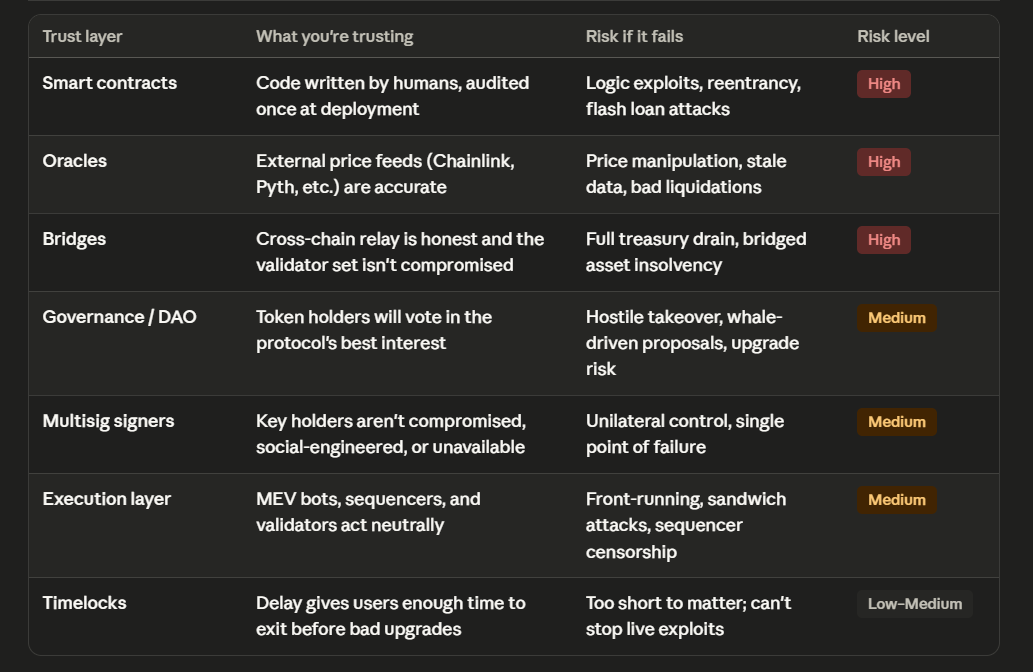
The “Trustless” Illusion: What DeFi Actually Runs On
--
The “Trustless” Illusion: What DeFi Actually Runs On
One of the earliest promises of DeFi sounded almost impossible at the time:
“We can build finance without trust.”
No banks.
No middlemen.
No centralized institutions controlling access.
Just code.
And for a while, that idea became the foundation of the entire industry.
People repeated phrases like:
- “Code is law”
- “Trustless systems”
- “Decentralization fixes this”
But the longer DeFi has existed, the clearer something has become:
Trust never disappeared.
It simply moved into places most people stopped paying attention to.
The Reality Beneath the Narrative
DeFi absolutely changed how trust works.
That part is real.
You no longer need to trust a single bank employee to process a transaction. You don’t need permission from a centralized platform to move assets. Smart contracts can automate financial activity in ways traditional systems never could.
But automation is not the same thing as removing trust.
Because every DeFi system still depends on assumptions.
You trust that:
- Smart contracts behave as intended
- Oracle data is accurate
- Governance participants act responsibly
- Bridges remain secure
- Validators continue operating honestly
The system may be decentralized.
But it is not free from trust.
Trust Didn’t Vanish — It Became Infrastructure
One of the most misunderstood ideas in crypto is the belief that decentralization automatically removes risk.
In practice, it often just changes where the risk lives.
For example:
A protocol might advertise immutable smart contracts while quietly relying on upgrade keys.
A DAO may technically govern the protocol, but only a tiny percentage of users participate in votes.
A bridge may claim decentralization while depending on a small validator set behind the scenes.
These aren’t necessarily flaws.
But they are forms of trust.
And pretending they don’t exist creates a dangerous illusion.
The Problem With Decentralization Theatre
There’s a growing gap in DeFi between systems that are genuinely resilient and systems that simply appear decentralized.
That gap matters.
Because decentralization without operational resilience doesn’t guarantee safety.
We’ve already seen situations where:
- Multisigs became the real center of control
- Governance processes moved too slowly during crises
- Timelocks delayed problems instead of preventing them
- “Decentralized” systems failed because no one could act fast enough
This is what decentralization theatre looks like.
A system optimized for perception rather than durability.
And markets expose that difference quickly.
Especially under stress.
Mature Systems Don’t Avoid Trust — They Structure It
Traditional finance figured something out a long time ago:
You cannot eliminate trust completely.
What you can do is structure it intelligently.
That’s the direction DeFi is slowly moving toward.
Instead of pretending trust doesn’t exist, stronger systems now focus on:
- Clearly defined permissions
- Transparent operational roles
- Enforced security constraints
- Accountability mechanisms
- Infrastructure designed for failure scenarios
This is what engineered trust looks like.
Not hidden trust.
Not blind trust.
Structured trust.
Why Operational Security Matters More Than Narratives
Code alone cannot handle every situation.
Markets are unpredictable.
Exploits evolve constantly.
Edge cases appear where no one expects them.
That’s why operational security matters just as much as decentralization.
Real infrastructure requires:
- Continuous monitoring
- Rapid response systems
- Layered security models
- Human judgment during abnormal conditions
Pure automation sounds elegant in theory.
But resilience usually comes from combining automation with intelligent oversight.
Especially when billions in capital are involved.
How Concrete Approaches Trust Differently
Concrete approaches this problem from a more realistic angle.
Instead of leaning heavily on “trustless” narratives, Concrete focuses on making trust visible, structured, and enforceable.
That includes:
- Role-based architecture
- Controlled execution environments
- On-chain enforcement combined with off-chain intelligence
- Systems designed for response — not just prevention
This distinction matters.
Because no system can guarantee perfect prevention.
But systems can be designed to react intelligently when unexpected situations happen.
Concrete prioritizes operational security over decentralization theatre.
And as institutional DeFi grows, that philosophy becomes increasingly important.
The Industry Is Growing Up
DeFi is entering a more mature phase now.
The conversation is slowly shifting away from ideological slogans and toward infrastructure quality.
Questions that matter today look different:
- Can the system withstand stress?
- Are risks transparent?
- Can operators respond during emergencies?
- Are permissions clearly defined?
This is how real financial systems are evaluated.
And increasingly, it’s how DeFi systems will be evaluated too.
Final Thought
The idea of “trustless finance” helped push DeFi forward.
But real systems are more complex than slogans.
Trust was never eliminated.
It was redistributed into protocols, governance systems, execution layers, and infrastructure.
The future of DeFi won’t belong to the protocols that pretend trust doesn’t exist.
It will belong to the ones that design trust carefully, transparently, and responsibly.
Because resilience isn’t built by denying trust.
It’s built by engineering it.
Explore Concrete at https://concrete.xyz/