DeFi Doesn’t Remove Trust — It Engineers It
 Karan malakar4 min read·Just now
--
DeFi Doesn’t Remove Trust — It Engineers It
One of the most powerful ideas behind DeFi was also one of its simplest:
“Don’t trust people. Trust code.”
It felt revolutionary.
No banks.
No intermediaries.
No centralized gatekeepers making decisions behind closed doors.
Just transparent smart contracts running exactly as written.
For a while, that idea created a kind of optimism across crypto. People believed DeFi could remove trust from finance entirely.
But as the ecosystem matured, something became harder to ignore:
Trust never disappeared. It just changed form.
Because even in DeFi, users are still trusting something.
Sometimes they just don’t realize what it is.
The Myth of “Trustless” Systems
The word trustless became one of the defining narratives of crypto.
And technically, there’s truth to it.
You don’t need to trust a bank employee to approve your transaction.
You don’t need permission from a centralized platform to move assets.
You don’t rely on a single institution to maintain the system.
But that doesn’t mean trust is gone.
It means trust has shifted from institutions toward infrastructure.
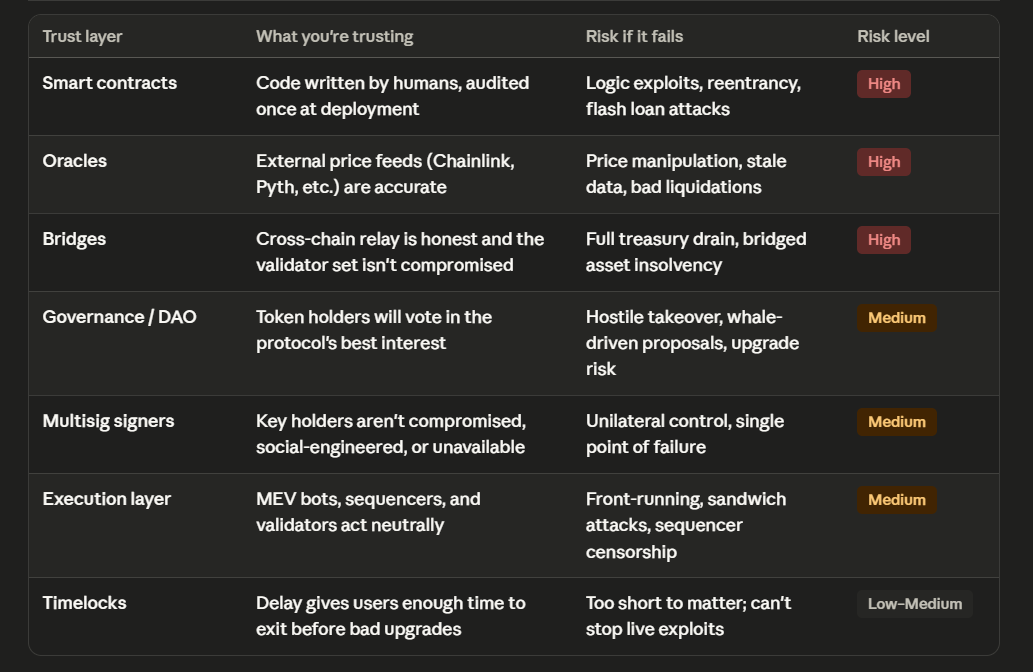
In DeFi, users trust:
- Smart contracts to execute correctly
- Oracles to provide accurate data
- Bridges to secure assets across chains
- Governance systems to make rational decisions
- Validators and execution layers to remain operational
The reality is simple:
No financial system is completely trustless.
The real question is whether trust is visible, structured, and enforceable — or hidden behind ideology.
Where Trust Actually Exists in DeFi
A lot of DeFi’s complexity comes from the fact that trust is layered.
At the surface, protocols may appear fully autonomous.
Underneath, there are assumptions everywhere.
A smart contract may be audited, but users still trust the audit quality.
A DAO may govern a protocol, but voter participation may be extremely low.
A bridge may be decentralized, but still rely on a small validator set.
Even “immutable” systems often contain upgrade mechanisms, emergency controls, or multisigs with privileged permissions.
None of this automatically makes a protocol unsafe.
But it does mean the system isn’t truly trustless.
The trust is simply abstracted away.
The Problem With Decentralization Theatre
One of the more uncomfortable realities in DeFi is that decentralization is sometimes treated more like branding than engineering.
A protocol can look decentralized on the surface while still remaining operationally fragile underneath.
We’ve seen examples of:
- DAOs where only a tiny percentage of holders participate
- Multisigs acting as the real decision-makers behind governance
- Timelocks that delay action but don’t eliminate risk
- Systems that become too slow to respond during emergencies
This creates what some people call decentralization theatre.
The appearance of decentralization without the resilience that should come with it.
And in moments of stress, appearances stop mattering very quickly.
Because markets don’t care about narratives.
They care about whether systems survive failure.
Trust Isn’t Removed — It’s Designed
This is where DeFi is starting to mature.
The conversation is slowly moving away from:
“Can we remove trust entirely?”
Toward:
“How do we engineer trust properly?”
That shift matters.
Because mature systems don’t pretend trust doesn’t exist.
They define it clearly.
Engineered trust means:
- Clear permissions
- Defined operational roles
- Transparent responsibilities
- Enforced constraints
- Systems designed to react under pressure
In other words, resilience becomes intentional instead of accidental.
And that’s how real financial infrastructure works.
Why Operational Security Matters
Code is powerful.
But code alone cannot predict every scenario.
Markets evolve too quickly. Edge cases appear unexpectedly. Exploits often happen in places no one originally anticipated.
That’s why operational security matters just as much as protocol design.
Real systems require:
- Continuous monitoring
- Fast response mechanisms
- Human judgment during unusual events
- Layered security across infrastructure
Pure automation sounds elegant in theory.
But resilience usually comes from combining automation with intelligent oversight.
Especially when real capital is involved.
How Concrete Approaches Trust Differently
Concrete takes a noticeably different approach compared to protocols that rely heavily on “trustless” marketing narratives.
Instead of pretending trust doesn’t exist, Concrete makes trust explicit.
The system is designed around operational resilience:
- On-chain enforcement combined with off-chain intelligence
- Role-based architecture with defined permissions
- Controlled execution environments
- Infrastructure built for response, not just prevention
This is an important distinction.
Because preventing every possible issue is unrealistic.
But building systems that can detect, respond, and adapt under stress is achievable.
Concrete prioritizes operational security over decentralization theatre.
And as DeFi matures, that approach becomes increasingly important.
Especially for long-term and institutional DeFi participation.
The Next Phase of DeFi
The industry is slowly moving beyond simplistic “trustless” narratives.
Not because decentralization failed.
But because real systems are more nuanced than slogans.
The next generation of DeFi infrastructure will likely be judged less by ideological purity — and more by performance under stress.
Questions like:
- How does the system behave during failure?
- Can it respond quickly during volatility?
- Are responsibilities transparent?
- Are risks clearly defined?
These are the questions mature capital cares about.
Because resilience matters more than aesthetics.
Final Thought
Trust was never removed from DeFi.
It was redistributed.
The difference now is whether protocols acknowledge that reality openly — or continue hiding behind the illusion of trustlessness.
Because the future of DeFi won’t belong to the systems that claim to remove trust completely.
It will belong to the systems that engineer it best.
Explore Concrete at https://concrete.xyz/