The Abstraction That Worked Too Well
 sameer2 min read·Just now
--
TrustlessWas a UX Layer
Builders marketed DeFi as trustless. Users clicked through clean interfaces and believed the system removed human risk.
The interface simplified the experience. It did not remove the underlying dependencies.
DeFi wrapped trust in better UX.
Early products hid complexity.
A user swapped tokens. A contract executed. The result looked deterministic.
That flow masked everything beneath it.
Developers defined the logic. Infrastructure processed the transaction. External data shaped the outcome.
Users saw a clean result and assumed the system itself was clean.
The System Beneath the Surface
Every DeFi action relies on coordinated components.
Developers choose contract architecture and retain influence through upgrades or controls.
Governance participants manage parameters. Participation levels decide how distributed that control remains.
Oracle networks deliver price data. Protocols act on those inputs without independent verification.
Bridge systems hold assets across chains. They centralize risk into specific mechanisms.
Validators and sequencers control ordering and inclusion. That affects execution in ways users rarely see.
Each component carries responsibility. Each component introduces trust.
The Cost of Hiding It
When systems hide trust, users cannot price risk.
They allocate capital based on yield, not structure.
Protocols scale faster under this model. They also fail harder.
When something breaks, users scramble to understand what they trusted.
By then, the system already reflects its design choices.
Designing Systems That Admit Reality
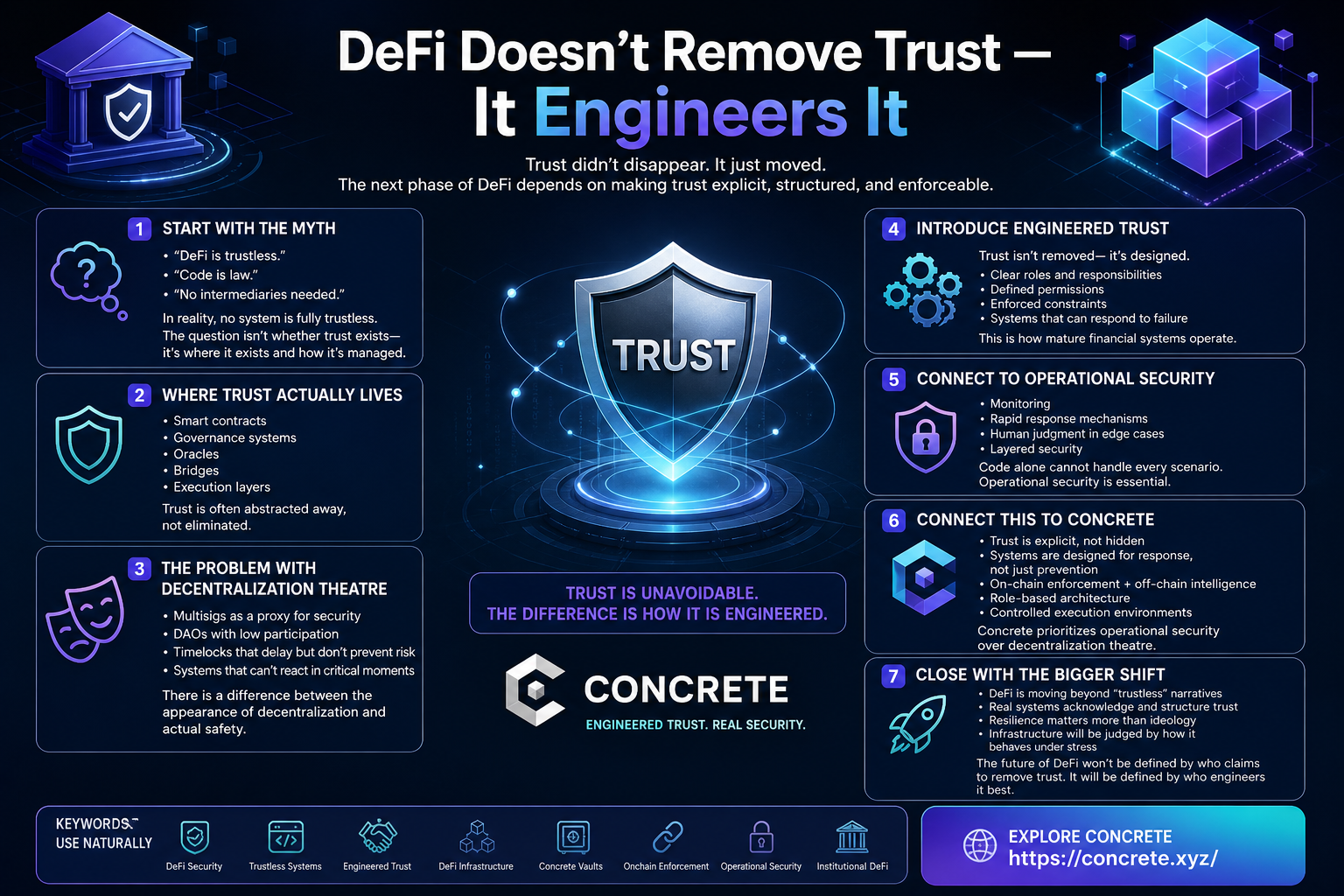
Strong systems expose their structure.
Builders define who can act. They constrain what actions are possible. They enforce those rules through code.
Engineered trust removes ambiguity.
Users can trace control. Builders can limit damage. Systems can respond within defined boundaries.
This approach treats trust as something to manage, not something to deny.
Security That Evolves With the System
Static guarantees cannot cover dynamic risk.
Protocols need monitoring to detect anomalies. Teams need structured ways to intervene.
Humans handle edge cases. Their actions must stay within enforced permissions.
Layered defenses prevent cascading failures. Each component carries part of the load.
Operational security keeps systems functional when assumptions break.
Concrete Builds for Explicit Control
Concrete structures DeFi infrastructure around visible trust.
Concrete vaults use onchain enforcement to define permissions and execution paths. Builders operate within controlled environments that reduce exposure.
Offchain intelligence adds context without removing constraints. Systems adapt without introducing hidden authority.
Concrete focuses on operational security that holds during stress, not only during ideal conditions.
This model aligns with how institutional DeFi evaluates risk and reliability.