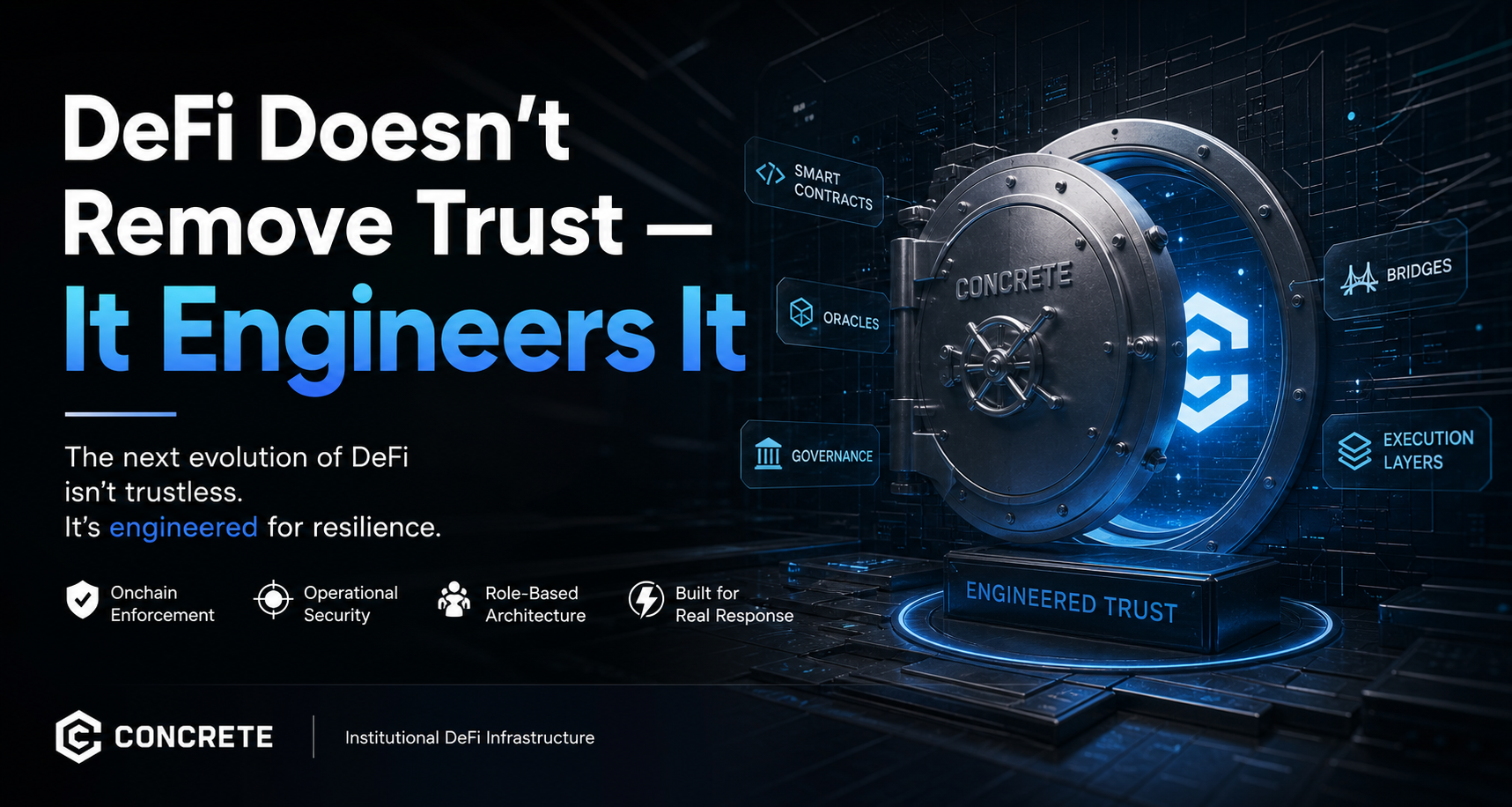
DeFi Doesn’t Remove Trust It Engineers It
--
DeFi didn’t eliminate trust. It made it less visible — and more important to understand.
When DeFi first emerged, it introduced a powerful idea:
“Don’t trust people. Trust code.”
It was a clean break from traditional finance.
No intermediaries.
No discretionary decisions.
No need to rely on institutions.
Everything would be handled by smart contracts.
Transparent. Deterministic. Trustless.
But as the system grew more complex, something became clear:
Trust never disappeared. It just moved deeper into the system.
The Belief vs The Reality
At the surface, DeFi feels trustless.
You connect a wallet.
You interact with a contract.
You receive outcomes automatically.
There’s no visible counterparty.
But beneath that interaction lies a stack of assumptions.
Assumptions about:
- how the code was written
- how it behaves under stress
- who can change it
- what external data it depends on
The experience feels trustless.
The system is not.
The Hidden Layers of Trust
Every DeFi interaction depends on multiple layers working correctly.
You rely on:
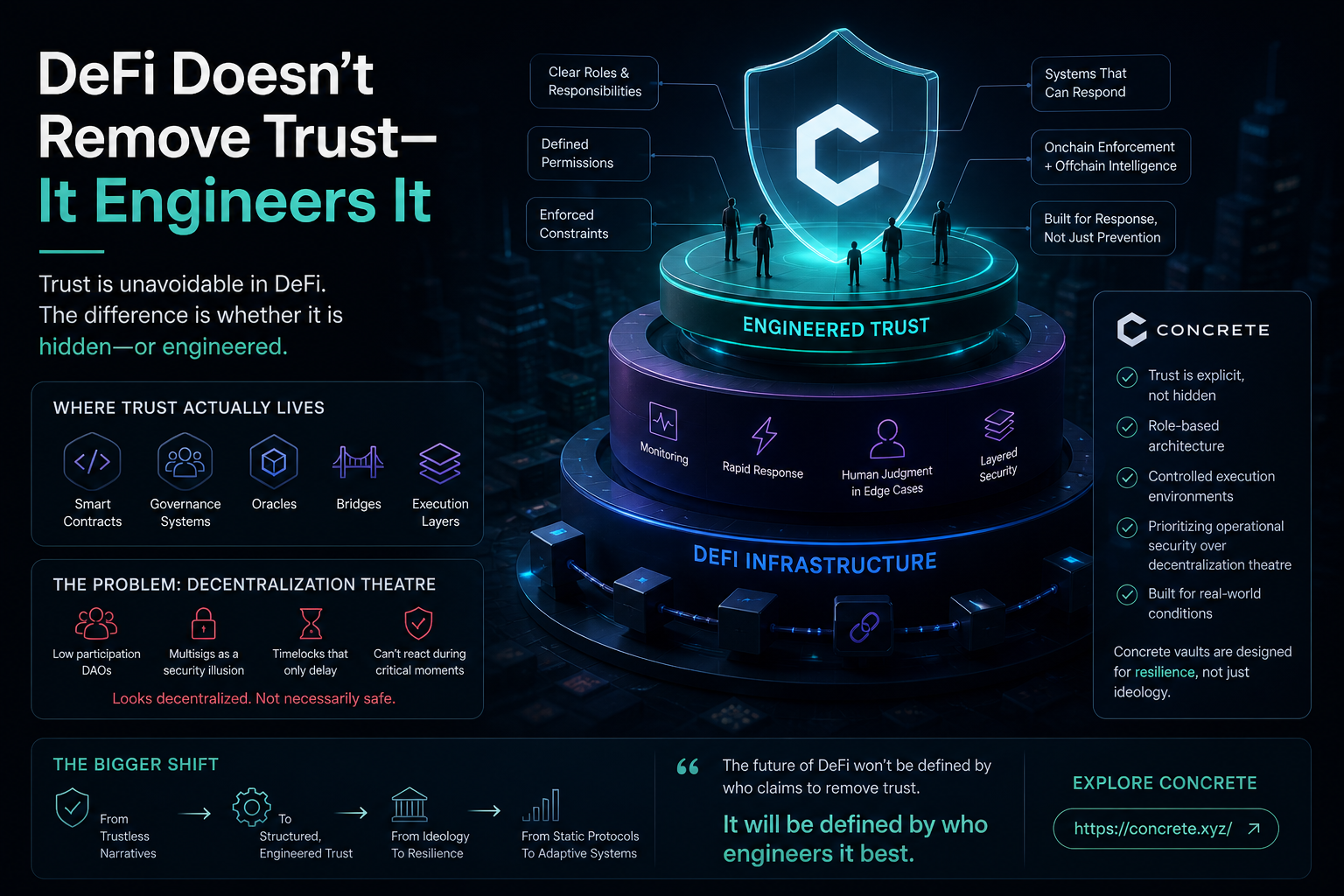
- smart contracts — that they are secure and function as intended
- governance systems — that upgrades won’t introduce risk
- oracles — that external data is accurate and timely
- bridges — that assets move safely across chains
- execution layers — that transactions are processed reliably
Each layer introduces its own risk profile.
And each layer requires a form of trust.
DeFi doesn’t remove trust.
It distributes it across infrastructure.
When Decentralization Becomes a Narrative
As DeFi matured, “decentralization” became a signal of safety.
But not all decentralization is equal.
Some systems rely on:
- small groups controlling multisigs
- DAOs with minimal participation
- governance structures that react slowly
- mechanisms that delay risk instead of preventing it
These designs can appear decentralized, but struggle under real conditions.
This is what’s often called decentralization theatre.
It prioritizes perception over resilience.
The system looks safe — until it’s tested.
The Shift Toward Engineered Trust
In practice, removing trust entirely is not realistic.
What matters is how it is structured.
This leads to a different model:
engineered trust
Instead of hiding assumptions, systems make them explicit.
They define:
- who has control over what
- how decisions are made
- what constraints exist
- how the system responds to failure
This is how mature financial infrastructure operates.
Not by eliminating trust —
but by designing it intentionally.
Why Code Alone Isn’t Enough
Smart contracts are powerful.
But they are static.
They execute exactly as written — nothing more, nothing less.
They cannot:
- adapt to unexpected market events
- respond dynamically to emerging risks
- make contextual decisions
That’s why real systems require more than code.
They require:
- monitoring systems
- response mechanisms
- layered defenses
- human judgment when necessary
This is the foundation of operational security.
It complements automation with adaptability.
How Concrete Engineers Trust
This is where Concrete introduces a more structured approach.
Instead of relying on the idea of trustless systems, it focuses on making trust explicit and enforceable.
Concrete is designed with:
- role-based architecture — clear responsibilities and permissions
- onchain enforcement — rules applied at the protocol level
- off-chain intelligence — systems that monitor and respond
- controlled execution environments
- a focus on real DeFi security
In this model, Concrete vaults are part of a broader DeFi infrastructure that prioritizes resilience over narrative.
The system is not pretending trust doesn’t exist.
It is managing it directly.
The Direction of Institutional DeFi
As DeFi evolves, expectations are changing.
Especially with the growth of institutional DeFi.
Larger capital allocators require:
- transparency in system design
- clarity around control and risk
- predictable behavior under stress
- enforceable constraints
These requirements cannot be met by vague claims of decentralization.
They require engineered systems.
The Bigger Shift
DeFi is moving beyond its early narratives.
The conversation is changing from:
“Is it trustless?”
to
“How is trust structured?”
From:
ideology
to
infrastructure
From:
appearance
to
performance under stress
Final Thought
Trust is not something DeFi can remove.
It is something DeFi must design.
The strongest systems will not be the ones that claim to eliminate trust.
They will be the ones that:
- make it visible
- structure it clearly
- enforce it reliably
Because in the end, the real innovation is not removing trust.
It’s engineering it.
Explore Concrete at https://concrete.xyz/ 🚀