DeFi Works Until Its Trust Assumptions Get Tested
 Kappusing2 min read·Just now
--
Builders wrote contracts and told users the system runs without trust. Users deposited capital and assumed outcomes stay predictable.
Outcomes stay predictable until an assumption breaks.
The Assumptions Layer
Every protocol rests on a set of assumptions.
Developers assume contract logic covers expected scenarios.
Governance voters assume parameters reflect current risk.
Oracle operators assume data sources remain accurate.
Bridge systems assume custody mechanisms hold.
Validators and sequencers assume fair processing of transactions.
These assumptions sit beneath every on-chain action.
When Assumptions Fail
Systems do not fail randomly.
They fail when one of these assumptions stops holding.
A price feed drifts and liquidations cascade.
A governance vote sets aggressive parameters and amplifies risk.
A bridge exploit drains pooled funds.
An upgrade introduces unintended behavior.
Each failure traces back to a broken assumption.
Why Users Miss the Risk
Interfaces show results, not assumptions.
Users see balances and yields. They do not see the conditions required for those numbers to remain valid.
Teams rarely expose those conditions. Simplicity drives adoption.
That gap leaves users unaware of what they rely on.
Designing Systems Around Assumptions
Resilient builders treat assumptions as explicit inputs.
They define them. They monitor them. They build systems that react when they break.
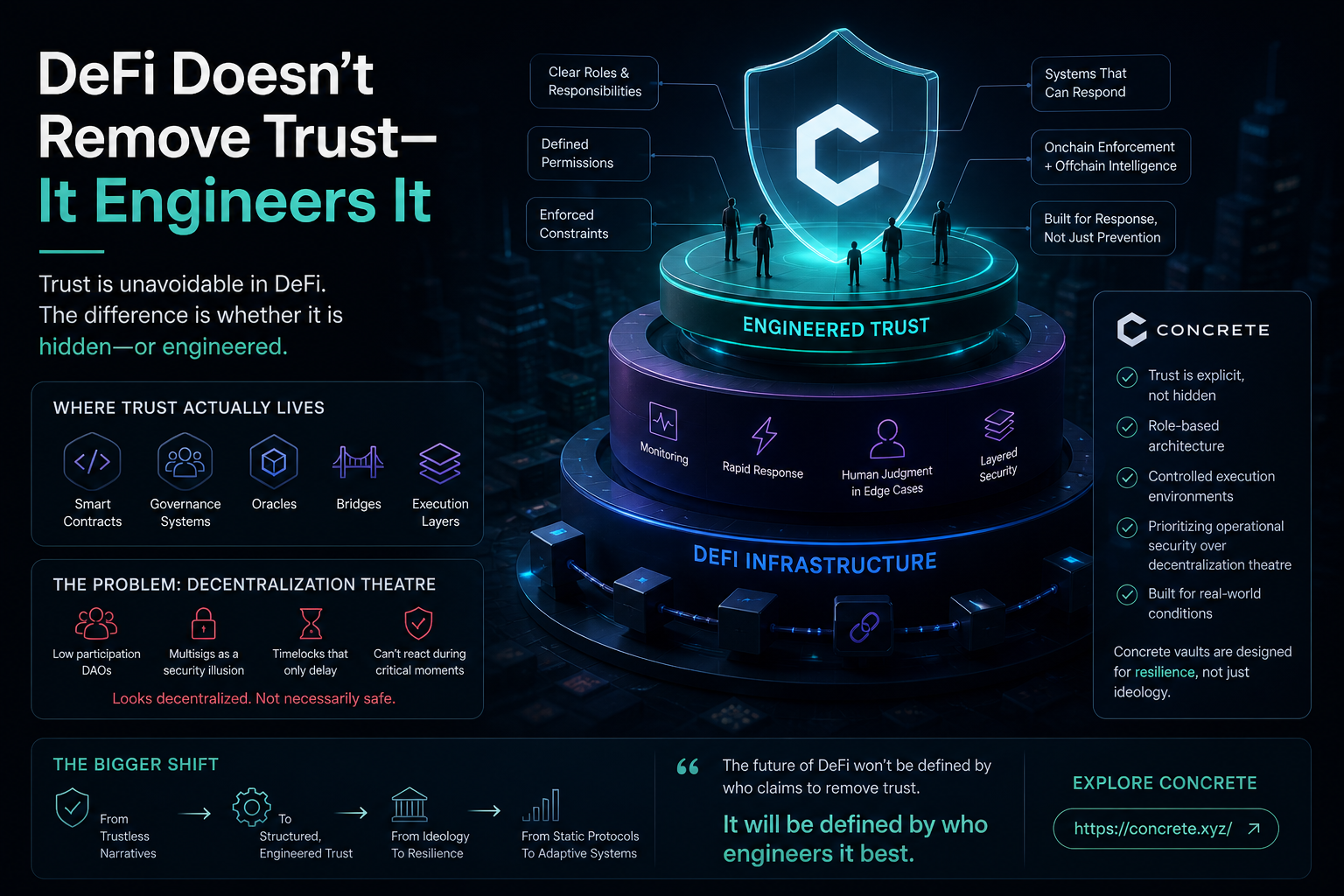
Engineered trust converts assumptions into enforceable boundaries.
Users gain visibility into risk. Systems gain the ability to respond before failure spreads.
Security That Adapts
Contracts enforce rules. They do not adapt to changing conditions alone.
Protocols need monitoring to detect when assumptions drift.
Teams need structured ways to act within constraints.
Humans respond during edge cases. Their actions follow predefined limits.
Layered defenses reduce impact and contain failures.
Operational security ensures systems stay functional under stress.
Concrete Designs for Assumption-Aware Systems
Concrete builds infrastructure that treats assumptions as part of system design.
Concrete vaults enforce permissions onchain and operate within controlled execution environments. Builders define how systems behave when conditions change.
Offchain intelligence tracks context and feeds it into controlled responses. Systems adapt without introducing hidden authority.
Concrete focuses on operational security that holds when assumptions break.
This design aligns with institutional DeFi, where systems must perform under uncertainty.