Modernization Is Solved — Until the Decision Has to Execute
 Chakri Maganti3 min read·Just now
--
Why core, data, APIs, and AI still fail to deliver outcomes in credit unions — and the layer no one is building.
1. The Modernization Stack Is Now Well Understood
Leaders like Anil Choudary at Keesler Federal Credit Union are converging on a clear architecture:
- A strong operating model (ways of working)
- A stable core banking strategy (3–5 year horizon)
- API-led integration
- A cohesive data strategy
- AI layered on top
- A unified digital experience
And in the near term:
- Automate manual steps
- Reduce handoffs (“hops”)
- Inject AI to improve productivity
This is the modern blueprint.
2. And Yet — Outcomes Still Break
Despite this clarity, institutions face a persistent issue:
Decisions are made.
They are correct.
They are approved.
But they don’t consistently become outcomes.
In mortgage:
- Loans are approved but not funded
- Conditions are satisfied but execution fails
- Workflows complete — but money doesn’t move
3. The Hidden Assumption in Modernization
Modernization assumes:
If you improve data + systems + automation → outcomes will follow.
But this assumes that:
A decision, once made, remains valid until execution.
That assumption is false.
4. What Actually Happens in Real Systems
Between decision and execution:
- State changes (documents, data, conditions)
- Policies evolve
- Authority shifts
- Dependencies break
By the time execution happens, the original decision may no longer be valid.
But most systems:
→ do not re-evaluate
→ do not block execution
→ do not generate evidence at that moment
5. Why Automation Doesn’t Fix It
Automation focuses on:
→ removing manual effort
→ speeding up workflows
→ reducing handoffs
But it does not validate correctness at execution.
So instead of fixing the problem:
It scales it.
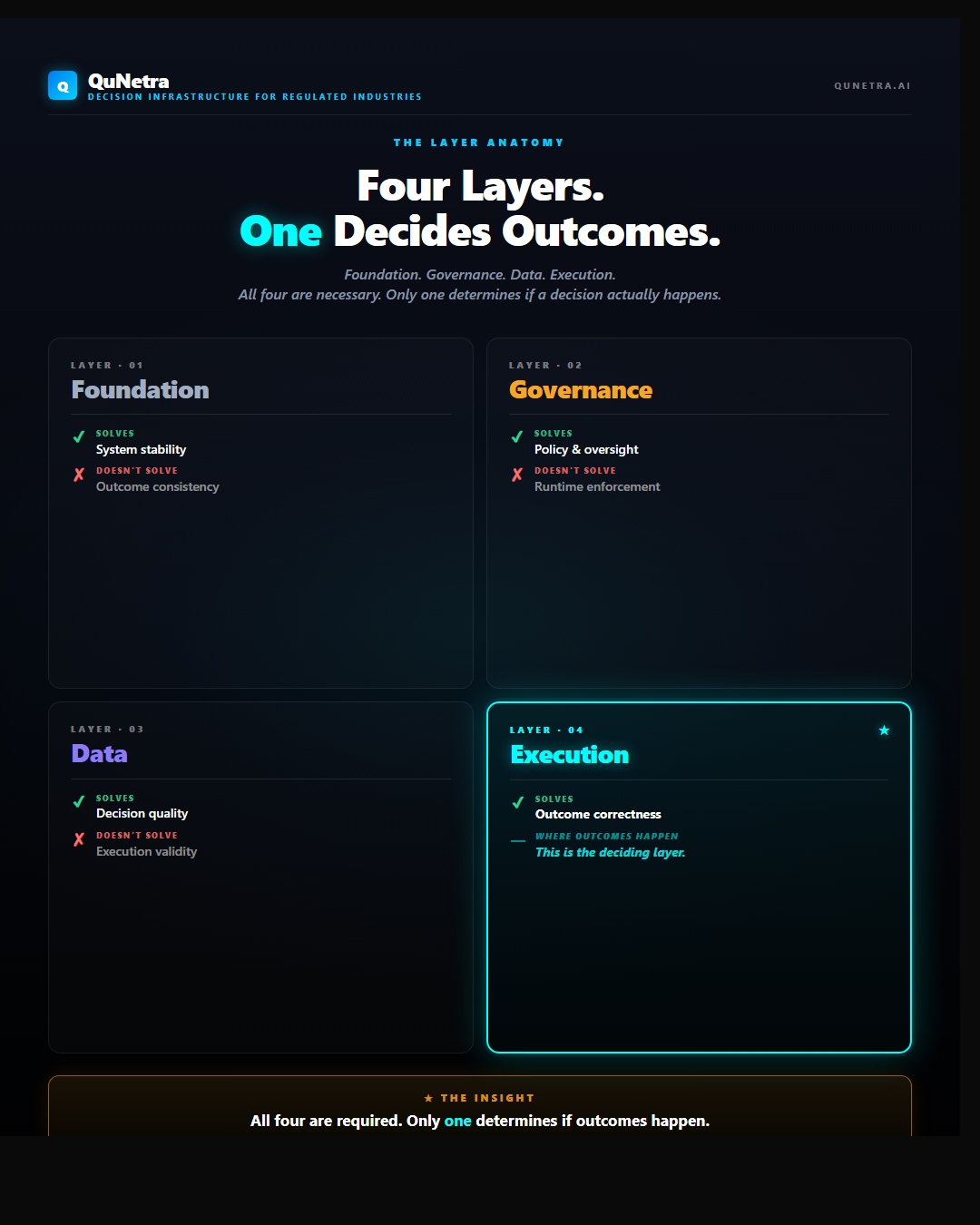
6. The Missing Layer in the Stack
Today’s stack:
Core → APIs → Data → AI → Workflows
Missing:
A layer that governs how decisions are validated and executed at runtime.
A layer that answers:
- Is this decision still valid right now?
- Does it meet current policy?
- Is authority intact?
- Has anything changed since validation?
7. The Moment That Matters Most
There is a single moment where everything converges:
When a decision produces a real-world effect.
This is where:
- correctness must be re-verified
- execution must be controlled
- evidence must be generated
Most systems are not designed for this moment.
8. Why This Is Critical for Credit Unions
For institutions like Keesler Federal Credit Union, this directly impacts:
- Funding rates
- Cycle time
- Operational efficiency
- Compliance exposure
- Member experience
Reducing “hops” improves efficiency.
But ensuring decisions actually execute correctly changes outcomes.
9. The Next Phase of Modernization
Modernization has evolved in layers:
- Core systems
- Integration (APIs)
- Data platforms
- AI and decisioning
The next layer is:
Ensuring that decisions become outcomes — correctly, consistently, and accountably.
10. Final Thought
The industry has spent a decade making better decisions.
The next decade will be about ensuring those decisions actually happen.
Because in financial systems:
A decision that doesn’t execute is indistinguishable from no decision at all.
Read more:
https://qunetra.ai/decision-infrastructure-architecture/
https://qunetra.ai/decision-systems-vs-decision-infrastructure/
https://qunetra.ai/why-decisions-fail-in-execution/
If you’re working on enterprise AI, architecture, or decision systems, I write about where these systems are heading — not just where they are today.
Subscribe to follow the evolution.
Follow me for more on Decision Infrastructure and enterprise AI: https://www.linkedin.com/in/chakri-maganti-mba-71b24b4/
and We’re applying this in mortgage at QuNetra: https://www.linkedin.com/company/qunetra/