--
DeFi was born from a bold premise like https://concrete.xyz/
“Don’t trust people. Trust code.”
For a moment, that idea felt revolutionary. Smart contracts replaced intermediaries. Protocols automated financial logic. Users interacted with systems instead of institutions.
The narrative was clear:
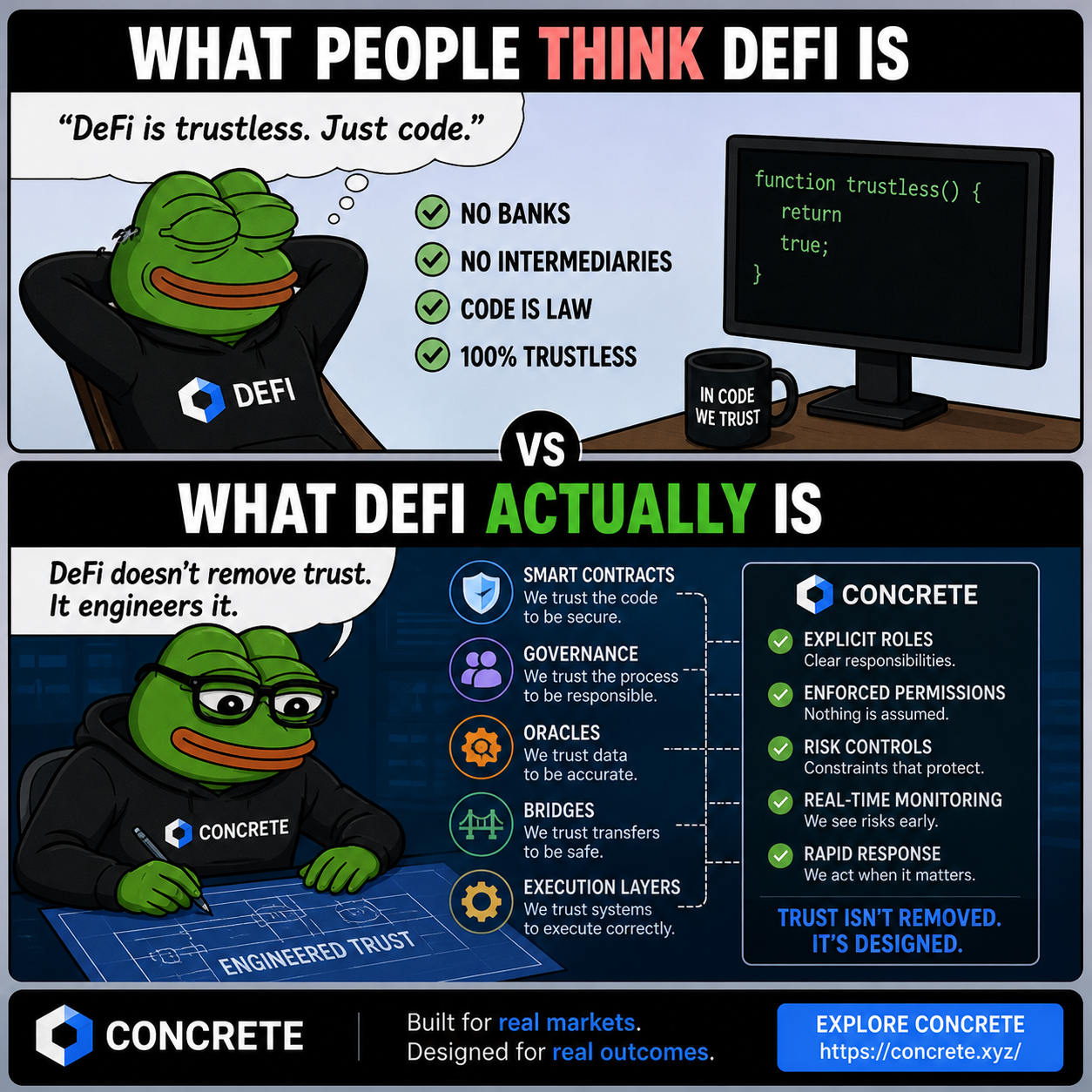
* DeFi is trustless
* Code is law
* Intermediaries are obsolete
But as the ecosystem matured, reality started to surface.
Trust didn’t disappear. It just moved.
The real question was never whether trust exists.
It’s where it lives — and how well it’s designed.
⸻
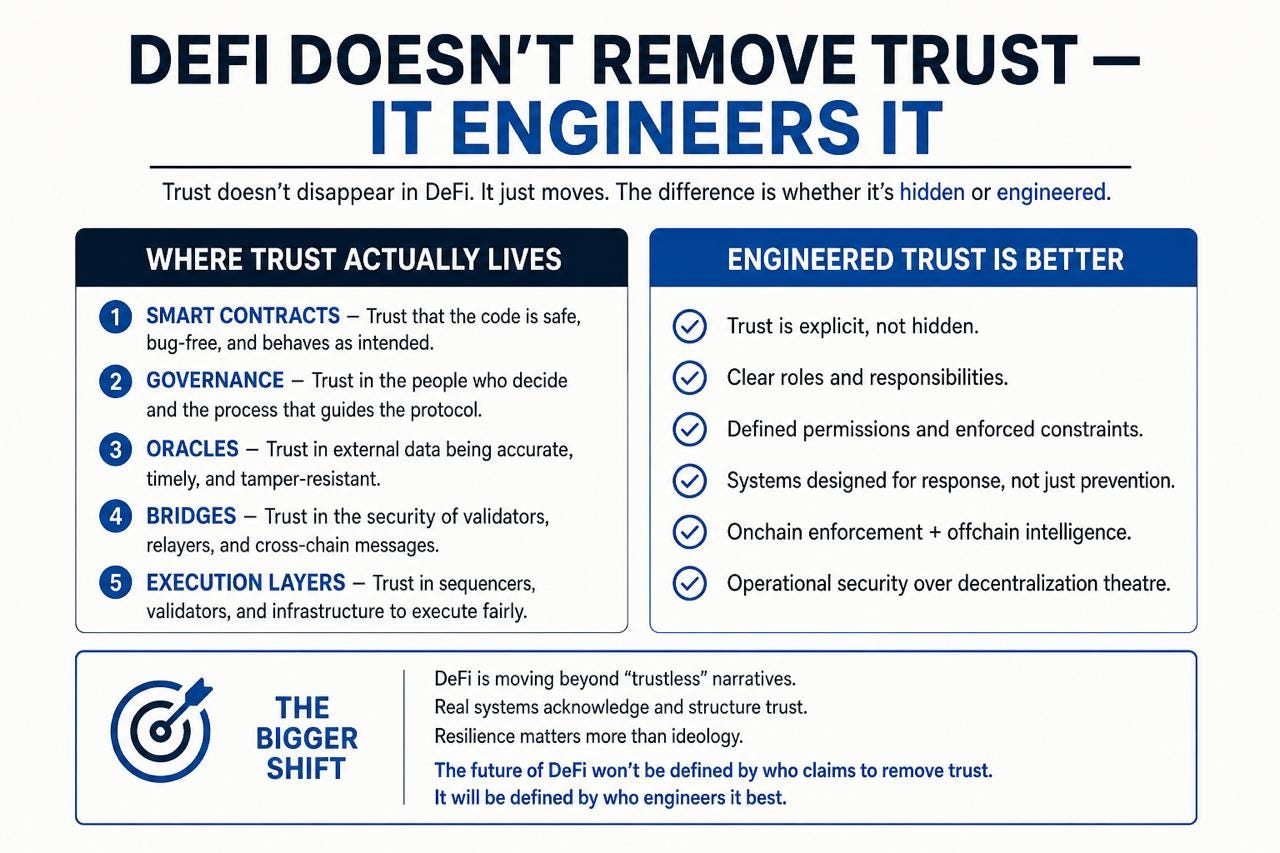
Where Trust Actually Lives in DeFi
Under the surface, every DeFi system still relies on multiple layers of trust. They’re just abstracted behind technical architecture.
1. Smart Contracts
Users trust that:
* The code is bug-free
* The logic behaves as intended
* No hidden exploits exist
But history has shown otherwise. Even audited contracts fail. “Code is law” only works if the law is flawless — and it rarely is.
⸻
2. Governance Systems
DAOs are often presented as decentralized decision engines. In practice:
* Voting power is concentrated
* Participation rates are low
* Key decisions are made by a small minority
You’re not removing trust — you’re redistributing it to governance participants.
⸻
3. Oracles
Protocols depend on external data feeds for pricing and triggers.
This introduces trust in:
* Data accuracy
* Data providers
* Update frequency and latency
If the oracle fails, the system fails — regardless of how “decentralized” the contract is.
⸻
4. Bridges
Cross-chain infrastructure is one of the largest attack surfaces in DeFi.
Users implicitly trust:
* Bridge validators or relayers
* Message verification systems
* Security assumptions across chains
Many of the largest exploits in DeFi history came from this layer.
⸻
5. Execution Layers
Even if contracts are secure, execution still depends on:
* Sequencers
* Validators
* Block producers
This creates dependencies on entities that can reorder, censor, or delay transactions.
⸻
The Problem With “Decentralization Theatre”
A critical issue in today’s DeFi landscape is the gap between perception and reality.
Some systems look decentralized but lack real resilience.
Common patterns:
* Multisigs as security theater
A handful of signers control critical functions
* DAOs with low engagement
Governance exists, but few actually participate
* Timelocks
They delay execution but don’t eliminate risk
* Rigid systems
Unable to react during fast-moving crises
These structures create an illusion of safety without guaranteeing it.
Decentralization ≠ security
A system can be decentralized and still fragile.
A system can have controls and still be robust.
⸻
Engineered Trust: A Better Model
Instead of pretending trust doesn’t exist, the next phase of DeFi is about designing it intentionally.
Engineered trust means:
* Clear roles and responsibilities
* Explicit permissions
* Enforced constraints
* Systems that can respond to failure
This is how mature financial infrastructure operates.
Not by eliminating trust — but by structuring it.
⸻
Why Operational Security Matters
Real-world systems don’t rely on static assumptions. They adapt.
DeFi infrastructure must incorporate:
* Continuous monitoring
* Rapid response mechanisms
* Human judgment in edge cases
* Layered security design
Because not every failure can be predicted.
And not every risk can be coded away.
⸻
How Concrete Approaches This Differently
Concrete represents a shift toward explicit, engineered trust.
Instead of hiding trust assumptions, it surfaces and structures them.
Key principles:
* Trust is explicit, not abstracted
Users understand where dependencies exist
* Designed for response, not just prevention
Systems can act under stress
* Onchain enforcement + offchain intelligence
Combining deterministic execution with adaptive oversight
* Role-based architecture
Permissions are clearly defined and constrained
* Controlled execution environments
Reducing unpredictable behavior and attack vectors
Concrete vaults prioritize operational security over ideology.
Not “trustless” — but trust-aware and resilient by design.
⸻
The Bigger Shift
DeFi is evolving.
The narrative is moving beyond:
* “Trustless systems”
* “Pure decentralization”
Toward something more grounded:
* Engineered trust
* Resilient infrastructure
* Explicit security models
Because in the end:
The systems that survive won’t be the ones that claim to remove trust.
They’ll be the ones that engineer it best.
⸻
Final Thought
The future of DeFi infrastructure — especially at the institutional level — will be judged by one thing:
How it behaves under stress.
Not how decentralized it looks.
Not how clean the narrative sounds.
But how well it manages the trust it inevitably holds.