🧱 If You Can’t Explain Yield, You Are the Yield
--
DeFi made one thing incredibly easy: seeing yield.
Open any dashboard and you’ll find it — bright, attractive numbers.
20% APY. 80% APY. Sometimes even more.
Click deposit → sit back → earn.
Simple, right?
That’s the illusion.
Because while yield in DeFi is easy to see… it’s much harder to truly understand.
And that’s where the real risk begins.
1️⃣ The Illusion of Easy Yield
When I first explored DeFi, it felt almost too good.
Platforms showed high APYs.
Returns updated in real time.
Everything looked automated and effortless.
No deep explanation.
No breakdown of how those returns were generated.
Just numbers.
But here’s the tension:
Yield looks simple on the surface — but underneath, it’s anything but.
2️⃣ Displayed Yield vs Real Yield
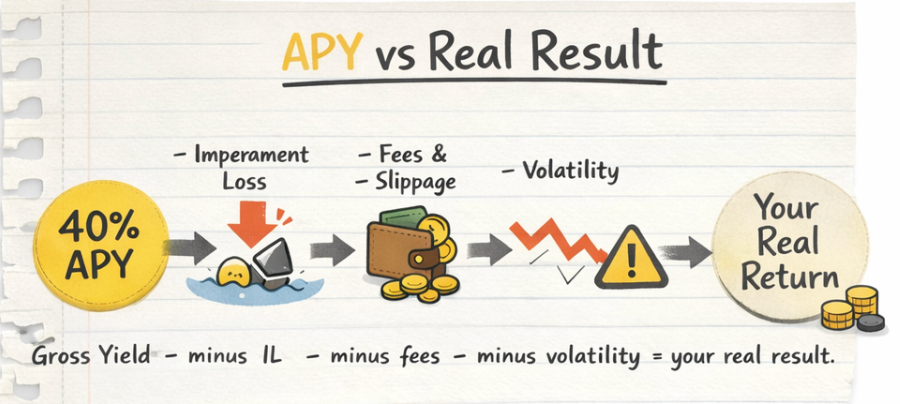
That number you see? It’s rarely the full story.
What actually matters is net yield — what you keep after everything else.
And a lot happens between “displayed” and “real” returns:
- Gross vs net returns
- Impermanent loss eating into profits
- Rebalancing costs over time
- Execution friction (gas fees, slippage)
- Market volatility impacting positions
A pool showing 60% APY might quietly deliver far less once these factors are accounted for.
Sometimes… much less.
3️⃣ Where Yield Actually Comes From
This is the question most people skip — but it’s the most important one:
Where is the yield coming from?
In DeFi, it usually comes from:
- Trading fees generated by activity
- Lending and borrowing demand
- Arbitrage opportunities
- Liquidation mechanisms
- Token incentives and emissions
But here’s the catch:
Not all yield is equal.
Some sources are sustainable.
Others are temporary — designed to attract liquidity, not maintain it.
Understanding this difference is everything.
4️⃣ Hidden Value Transfer
There’s an uncomfortable truth in markets:
If you don’t understand the system… you might be the one funding it.
In DeFi, this happens more often than people realize:
- Providing liquidity without fully understanding risk
- Chasing incentives while absorbing downside
- Participating without modeling outcomes
You think you’re earning yield.
But sometimes, you’re actually subsidizing someone else’s strategy.
That’s when the title becomes real:
If you can’t explain the yield — you are the yield.
5️⃣ Why Outcomes Differ
Two users can enter the same protocol…
And walk away with completely different results.
Why?
Because they approach it differently:
- Some chase the highest APY
- Others analyze structure, cost, and risk
- More advanced participants model outcomes before deploying capital
Same system.
Different mindset.
Different outcome.
The edge isn’t access — it’s understanding.
6️⃣ The Shift Toward Engineered Yield
DeFi is evolving.
We’re moving from:
Yield chasing → Yield engineering
This shift changes everything.
Instead of blindly following APYs, users are starting to:
- Model expected returns
- Manage risk actively
- Optimize allocations over time
- Focus on net, not headline yield
It’s no longer about “what looks high.”
It’s about “what actually performs.”
7️⃣ Enter: Concrete Vault Infrastructure
This is where structured systems like Concrete Vaults come in.
Rather than guessing, they introduce discipline into DeFi.
Concrete Vaults help by:
- Automating capital allocation
- Managing complex strategies
- Rebalancing positions efficiently
- Reducing manual errors
They shift the experience from:
trial-and-error → structured exposure
If you want to explore this approach:
👉 Explore Concrete at https://app.concrete.xyz/
8️⃣ Final Insight
Yield is not just a number on a screen.
It is:
Revenue
— Costs
— Risk adjustments
And until you understand all three…
You’re not really earning yield.
You’re participating in it — often without realizing your role.