If You Can’t Explain Yield, You Are the Yield
 Gligarto9 min read·Just now
--
DeFi made yield easy to see. It made it much harder to understand.
There’s a question that almost nobody asks when they deposit into a DeFi protocol.
Not “what’s the APY?” everyone asks that. Not “is this audited?” some people ask that. The question almost nobody asks is the most important one:
Where is this yield actually coming from?
It sounds simple. It turns out to be the question that separates participants who extract value from DeFi from participants who, often without realizing it, provide it.
The Illusion of Simple Yield
DeFi is extraordinarily good at making yield look easy.
The interface is clean. The flow is intuitive: deposit here, earn this. APYs update in real time, projected forward on an annualized basis, displayed prominently so the comparison is immediate. The number is large. The process is frictionless. Capital flows in.
What the interface doesn’t show is the machinery underneath. The risks that have been abstracted away from view. The conditions under which the displayed rate holds and the conditions under which it doesn’t. The costs that accrue silently against the gross yield the dashboard advertises.
This abstraction is partly a design feature. Complexity is the enemy of adoption, and DeFi needs adoption. But it also creates a systematic information gap between what participants think they are earning and what they are actually earning and that gap has a direction. It almost always runs against the user who doesn’t understand the system.
The Gap Between Displayed and Real Yield
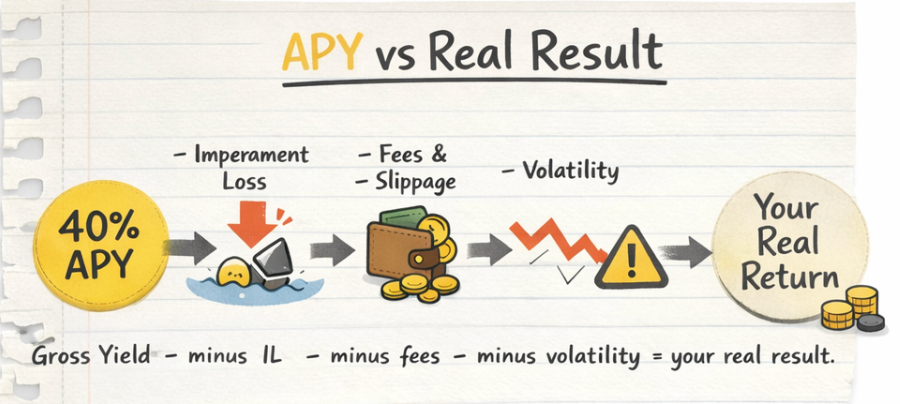
The number on the dashboard is gross yield under idealized conditions. The number you actually earn is something different. Understanding the gap between them is the first step toward understanding yield honestly.
Gross vs net return. APY is calculated before costs. Gas fees for entering, exiting, and managing positions are real expenses that reduce net return. At small position sizes, these costs can consume a significant fraction of earned yield. At larger sizes, the cost profile improves but it never disappears, and it is never reflected in the advertised rate.
Impermanent loss. Liquidity providers in AMM pools earn fees on trading volume. They also absorb divergence loss when the prices of the underlying assets move relative to each other. The fee income shows up in the APY calculation. The impermanent loss does not or at least not transparently. A pool advertising 35% APY may be generating 35% in fees while simultaneously producing 20% in impermanent loss. The net return is 15%. The dashboard shows 35%.
Rebalancing costs. Strategies that require active management adjusting positions, shifting allocations, harvesting and reinvesting rewards incur execution costs each time an action is taken. These costs reduce realized yield below the theoretical rate. The more frequently a strategy requires intervention, the more meaningful this drag becomes.
Execution friction. In thin markets or under stress, execution costs rise. Entering and exiting positions at the prices implied by the quoted rate requires sufficient liquidity depth. When liquidity is limited, slippage compresses the actual return below the theoretical one. Strategies that look efficient in calm conditions become expensive to operate when market conditions shift.
Volatility impact. Many high-yield strategies are implicitly short volatility. They generate consistent returns in calm markets and lose money, sometimes significantly, when volatility spikes. The APY figure reflects the calm scenario. The risk of the volatile one is not priced into the display.
Take a 40% APY and subtract realistic estimates for each of these factors. The number that remains is often startlingly different from the one that attracted the deposit.
Where Yield Actually Comes From
Every yield source in DeFi ultimately traces back to real economic activity. Understanding which activity is generating a specific yield and whether that activity is sustainable is the foundation of honest yield analysis.
Trading fees are generated when liquidity providers facilitate trades in AMM pools. This yield is real and sustainable as long as trading volume persists. It scales with market activity and is directly connected to the economic value the liquidity provider is creating. It is also subject to impermanent loss, which must be netted against it.
Lending activity generates yield through interest payments from borrowers. This yield is sustainable as long as demand for borrowing exists. It responds to market conditions demand for leverage rises in bull markets and compresses in bear markets but the underlying economic logic is sound. Someone is paying for the use of capital, and the yield reflects that payment.
Arbitrage generates yield by correcting price discrepancies across markets. Arbitrageurs capture the spread between mispriced assets and return prices to equilibrium. The yield is real but highly competitive it flows to the fastest and most efficient participants, and the margins are thin.
Liquidations generate yield through the fees and discounts captured when undercollateralized positions are closed. This yield is episodic and tied to market stress. It exists because the protocol needs external capital to maintain solvency during volatile periods and the yield is the payment for providing that capital at precisely the moment it is most risky to do so.
Incentives and emissions are fundamentally different from all of the above. When a protocol distributes its own token as yield, the source of that yield is token inflation. No external economic activity is generating it. Early participants receive tokens that are worth something because later participants are expected to buy them. The yield is real for those who exit at the right time. For those who don’t, it is a transfer from late entrants to early ones.
Not all yield is equal. The distinction between yield that comes from sustainable economic activity and yield that comes from token inflation is the most important distinction in DeFi. The first compounds over time. The second has an expiry date.
If You Don’t Understand the System, You May Be Subsidizing It
Here is the uncomfortable idea at the center of this article.
Financial markets are not neutral systems that distribute returns evenly. They are systems where value flows from less-informed participants to more-informed ones. This is not a conspiracy it is a structural property of how markets work. Every trade has a counterparty. Every liquidity provision involves risk. Every yield has a cost that someone is bearing.
In DeFi, this dynamic plays out in several specific ways.
When you provide liquidity to an AMM pool without modeling impermanent loss, you are bearing a risk that more sophisticated participants have already priced. Arbitrageurs who are running automated systems optimized for exactly this purpose extract value from your position each time prices diverge. The fees you earn are the compensation for the risk you’re taking. Whether they adequately compensate for that risk depends on conditions you may not have fully modeled.
When you farm emissions-driven yield without a clear exit strategy, you are participating in a system where your returns depend on capital continuing to flow in after you. The yield is real in the short term. The question is whether you will exit before the dynamics reverse. Participants who understand the emissions schedule and have modeled the token price behavior are better positioned to answer that question than those who are simply chasing the headline number.
When you deploy capital into strategies you don’t fully understand, you are delegating the risk modeling to the protocol and protocols have incentives that don’t always align with yours. The yield is designed to attract capital. The risk is distributed across participants who may not have priced it accurately.
This is what the title means. If you cannot explain where your yield is coming from what economic activity is generating it, who is on the other side, what happens to your position when conditions change you are likely occupying the role of the less-informed participant in the system. And in markets, that is a costly position to be in.
Same System, Different Outcomes
Walk through any major DeFi protocol and you will find participants with very different outcomes, all depositing into the same pools at roughly the same time.
Some users optimize purely for APY. They sort dashboards by yield, deposit into whatever is highest, and move on. They rarely model costs, rarely consider sustainability, and rarely have a clear framework for when to exit.
Others analyze structure first. They look at what’s generating the yield, whether the source is sustainable, what the realistic net return is after costs and risks, and how the strategy behaves in adverse conditions. They deploy capital into strategies they understand, size positions relative to their risk tolerance, and manage exits deliberately.
Institutions do this more formally still. Before deploying significant capital into any strategy, they model expected outcomes across scenarios, stress-test positions, assess liquidity profiles, and quantify downside risk. They do not allocate based on a dashboard number. They allocate based on a risk-adjusted return framework that accounts for the full distribution of possible outcomes.
Same protocols. Same pools. Same advertised APY. Profoundly different outcomes because the difference is not access, it is understanding.
From Yield Chasing to Yield Engineering
DeFi is evolving. The early phase characterized by emissions races, APY leaderboards, and capital flowing toward the highest number regardless of what was behind it is giving way to something more mature.
The shift is from yield chasing to yield engineering.
Yield engineering means treating return as a variable to be optimized across multiple dimensions, not a number to be maximized in isolation. It means modeling expected outcomes rather than accepting advertised rates at face value. It means managing risk as a first-order consideration rather than an afterthought. It means focusing on net returns what actually compounds into your balance after all costs and risks are accounted for rather than gross yield under ideal conditions.
This shift is being driven partly by maturing participants who have learned from experience, and partly by the entrance of institutional capital that has never operated any other way. Institutions do not ask “what’s the APY?” They ask “what is the risk-adjusted expected return, and what is the realistic distribution of outcomes?” As this capital enters DeFi, the infrastructure that serves it will look increasingly different from the dashboards that serve yield chasers.
Engineered yield requires infrastructure. You cannot optimize across all of these dimensions manually, at scale, continuously. The complexity is too high and the market moves too fast.
How Concrete Vaults Change the Equation
Concrete vaults are infrastructure built for yield engineering rather than yield chasing.
The problem they solve is not that good yield doesn’t exist in DeFi — it does. The problem is that accessing it well requires modeling, monitoring, rebalancing, compounding, and risk management that most participants cannot perform consistently on their own. The result, for most users, is a gap between the yield that is theoretically available and the yield that is actually realized.
Concrete vaults close this gap by automating the management layer.
Capital deposited into a Concrete vault is actively deployed through the Allocator dynamically positioned across a curated strategy universe based on current market conditions, not locked into a static allocation that drifts out of optimality as conditions change.
The Strategy Manager defines the boundaries of where capital can go. This is not a passive permission list, it is a curated perimeter that ensures capital is only deployed into vetted, understood strategies. The vault cannot drift toward fragile structures through market pressure.
The Hook Manager enforces risk parameters at the execution layer. Risk governance is architectural. It does not depend on user vigilance or operator discretion. The constraints are built into the system.
Rewards are compounded automatically. Positions are rebalanced when conditions shift. The operational complexity that forces most users into suboptimal outcomes the gas costs, the monitoring burden, the timing of harvests, the execution of rebalances is handled by infrastructure.
The result is that users move from guessing to structured exposure. Not from uncertainty to guarantee yield always carries risk. But from uninformed participation to a system where the risks are defined, the management is active, and the outcomes reflect genuine optimization rather than lucky timing.
The Core Insight
Yield is not a number. It is a formula.
Revenue, minus cost, adjusted for risk.
Every number on every dashboard in DeFi is a simplified, idealized representation of this formula under favorable conditions. The actual return you earn is this formula, applied to the real conditions of the market you’re operating in.
Understanding this changes everything about how you approach DeFi.
It means asking “where does this revenue come from?” before asking “how high is the number?” It means modeling costs before committing capital. It means thinking about risk not as an abstract concern but as a variable that directly determines your net return.
It means understanding that in every market, value flows toward participants who understand the system and away from those who don’t. The yield someone else is earning on the other side of your liquidity provision, your emissions farming, your uninformed deposit, is the yield that could have been yours if you had modeled the situation more carefully.
DeFi is not a system designed to take advantage of its users. But it is a system where understanding is rewarded and ignorance is expensive. The participants who thrive in the next phase of DeFi’s evolution will not be the ones who found the highest APY. They will be the ones who understood what was behind it.
That understanding starts with a single question: where is this yield actually coming from?