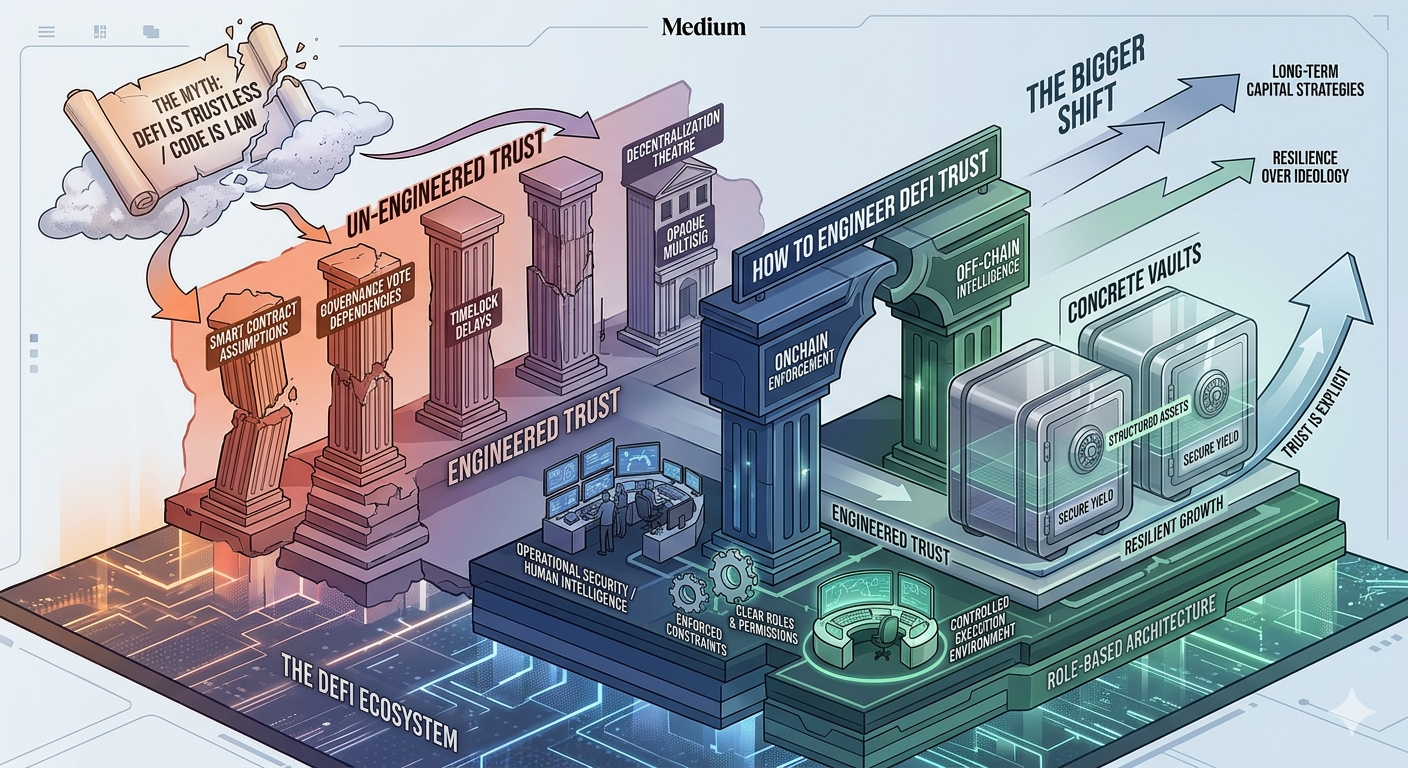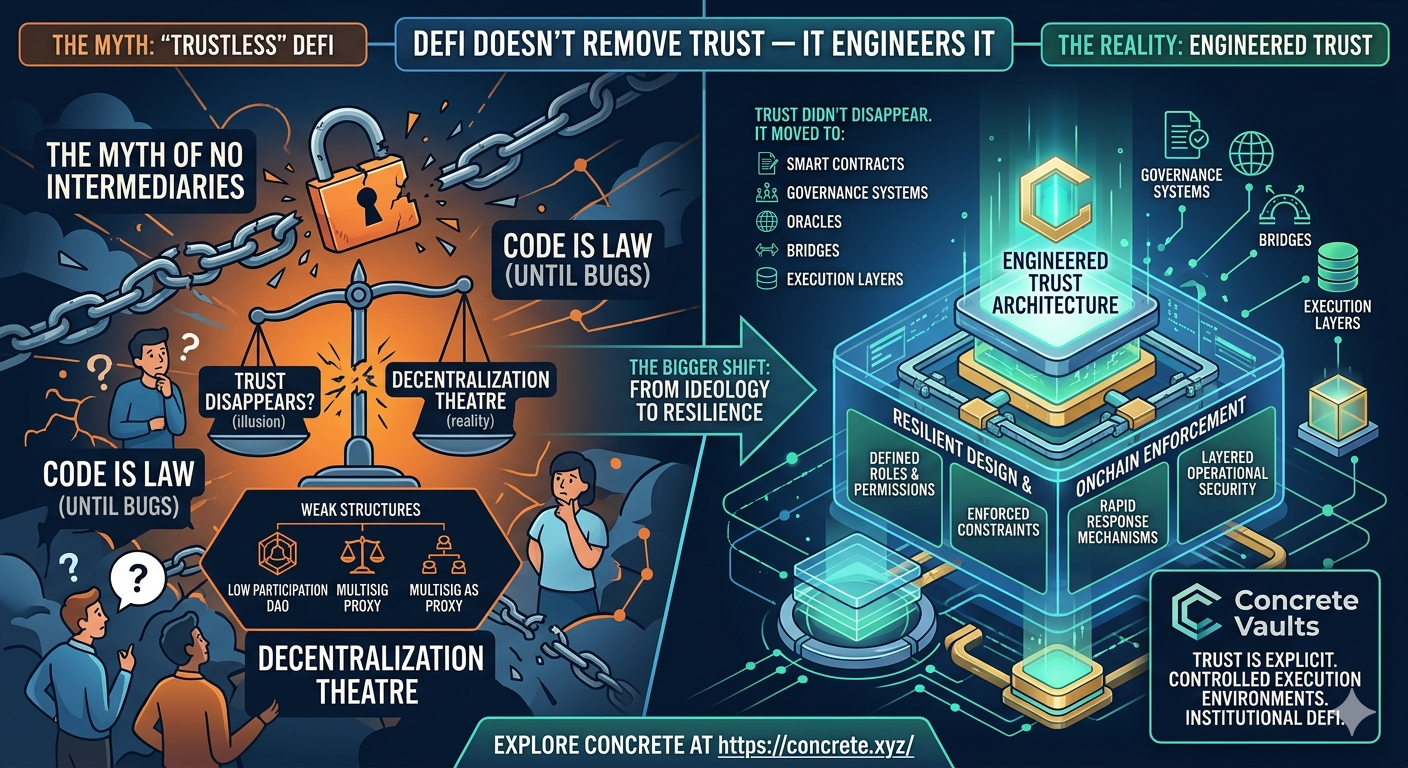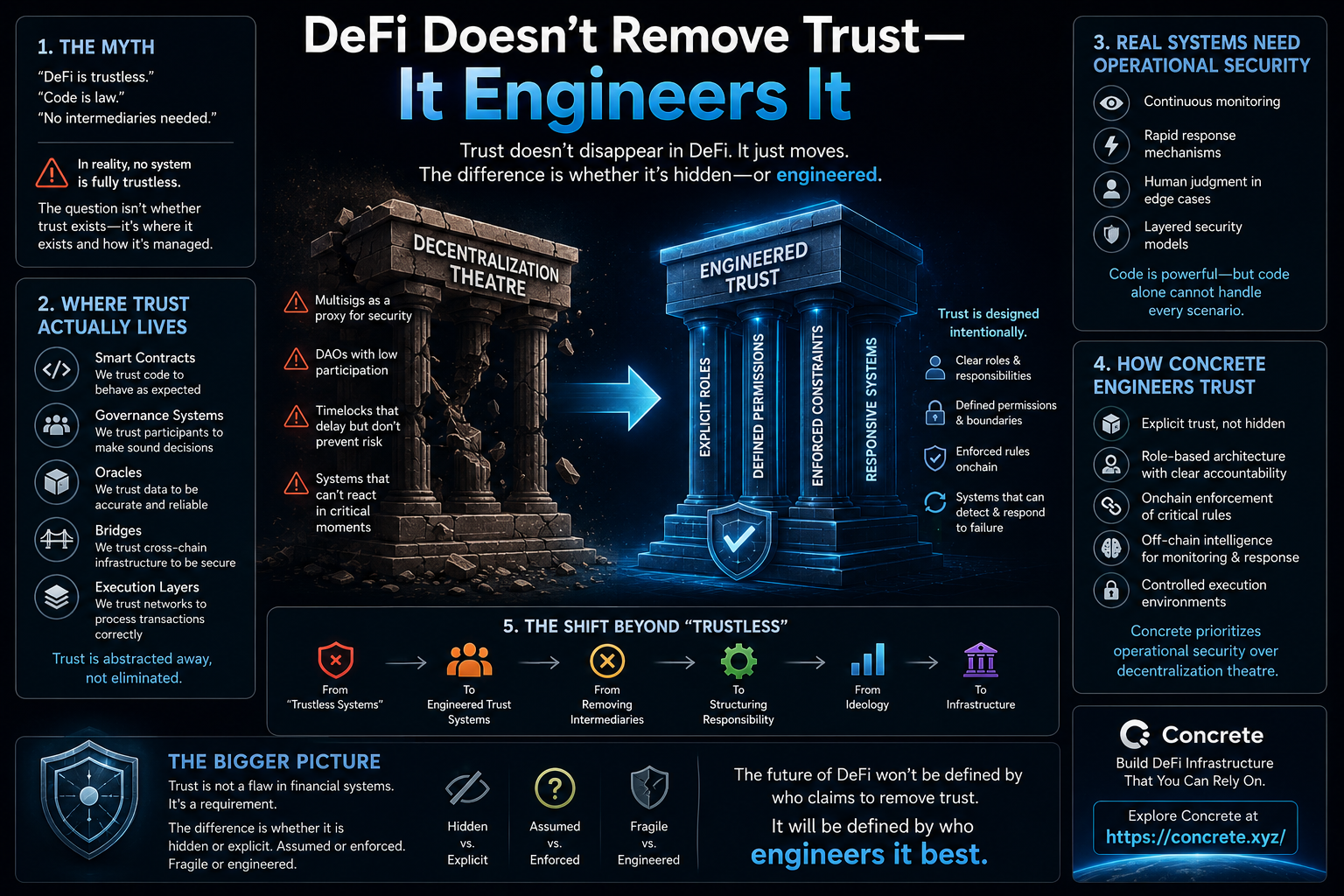
DeFi Doesn’t Remove Trust — It Engineers It
 Sandipranaya9 min read·Just now
--
The “trustless” narrative was a founding myth. The next generation of decentralized finance will be built by those who design trust deliberately — not those who pretend it doesn’t exist.
For a decade, DeFi sold itself on one idea.
Strip out the middlemen. Replace institutions with algorithms. Let code be the final arbiter of truth. The rallying cries were simple, seductive, and easy to repeat:
“DeFi is trustless.” “Code is law.” “No intermediaries needed.”
For a generation of builders and users who had watched traditional finance fail — banks bailed out while ordinary people bore the cost — these weren’t just slogans. They were a founding philosophy. And for a while, they worked. Protocols launched. Billions flowed in. A parallel financial system seemed genuinely possible.
But beneath the surface, something was quietly true from the very beginning: trust never disappeared. It just moved to places most people weren’t looking.
The question for DeFi’s next chapter is not whether trust exists. It does. It always has. The real question is whether we’re honest enough to say so — and disciplined enough to design for it.
Where Trust Actually Lives in DeFi
The “trustless” label was always a simplification.
What decentralized systems actually did was redistribute trust — away from centralized intermediaries and into a layered stack of technical and social dependencies. Trust wasn’t eliminated. It was abstracted away, buried inside systems most users interact with daily but rarely examine. Those layers are real, and they carry real risk.
Smart Contracts
Every time you interact with a DeFi protocol, you trust that the code does exactly what it claims. Logic errors, upgrade mechanisms, admin keys, and unforeseen edge cases mean that “audited” does not mean “safe.” Trust is delegated to the code reviewers, the audit firms, and the original developer’s intent. When any of those fail, the code fails with them.
Governance Systems
Most major protocols are governed by token holders who can vote to change the rules. In practice, governance participation is often extremely low, voting power is concentrated in a small number of wallets, and critical decisions are made by a group far smaller than the protocol’s user base. The appearance of decentralization can mask significant centralization of influence — and power without accountability.
Oracle Dependencies
On-chain systems routinely depend on off-chain price feeds and data sources. These oracles are trusted infrastructure — but they introduce external dependency points that can be manipulated, delayed, or compromised. An oracle failure can drain a protocol in minutes. This is not a hypothetical. It has happened, repeatedly, across billions of dollars of user funds.
Cross-Chain Bridges
Bridges are among the most dangerous trust points in the entire DeFi ecosystem. Over $2 billion was lost to bridge exploits in a single year. Every bridge requires trusting a set of validators, multisig signers, or smart contract logic — layers that have proven to be attack surfaces when economic incentives are high enough.
Execution Layers
MEV bots, block builders, and sequencers shape what transactions actually get executed and in what order. In a world of rollups and restaking, the execution environment itself is a trust assumption that most users never see or question — but that shapes every outcome they experience.
None of this is a fatal flaw. But it is a truth that the industry has been reluctant to name clearly. DeFi doesn’t eliminate trust. It engineers it into a different configuration. The honest builders are the ones who map that configuration explicitly — not the ones who hide it behind a “trustless” label.
The Problem With Decentralization Theatre
There is a specific failure mode in DeFi that deserves its own name: decentralization theatre.
It is the gap between the narrative a protocol presents and the actual risk profile its users are accepting. And it is more dangerous than outright centralization, because it creates false confidence.
It looks like this:
A protocol uses a multisig wallet and claims “no single point of control” — but the 3-of-5 signers all know each other, and a single coordinated compromise takes the whole thing down.
A protocol claims to be DAO-governed — but average governance participation sits below 5%, and most votes are decided by a handful of large token holders with no accountability to the broader community.
A protocol implements timelocks to protect against malicious upgrades — but timelocks delay risk; they don’t prevent it. A determined attacker simply waits. A legitimate crisis still unfolds in slow motion while users are exposed.
A protocol uses immutable code and presents this as a security feature — but immutability means it cannot respond when an exploit is discovered. The protocol is not safe. It is just frozen.
The question isn’t whether a system looks decentralized. It’s whether it can stay safe when something goes wrong.
Resilience is not a marketing feature. It’s an engineering requirement. A system that cannot respond to failure — because it has no mechanisms for response built in — is not decentralized. It is simply brittle. The appearance of decentralization is not the same as actual safety, and conflating the two has cost the industry billions.
Introducing Engineered Trust
The alternative to decentralization theatre is not centralization. It’s precision. It’s honesty. It’s designing trust into systems deliberately, explicitly, and with clear accountability at each layer.
This is what engineered trust looks like in practice.
Explicit roles and permissions. Every actor in the system — whether a smart contract, a multisig, a committee, or an automated process — has defined capabilities and defined limits. Nothing operates with undefined authority. Role-based architecture means that compromise at one layer does not cascade into total system failure.
Onchain enforcement with offchain intelligence. The blockchain enforces what it can verify. But intelligent systems layer monitoring, anomaly detection, and human judgment on top of onchain logic — because code alone cannot anticipate every edge case the real world will generate. This is not a weakness. This is exactly how mature financial institutions — from central banks to custodians — approach operational security. They do not rely on a single mechanism and hope for the best. They stack controls, each independent, each covering the gaps left by the others.
Systems designed to respond, not just prevent. Security is not only about blocking attacks before they happen. It is about maintaining the capacity to act when something unexpected occurs. Engineered trust includes circuit breakers, escalation paths, and defined procedures for edge cases. Resilience is built in from the beginning, not patched in after a crisis.
The insight for DeFi is that these disciplines — the same ones that govern how serious financial infrastructure operates — are not in conflict with decentralization. They are the precondition for it working at scale.
Why Code Alone Is Never Enough
The “code is law” maxim carries a profound hidden assumption: that the code is correct, complete, and that all possible scenarios were anticipated when it was written.
History has shown, repeatedly, that none of these assumptions hold universally.
Real-world financial systems require things that pure on-chain logic cannot provide on its own.
Monitoring and detection. A smart contract cannot observe itself from the outside. Effective DeFi security requires off-chain surveillance — systems that watch for unusual patterns, simulate pending transactions, and raise flags before damage is done. In operational security, you need eyes on the system that the system itself cannot have.
Rapid response mechanisms. When an exploit begins, seconds matter. Protocols with rigid on-chain governance cannot pause, patch, or redirect in real time. Systems without accessible emergency controls have proven catastrophically vulnerable. The ability to respond is not a compromise — it is a feature.
Layered security architecture. No single control is sufficient. Effective security stacks independent layers: on-chain constraints, access controls, monitoring, governance, and incident response. The failure of any one layer should not mean total compromise. This is defense-in-depth — a foundational principle in security engineering that DeFi is only beginning to apply seriously.
Human judgment in edge cases. The space of possible market conditions, exploit vectors, and systemic risks is effectively unbounded. Code handles the defined cases well. Humans — with context, judgment, and accountability — handle the undefined ones. Trustless systems that exclude human judgment entirely are not stronger for it. They are more brittle.
The conclusion is straightforward: code is a tool, not a governance philosophy. The best DeFi infrastructure treats it as one powerful layer among many — not as the final word on every possible future.
How Concrete Builds Engineered Trust
This is where the theory becomes infrastructure.
Concrete was built on a specific conviction: the future of DeFi belongs to systems that make trust explicit — designed deliberately, enforced on-chain, and backed by the operational intelligence to respond when things don’t go as expected.
Most protocols treat security as a feature you add. Concrete treats it as an architecture you build from the ground up. Here is what that looks like in practice.
Concrete Vaults: where engineered trust is most visible.
Concrete vaults are the operational core of the protocol — controlled execution environments where assets are held, managed, and protected under a clearly defined set of rules. Unlike generic smart contract pools that rely entirely on code correctness and hope no edge case is ever encountered, Concrete vaults are designed with explicit role-based permissions. Every action within a vault — deposits, withdrawals, strategy execution, risk responses — is governed by defined constraints. Who can act, under what conditions, and with what limits is not assumed. It is enforced.
This means that even in adversarial conditions — a market dislocation, a governance attack, an oracle anomaly — the vault’s behavior is predictable and bounded. There is no hidden authority that can be exploited. There is no undefined permission that can be abused. The trust is explicit, and the constraints are real.
Onchain enforcement as the baseline.
Core security guarantees in Concrete are enforced at the protocol level — not dependent on operational goodwill or the assumption that operators will always act correctly. Onchain enforcement means that defined behaviors are cryptographically guaranteed, not merely promised. This is the baseline from which everything else is built.
Offchain intelligence as the response layer.
Concrete layers real-time monitoring and risk detection on top of its onchain architecture. This is the intelligence layer — the part of the system that can see what the smart contracts themselves cannot: patterns, anomalies, correlations across market conditions that signal elevated risk before it becomes an exploit. When something unusual is detected, the system can respond — pausing activity, flagging for review, or triggering predefined safety mechanisms — rather than waiting for on-chain governance to catch up.
Role-based architecture that limits blast radius.
Concrete’s architecture is designed so that compromise at one layer does not mean compromise of everything. Roles are separated. Permissions are scoped. An attacker who gains access to one component does not automatically gain access to the whole system. This is how serious financial infrastructure handles the reality that no single point of defense is perfect.
Operational security over decentralization theatre.
Concrete explicitly prioritizes real resilience over aesthetic decentralization. The goal is not to look trustless — it is to be secure, to respond effectively to failure, and to protect users when the edge cases arrive. This is what DeFi infrastructure built for institutional participation actually looks like: not a protocol that defers all responsibility to code, but one that takes ownership of engineering the trust its users extend every time they interact with it.
👉 Explore Concrete at https://concrete.xyz/
The Bigger Shift: From Ideology to Infrastructure
DeFi is at an inflection point.
The industry built on the “trustless” narrative has produced extraordinary innovation — and extraordinary losses. Billions have been drained through smart contract exploits, oracle manipulations, governance attacks, and bridge failures. The common thread in most of these failures is not bad luck. It is unacknowledged trust — trust that was always there, hidden inside the architecture, waiting for the moment someone decided to look for it.
The next generation of DeFi will not be defined by who makes the strongest ideological claims about decentralization. It will be defined by who builds the most resilient systems in practice. And resilience requires honesty about trust.
The market is already selecting for this. Institutional capital flowing into DeFi demands it. Sophisticated users who have been through multiple cycles of exploits and collapses are increasingly skeptical of any protocol that presents “trustless” as a terminal destination rather than an ongoing engineering challenge.
DeFi infrastructure will increasingly be judged not by its ideology, but by how it behaves under stress. Not by what it claims about trust, but by how it handles trust when systems break and decisions must be made in real time.
DeFi is moving beyond the “trustless” narrative — not because the original vision was wrong, but because the industry has matured enough to understand what that vision actually requires. Real systems acknowledge trust. Structure it. Enforce it. And design for the moment it is tested.
The future of DeFi won’t be defined by who claims to remove trust.
It will be defined by who engineers it best.
Concrete is building engineered trust infrastructure for the next phase of DeFi. Explore at concrete.xyz.
Tags: DeFi security · trustless systems · engineered trust · DeFi infrastructure · Concrete vaults · onchain enforcement · operational security · institutional DeFi