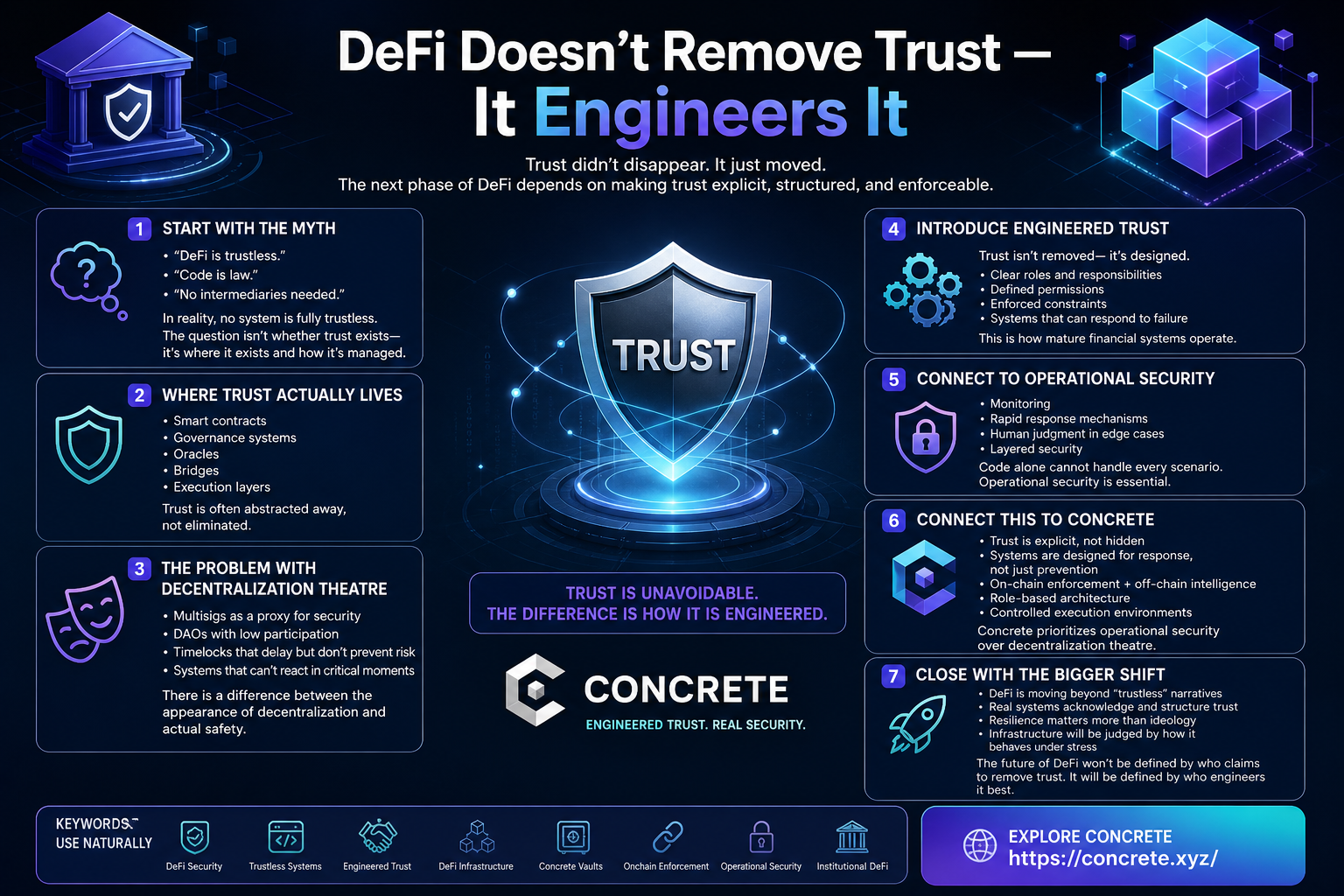
DeFi Doesn’t Remove Trust — It Engineers It
 Mjalborz3 min read·Just now
--
DeFi was born from a powerful narrative:
“Don’t trust people. Trust code.”
“Code is law.”
“No intermediaries needed.”
For a time, this framing felt revolutionary. It promised a financial system free from human bias, centralized control, and opaque decision-making. But as DeFi matured, reality revealed something more nuanced:
Trust didn’t disappear — it evolved.
No system is truly trustless. The real question is not whether trust exists, but where it exists, how it is structured, and whether it is visible or hidden.
The Myth of Trustlessness
The idea of “trustless systems” is compelling, but misleading when taken literally.
Even in DeFi, users implicitly trust multiple layers:
- That smart contracts are written without critical bugs
- That governance participants act rationally
- That price feeds reflect reality
- That infrastructure behaves as expected under stress
What DeFi actually did was shift trust from institutions to systems.
But shifting trust is not the same as removing it.
Where Trust Actually Lives
In practice, trust in DeFi is distributed across several critical layers:
Smart Contracts
Users trust that deployed code is secure, audited, and immutable in the ways that matter.
Governance Systems
Token holders or multisigs often control upgrades, parameters, and emergency actions. This introduces human coordination and incentive alignment.
Oracles
External data providers act as a bridge between on-chain logic and real-world information. If they fail or are manipulated, the entire system can break.
Bridges
Cross-chain infrastructure relies on complex validation mechanisms — historically one of the most vulnerable parts of the ecosystem.
Execution Layers
Block producers, sequencing mechanisms, and MEV dynamics all influence how transactions are processed and prioritized.
In all of these layers, trust is not eliminated — it is abstracted.
The Problem with “Decentralization Theatre”
A major issue in modern DeFi is what can be described as decentralization theatre:
Systems that appear decentralized on the surface, but lack true resilience underneath.
Examples include:
- Multisigs presented as “secure,” but controlled by a small group
- DAOs with minimal active participation
- Timelocks that delay actions but don’t mitigate underlying risk
- Protocols unable to respond effectively during crises
This creates a dangerous illusion:
Decentralization ≠ safety
A system can be decentralized in structure yet fragile in operation.
Engineered Trust: A Better Model
Instead of pretending trust doesn’t exist, the next phase of DeFi focuses on engineering trust deliberately.
Engineered trust means:
- Clearly defined roles and responsibilities
- Explicit permission structures
- Enforced operational constraints
- Systems designed to handle failure, not just prevent it
This approach mirrors how mature financial systems operate:
Not by eliminating trust, but by structuring it, monitoring it, and constraining it.
Operational Security Matters
Real-world systems must deal with uncertainty, edge cases, and adversarial conditions.
This requires:
- Continuous monitoring
- Rapid response capabilities
- Human intervention when necessary
- Layered defense mechanisms
Purely autonomous code cannot anticipate every scenario.
Operational security becomes the backbone of reliability.
How Concrete Approaches Trust
Concrete represents a shift toward this engineered model.
Rather than hiding trust assumptions, it makes them explicit and structured:
- Trust is acknowledged, not abstracted away
- Systems are built for response, not just prevention
- Onchain enforcement is combined with off-chain intelligence
- Role-based architectures define who can act and when
- Execution environments are controlled and predictable
Concrete vaults are designed with operational security as a priority, focusing on how systems behave under real-world conditions — not just ideal ones.
This approach moves beyond ideological decentralization toward practical resilience.
The Bigger Shift in DeFi
DeFi is entering a new phase.
The narrative is evolving:
- From “trustless systems” → to transparent trust systems
- From ideology → to infrastructure reliability
- From decentralization claims → to performance under stress
The protocols that will define the future are not those that claim to remove trust entirely.
They are the ones that:
- Expose trust assumptions clearly
- Structure them intelligently
- Enforce them rigorously
Because in the end:
Trust is not the enemy of DeFi.
Unstructured, invisible trust is.
Explore Concrete at https://concrete.xyz/