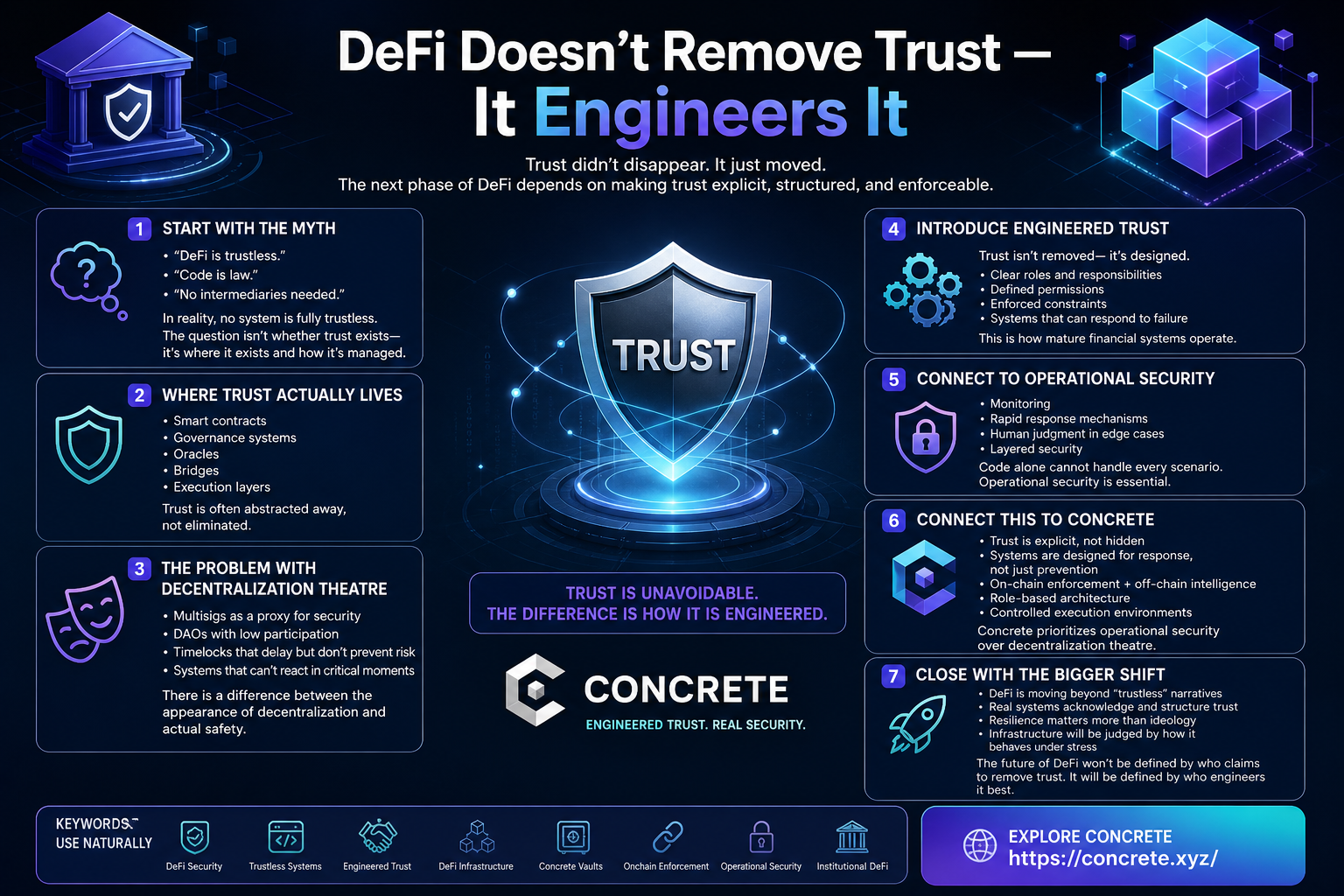
DeFi Doesn’t Remove Trust — It Engineers It
DeFi was born from a bold promise:
“Don’t trust people. Trust code.”
At first glance, it made perfect sense.
Smart contracts replaced intermediaries. Transactions became transparent. Systems executed automatically without human involvement.
For a moment, it felt like we had finally removed trust from finance.
But as the ecosystem evolved, reality started to look different.
Trust didn’t disappear. It just moved.
The Illusion of “Trustless” Systems
The idea that DeFi is “trustless” has been one of its strongest narratives.
No banks
No middlemen
Code is law
But if you look closer, no system truly operates without trust.
Even in DeFi, every interaction depends on assumptions:
That the code works as intended
That governance decisions are rational
That data inputs are correct
That infrastructure won’t fail under pressure
So the real question isn’t whether trust exists.
It’s where trust lives—and whether we acknowledge it.
Where Trust Actually Exists
In practice, DeFi redistributes trust across multiple layers:
Smart Contracts
You trust that the code is secure, audited, and free from hidden vulnerabilities.
Governance Systems
You trust that token holders or decision-makers act in the best interest of the protocol.
Oracles
You trust that off-chain data feeding the system is accurate and tamper-resistant.
Bridges
You trust that assets moving across chains are safe from exploits.
Execution Layers
You trust that transactions are processed correctly and fairly.
None of these are trustless.
They are simply less visible forms of trust.
The Rise of “Decentralization Theatre”
As DeFi grew, a new pattern emerged.
Many systems looked decentralized—but weren’t necessarily resilient.
This is what we can call:
Decentralization theatre
Examples include:
Multisigs that concentrate power in a few hands
DAOs with low participation, effectively controlled by insiders
Timelocks that delay actions but don’t prevent harmful decisions
Protocols that cannot react quickly during crises
These systems give the impression of safety.
But under stress, they often reveal hidden weaknesses.
The key distinction becomes clear:
Decentralization as appearance vs security as reality
From Trustless to Engineered Trust
If trust cannot be removed, then what should we do?
The answer is simple—but often overlooked:
We design it.
Engineered trust means building systems where trust is:
Explicit
Structured
Enforceable
Instead of pretending trust doesn’t exist, we define:
Who has authority
What actions are allowed
What constraints are enforced
How systems respond to failure
This is how mature financial systems operate.
Not by eliminating trust—but by controlling and shaping it.
Why Code Alone Is Not Enough
Smart contracts are powerful.
But they are not omniscient.
They cannot anticipate every edge case, every attack vector, or every unexpected market condition.
Real systems require more than automation.
They require:
Continuous monitoring
Rapid response mechanisms
Human judgment in critical moments
Layered security architectures
Because when things break—and they will—
the ability to respond matters more than the illusion of perfection.
A New Model: Concrete
This is where the next evolution of DeFi infrastructure begins.
Concrete takes a fundamentally different approach.
Instead of hiding trust, it makes it explicit and operational.
Its design focuses on:
Transparent trust assumptions
Systems built for response, not just prevention
Onchain enforcement combined with off-chain intelligence
Role-based architectures with clearly defined permissions
Controlled execution environments
This approach prioritizes something often overlooked in DeFi:
Operational security
Not just how systems function in ideal conditions—
but how they behave under stress.
Explore Concrete at https://concrete.xyz/�
The Shift That Defines the Future
DeFi is entering a new phase.
The narrative is changing.
From:
“Trustless systems”
“Code is everything”
To:
Structured trust
Resilient infrastructure
Systems designed for real-world conditions
Because ultimately:
A system is not defined by how it works when everything goes right.
It is defined by how it behaves when things go wrong.
Conclusion
Trust was never eliminated from DeFi.
It was redesigned.
The protocols that will define the future are not the ones that claim to remove trust—
but the ones that engineer it deliberately, transparently, and securely.
Because in the end:
Resilience beats ideology.
And the future of DeFi will belong to those who understand that.
--