 Khodadadsarwari3 min read·Just now
--
DeFi Doesn’t Remove Trust — It Engineers It
At the beginning, the idea sounded simple:
“Don’t trust people. Trust code.”
DeFi was supposed to be fully trustless.
No intermediaries. No need to rely on anyone.
But as the space evolved, something became clear:
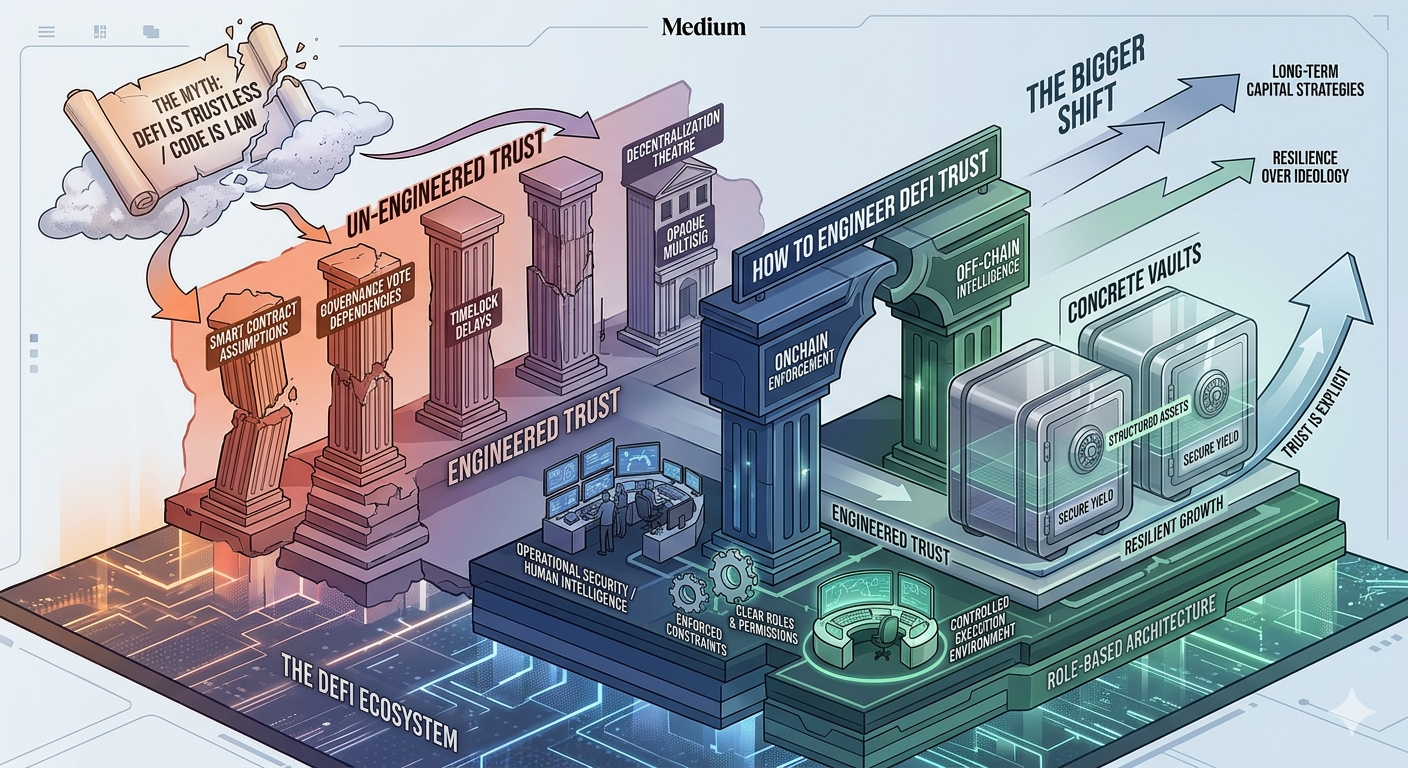
Trust didn’t disappear — it just changed form.
In real systems, trust is unavoidable.
The only difference is whether it’s hidden — or intentionally designed.
1️⃣ Start With the Myth
A lot of people still think about DeFi like this:
● trustless systems
● code is law
● no intermediaries needed
And on the surface, that sounds perfect.
A system that runs on logic, not people.
But in reality, no system is completely trustless.
Even when you “trust code,”
you’re still trusting that:
○ it was written correctly
○ it has no critical bugs
○ it behaves as expected in edge cases
So the real question isn’t whether trust exists.
It’s:
Where does trust actually live?
2️⃣ Show Where Trust Actually Lives
If you look a bit deeper, trust is still everywhere in DeFi:
● smart contracts that need to be secure
● governance systems that can change parameters
● oracles that bring in external data
bridges that move assets across chains
● execution layers that process transactions
Each of these is a point of trust.
The difference is that trust is now distributed and abstracted —
not removed.
That’s why DeFi security isn’t just about code.
It’s about the entire system around it.
3️⃣ Explain the Problem With “Decentralization Theatre”
There’s also a common issue in DeFi:
systems that look decentralized, but aren’t actually resilient.
This is often called:
decentralization theatre
For example:
● multisigs that concentrate control in a few hands
● DAOs with very low participation
● timelocks that delay actions but don’t prevent risk
● systems that can’t respond during critical moments
So you end up with something that looks decentralized,
but doesn’t necessarily behave safely under pressure.
There’s a big difference between:
the appearance of decentralization
and
actual system resilience
4️⃣ Introduce Engineered Trust
This is where a more realistic model comes in:
Trust isn’t removed — it’s designed.
This is what we mean by engineered trust.
It includes:
○ clearly defined roles and responsibilities
○ explicit permissions
○ enforced constraints
○ systems that can respond when something goes wrong
In other words, trust becomes enforceable, not just assumed.
This is how mature financial systems operate.
And this is the direction DeFi infrastructure is moving toward —
not hiding trust, but structuring it.
5️⃣ Connect This to Operational Security
In practice, code alone is not enough.
Not everything can be predicted in advance.
Real systems need:
● continuous monitoring
● fast response mechanisms
● human judgment in edge cases
● multiple layers of protection
This is what operational security is about.
Security that doesn’t stop at deployment,
but continues throughout the system’s lifecycle.
6️⃣ Connect This to Concrete
This is where Concrete takes a different approach.
Instead of claiming to be fully trustless,
it makes trust explicit and structured.
In Concrete:
● trust is visible, not hidden
● systems are designed for response, not just prevention
● onchain enforcement is combined with off-chain intelligence
● architecture is role-based, with defined responsibilities
● execution happens in controlled environments
Concrete vaults are built around this idea.
The focus is not just decentralization as a concept,
but real, practical DeFi security and reliability.
This is also why this model aligns well with institutional DeFi,
where clarity and control matter.
7️⃣ Close With the Bigger Shift
DeFi seems to be moving past the “trustless” narrative.
Toward systems that:
○ acknowledge trust
○ structure it
○ and manage it intentionally
Because in real systems, trust is unavoidable —
the difference is how well it’s engineered.
Going forward:
● systems will be judged by how they behave under stress
● not just by how they market themselves
In the end, DeFi won’t be defined by who claims to remove trust.
It will be defined by:
who engineers it best.
🚨 Explore Concrete at https://concrete.xyz/� 🚨