DeFi Doesn’t Remove Trust — It Engineers It
 Adeyemi7 min read·Just now
--
And the protocols that understand this will define the next era of crypto.
There's a founding myth baked into every DeFi protocol.
You've heard it before. Maybe you've even said it yourself.
"This is trustless."
"Code is law."
"No intermediaries. No counterparty risk. Just pure, immutable logic."
It's a compelling story. And honestly? For a while, it was enough to build an entire industry on.
But here's the thing about stories — the more complex the world gets, the more the cracks start to show.
---
The Myth That Built a Movement
Let's be fair to the original idea. The "trustless" narrative wasn't just marketing. It came from a real place.
Bitcoin was born out of genuine frustration with trusted institutions — banks that failed, governments that bailed them out, and a financial system where ordinary people absorbed the downside while insiders captured the upside. The promise was simple: replace human judgment with mathematical certainty. Replace institutions with code.
Ethereum extended that vision. Smart contracts meant you didn't have to trust a counterparty — you trusted the execution. You didn't need a lawyer for a loan, a broker for a trade, or a custodian for your assets. The protocol handled it.
And that genuinely worked. Peer-to-peer lending. Decentralized exchanges. Automated market makers. These weren't theoretical — billions of dollars flowed through systems that operated without a CEO, a compliance team, or a customer service desk.
So what's the problem?
The problem is what happened next.
---
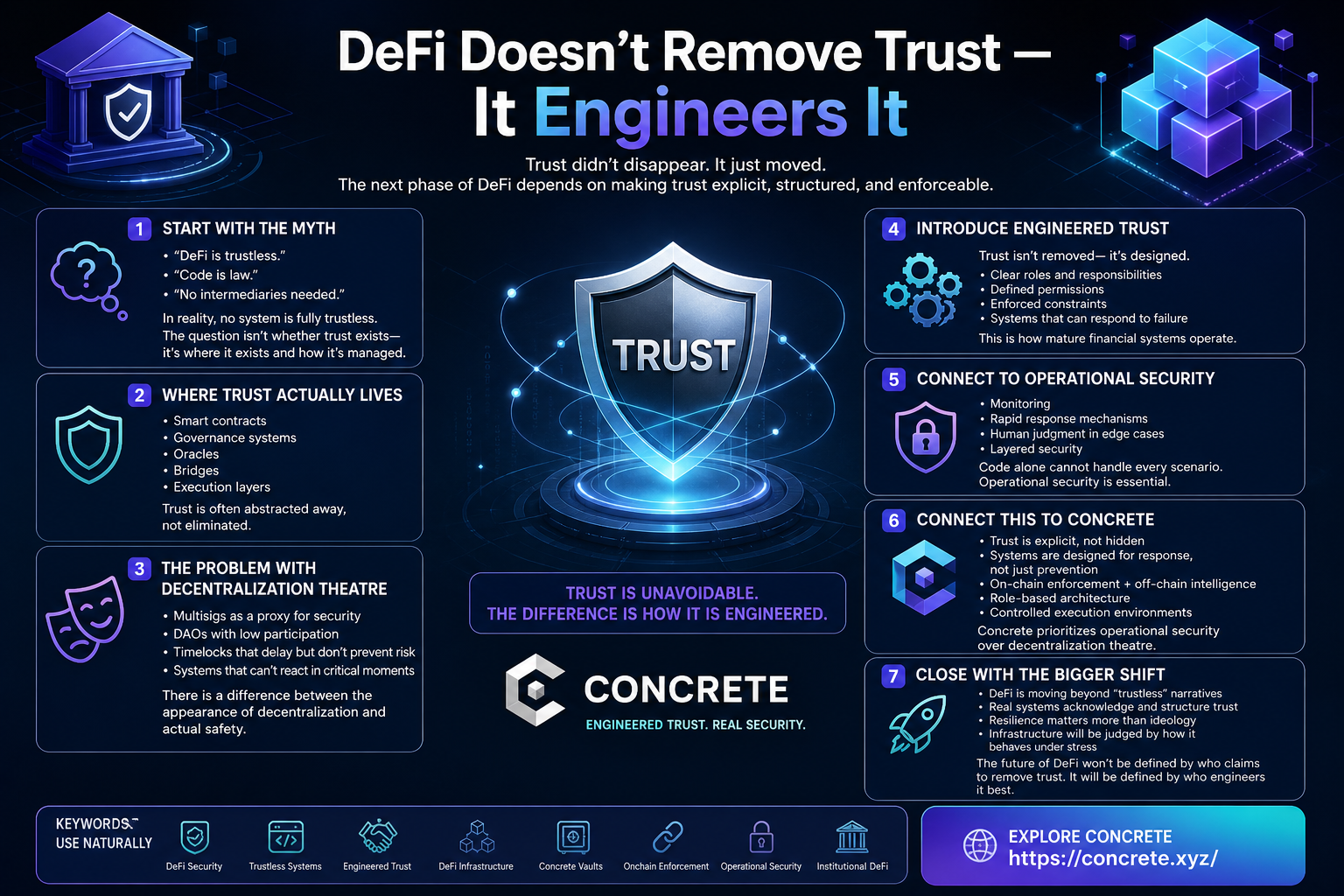
Trust Didn’t Disappear. It Just Moved.
Here’s what nobody put on the roadmap: as DeFi grew more complex, trust didn’t get eliminated. It got redistributed.
Think about what you're actually trusting when you interact with a "trustless" DeFi protocol today:
Smart contracts — that the code was written correctly, audited thoroughly, and doesn’t contain an edge case that drains the pool at 3am on a Tuesday.
Governance systems — that the people voting on protocol changes are informed, aligned, and not quietly accumulating power through token acquisition.
Oracles — that the price feeds powering liquidations, lending rates, and synthetic assets actually reflect reality, and aren’t being manipulated.
Bridges — that the mechanism connecting Chain A to Chain B is secure, and that the assets locked on one side are actually safe when the other side moves.
Execution layers — that MEV bots, sequencers, and block builders aren’t extracting value from you in ways you can’t see or audit.
Every single one of these is a trust relationship. The difference is that it's buried under layers of abstraction, dressed up as technical neutrality.
Trust didn't leave the system. It just stopped wearing a name tag.
---
Welcome to Decentralization Theatre
There’s a term worth introducing here: decentralization theatre.
It describes systems that look decentralized — on the surface — but behave in ways that undermine the whole point.
A few examples worth thinking about:
The multisig illusion. A protocol claims its treasury is community-controlled. Look closer, and it’s a 3-of-5 multisig held by five wallets tied to the same founding team. Is that decentralized? Technically. Is that resilient? Not really.
The DAO with no quorum. Governance proposals pass or fail based on 2-3% of token holders. The rest are too disengaged, too busy, or holding on an exchange that doesn’t support voting. The mechanism exists. The participation doesn’t. Decisions get made by a small group — which is fine, until it isn’t.
The timelock that delays but doesn’t protect. Timelocks are often cited as a security feature — they give the community time to react before changes go live. But a timelock on a fundamentally broken governance decision just gives you 48 hours of advance notice before the bad outcome happens. It’s not a safeguard. It’s a countdown timer.
The system that can’t move fast enough. When an exploit is live, seconds matter. Protocols that require governance votes to pause contracts, update parameters, or respond to an attack are operating with one hand tied behind their back. The ideology of decentralization becomes a vulnerability.
The distinction that matters here isn’t decentralized vs. centralized. It’s resilient vs. fragile. And a lot of systems optimized for the appearance of one have quietly sacrificed the other.
---
What Engineered Trust Actually Looks Like
Here's the reframe that changes everything:
The goal was never to remove trust. The goal was to make trust legible — to take the invisible, informal, and assumed relationships that define traditional finance, and make them explicit, auditable, and enforceable.
That's a completely different problem. And it requires a completely different approach.
Engineered trust means:
- Clear roles and responsibilities — not every participant has the same permissions. Someone can read a state without being able to change it. Someone can trigger a pause without being able to drain a vault.
- Defined constraints, not infinite flexibility — the system knows what should happen in normal conditions, and has explicit rules for what to do when conditions aren’t normal.
- Mechanisms for response, not just prevention — because no security model is perfect. The question isn’t whether something will go wrong. It’s whether the system can contain, respond to, and recover from failure when it does.
- Human judgment at the edges — code handles what code is good at. Humans handle what humans are good at. The interface between the two is designed deliberately, not assumed away.
This is how mature financial infrastructure actually works. Not through the absence of trust, but through its deliberate architecture.
---
Operational Security Is the Missing Layer
The DeFi security conversation has been dominated by one question for years: "Was the code audited?"
That's a necessary question. It's not a sufficient one.
Audits are a snapshot. They tell you what the code looked like at a specific moment in time, under specific assumptions. They don't tell you how the system behaves six months later when market conditions change, when a new integration introduces unexpected behavior, or when someone finds the one edge case three firms missed.
Real operational security looks different:
Monitoring — continuous, not periodic. The kind that catches anomalous behavior before it becomes catastrophic behavior.
Rapid response — the ability to act in seconds or minutes, not the hours or days a governance process requires.
Layered architecture — where a failure at one level doesn’t cascade into a failure at every level. Defense in depth, not a single perimeter.
Human judgment in the loop — specifically for edge cases, novel situations, and moments where the protocol encounters something it wasn’t designed to handle.
This isn't a retreat from DeFi's values. It's what taking those values seriously actually requires at scale.
---
How Concrete Gets This Right
This is where the philosophy becomes concrete — quite literally.
Concrete was built on a premise that the industry is only beginning to accept: trust in DeFi infrastructure should be explicit, structured, and enforceable. Not hidden. Not assumed. Not dressed up as something it isn’t.
A few things that make Concrete's approach different:
Trust is surfaced, not buried. Concrete vaults are designed so that the trust relationships within the system are visible and intentional. You know who can do what, under what conditions, with what constraints. There’s no pretending the architecture is flat when it isn’t.
On-chain enforcement meets off-chain intelligence. Smart contracts handle what smart contracts are good at — execution, settlement, transparent rules. But Concrete pairs that with off-chain intelligence: monitoring, anomaly detection, and response capabilities that exist precisely because onchain enforcement alone isn’t always fast enough or smart enough.
Role-based architecture. Not every participant in a Concrete system has the same access. Roles are defined, permissions are scoped, and the blast radius of any single compromised key or bad actor is limited by design.
Controlled execution environments. The system knows what normal looks like. It can identify and respond to deviation — pausing, constraining, or escalating — without requiring a governance vote while the clock is ticking.
Designed for stress, not just for ideal conditions. The real test of any DeFi infrastructure is how it behaves when things go wrong. Concrete is built with that test in mind from day one — not as an afterthought, and not as a marketing claim.
This is what institutional-grade DeFi security actually looks like. Not theater. Not ideology. Engineering.
---
The Bigger Shift Coming for DeFi
We're at an inflection point.
The first era of DeFi was defined by the question: "Can we build this without trusting anyone?"
The next era will be defined by a better question: "Can we build this so that trust is handled well?"
The protocols that survive and scale won't be the ones that made the boldest claims about being trustless. They'll be the ones that took the hardest problem seriously — making trust explicit, resilient, and honest — and built infrastructure capable of holding real value under real conditions.
Decentralization is a tool, not a religion. The goal was always security, fairness, and accessibility — not the ideology itself.
The future of DeFi will be judged by how systems behave under stress. By whether monitoring caught the exploit before it became a headline. By whether response mechanisms were fast enough to matter. By whether the architecture actually held when assumptions were tested.
Not by who made the most convincing argument for why trust doesn't exist.
Explore how Concrete is engineering trust for the next era of DeFi at concrete.xyz.