@CONCRETE
--
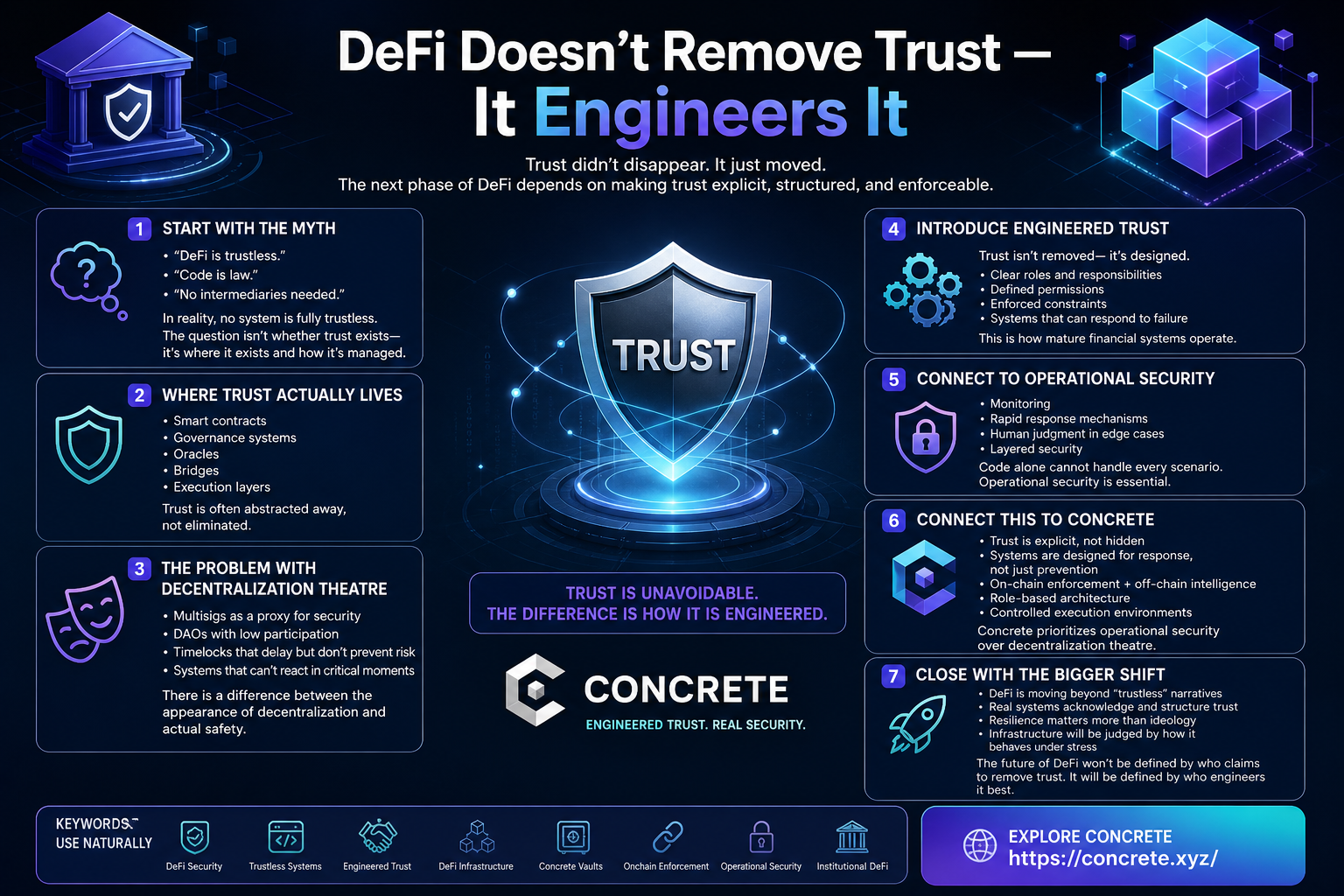
## **DeFi Doesn’t Remove Trust — It Engineers It**
At the beginning, DeFi was built on a simple idea:
**“Don’t trust people. Trust code.”**
It was a powerful narrative.
“Trustless systems.”
“Code is law.”
“No intermediaries needed.”
For a while, it worked. It attracted attention, capital, and belief.
But as the ecosystem evolved, something became clear:
**Trust didn’t disappear. It just moved.**
— -
### **The Myth of “Trustless”**
The truth is, no system is fully trustless.
No matter how decentralized a protocol claims to be, there is always something you rely on.
So the real question isn’t:
**“Is there trust?”**
It’s:
**“Where does trust live — and how is it managed?”**
— -
### **Where Trust Actually Lives in DeFi**
If you look deeper, trust exists in multiple layers of DeFi:
- **Smart contracts** — you trust that the code is secure and free from critical bugs
- * **Governance systems** — you trust voters and decision-makers
- * **Oracles** — you trust external data sources to be accurate
- * **Bridges** — you trust cross-chain infrastructure to be secure
- * **Execution layers** — you trust transactions are processed correctly
So what really happened?
**Trust wasn’t removed — it was abstracted.**
And in many cases, that makes it harder to see.
— -
### **The Problem With “Decentralization Theatre”**
This leads to a dangerous illusion:
**Decentralization theatre.**
Some systems look decentralized on the surface, but aren’t truly resilient underneath.
Examples include:
- Multisigs that appear secure but rely on a small group of signers
- * DAOs with low participation, where control is concentrated
- * Timelocks that delay actions but don’t prevent bad ones
- * Systems that cannot respond quickly during critical situations
From the outside, everything looks safe.
But stress reveals the truth.
**There’s a difference between the appearance of decentralization and actual safety.**
— -
### **Engineered Trust: A Better Model**
Instead of pretending trust doesn’t exist, a better approach is to **design it intentionally.**
This is what **engineered trust** means.
It involves:
- Clearly defined roles and responsibilities
- * Explicit permissions
- * Enforced constraints
- * Systems that can respond to failure, not just prevent it
This is how mature financial systems operate.
And it’s where DeFi infrastructure is heading next.
— -
### **Why Operational Security Matters**
The idea that “code is law” has limits.
Code cannot anticipate every edge case.
Real systems require:
- Continuous **monitoring**
- * **Rapid response mechanisms**
- * **Human judgment** in critical scenarios
- * Layered **DeFi security**
Pure automation can create fragile systems.
But combining automation with control creates resilience.
— -
### **A Different Approach: Concrete**
This is where **Concrete** takes a different path.
Instead of hiding trust, it makes it **explicit, structured, and enforceable.**
Concrete is built around:
- Clear assignment of responsibilities
- * Systems designed for **response**, not just prevention
- * A combination of **onchain enforcement** and offchain intelligence
- * **Role-based architecture** for controlled access
- * **Controlled execution environments** to reduce risk
Rather than relying on the illusion of trustless systems,
**Concrete focuses on engineered trust and operational security.**
If you want to explore how this works in practice:
👉 **Explore Concrete at [https://concrete.xyz/](https://concrete.xyz/)**
You’ll see how **Concrete vaults** and infrastructure are designed for real-world reliability, not just theoretical decentralization.
— -
### **The Bigger Shift in DeFi**
DeFi is entering a new phase.
The narrative is shifting away from:
- “Trustless systems”
- * “Fully decentralized everything”
Toward something more honest and more durable:
**Systems that acknowledge and structure trust.**
Because in the end, what matters most isn’t ideology — it’s resilience.
The real test of any system is:
**How does it behave under stress?**
The future of **institutional DeFi** and **DeFi infrastructure** will not be defined by who claims to remove trust.
**It will be defined by who engineers it best.**