Why Should You Use a Concrete Vault?
--
Most DeFi users are working harder than they need to. Concrete Vaults are built to change that — turning constant manual effort into structured, automated capital deployment.
— -
The Current DeFi Experience Is Exhausting
If you’ve been active in DeFi for more than a few months, you know the routine.
You find a protocol with a good APY. You move liquidity over. A week later, the yield drops. You find something better. You move again. You forget to claim rewards. You miss a rebalancing window. You check your position at midnight because you’re not sure if the market moved.
This is what staying competitive in DeFi actually looks like today:
→ Monitoring APYs across multiple protocols constantly
→ Moving liquidity whenever better opportunities appear
→ Claiming and compounding rewards manually
→ Rebalancing positions as market conditions shift
→ Tracking risk across every open position yourself
It works — barely. But it doesn’t scale.
The time and attention required to manage capital this way is enormous. And for most users, the effort quietly eats into the returns they’re chasing.
There’s a better way to participate.
What a Concrete Vault Actually Does
A Concrete Vault replaces the manual loop with a structured system.
Instead of you monitoring, moving, and managing — the vault does it.
When you deposit into a Concrete Vault, your capital is pooled with other depositors and deployed across strategies automatically. The vault handles compounding, rebalancing, and optimization continuously — so you don’t have to.
Here’s what that means in practice:
→ Pool capital together — your deposit combines with others, enabling access to opportunities that require larger positions or more complex coordination.
→ Automate compounding — rewards are harvested and reinvested without manual claiming, so your position compounds consistently over time.
→ Deploy across strategies — capital is allocated across yield opportunities based on the vault’s defined strategy, removing the need for constant repositioning.
→ Optimize positions over time — as conditions change, the vault rebalances to stay aligned with its target strategy.
→ Reduce operational complexity — instead of managing multiple positions across multiple protocols, you hold a single vault position that does the coordination for you.
The result is structured exposure to DeFi yield — without the full-time job of managing it yourself.
— -
The Real Benefits of Vault Infrastructure
Vaults aren’t just convenient. They’re fundamentally more efficient.
When capital is managed manually, a significant portion sits idle between moves. You exit a position, the capital sits in your wallet while you decide where it goes next. You miss a compounding window. You delay a rebalance because you’re busy.
Vault infrastructure reduces this friction at every step.
Automation means compounding happens on schedule, not when you remember. Capital efficiency improves because idle time is minimized. Strategy execution is consistent, not dependent on whether you checked the dashboard today.
For users, this means:
→ Less time spent monitoring and managing positions
→ More consistent execution of the underlying strategy
→ Reduced risk of human error or delayed action
→ Simplified exposure to structured yield opportunities
Vaults help users spend less time managing positions — while improving the consistency of outcomes over time.
Vaults Are Not Just Yield Wrappers
It’s worth being direct about this: a Concrete Vault is not simply a wrapper that deposits your funds somewhere and earns a rate.
The infrastructure behind a Concrete Vault is built to coordinate capital deployment actively — not just passively hold it.
This includes:
→ Coordinated capital deployment — deciding when and how capital is allocated across available opportunities, based on defined strategy parameters.
→ Position rebalancing — adjusting allocations as market conditions shift, maintaining alignment with the vault’s target risk and return profile.
→ Strategy constraint enforcement — rules are enforced at the system level, not left to discretion. The vault operates within defined boundaries.
→ Response to changing conditions — when the environment changes, the vault is built to respond — not wait for a user to notice and act.
This creates a more structured approach to participating in DeFi than most users can realistically maintain on their own.
— -
How Concrete Vault Architecture Works
The design of Concrete Vaults reflects this philosophy at every layer.
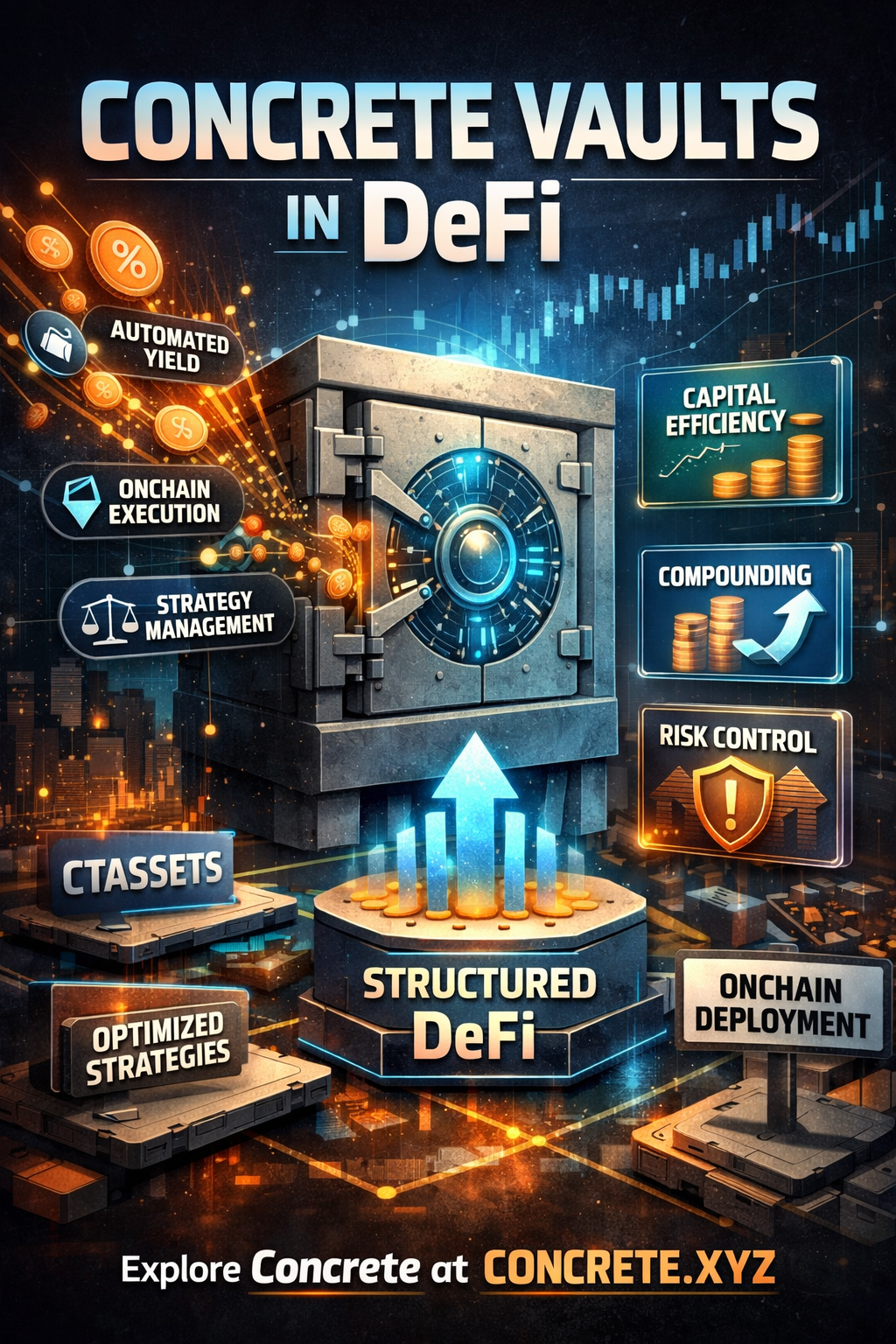
ctAssets are the onchain representation of your vault position. When you deposit into a Concrete Vault, you receive ctAssets — tokens that represent your share of the pooled capital and accrue value as the vault compounds and optimizes over time. They’re composable, meaning they can be used across the broader DeFi ecosystem while your underlying position keeps working.
Automated compounding is built into the vault’s execution layer. Rewards don’t sit unclaimed — they’re harvested and redeployed automatically, keeping your position working continuously without manual intervention.
Onchain execution means the vault’s strategy logic runs transparently and verifiably. Capital deployment decisions are enforced by the system, not dependent on off-chain coordination or manual approvals.
Structured vault systems bring all of this together — pooled capital, automated execution, enforced constraints, and continuous optimization — into a single interface that scales with your position.
Concrete Vaults are designed to coordinate onchain capital efficiently across opportunities — so that the infrastructure does what most users can’t: stay consistent, stay active, and respond when conditions change.
— -
The Bigger Shift in DeFi
DeFi is getting more complex, not simpler.
New protocols, new chains, new yield opportunities, new risk vectors — the landscape expands faster than any individual user can track. The strategy that worked last month may need revisiting today. The protocol with the best yield last week may have shifted conditions by Friday.
Manual capital management doesn’t scale to this environment.
The users clicking between protocols all day, chasing APYs and manually compounding rewards — they’re working against the grain of where DeFi infrastructure is heading.
Vaults are becoming the default interface for deploying capital onchain. Not because they’re simpler (though they are) — but because they’re structurally better at doing what active capital management requires.
> The future of DeFi may not belong to the users managing everything manually. It may belong to the systems built to coordinate capital more efficiently.
Infrastructure is replacing constant repositioning. Structured DeFi is replacing ad-hoc strategy. And the gap between users with access to vault infrastructure and those without it will only widen as the ecosystem grows.
Explore Concrete Vaults and see how structured vault infrastructure can put your onchain capital to work — without the constant manual effort.
Explore Concrete at → https://concrete.xyz/