
SATO: The Ethereum Scarcity Experiment the Market Is Still Learning to Price
 Dante Fabillar8 min read·Just now
--
A clear, non-hype breakdown of $SATO, its burn mechanism, ETH reserve, whale capitulation event, and why the market may be misunderstanding the token.
Ticker: $SATO
Network: Ethereum
Original contract: 0x829f4B62EEBE12Af653b4dD4fFc480966F7d7f09
Official site: sat0.org
Important note: $SATO has no official Twitter, Telegram, Discord, or social-media representative. Anyone claiming to represent $SATO should be treated with caution unless verified through the original contract and official site.
The Market Saw a Dump. The Mechanism Saw a Stress Test.
Most crypto charts tell only one story: price went up, or price went down.
$SATO is different.
When $SATO fell sharply, many people saw only fear. They saw a whale exit. They saw red candles. They saw panic. They saw another early token being tested by volatility.
But underneath the chart, something more important happened.
The mechanism started showing itself.
A large holder sold. Price dropped toward the burn zone. Weak hands followed. The market panicked. Then the curve and burn dynamics became visible in real time.
More than 100,000 $SATO was burned in a single 24-hour period while minting stayed extremely low.
That is not normal meme-coin behavior.
That is not just another random chart move.
That is the moment where traders had to stop looking only at candles and start looking at the structure.
This is why $SATO is worth understanding before judging.
What Is $SATO?
$SATO is an Ethereum-based token built around a scarcity narrative and a curve-based mint/burn mechanism.
It uses a Bitcoin-style psychological frame: a limited-supply asset approaching a 21 million-style asymptote.
But $SATO is not Bitcoin.
It is not trying to be a blockchain.
It is an Ethereum experiment where code, liquidity, reserve, market psychology, and scarcity mechanics interact in public.
The official $SATO messaging is intentionally minimal:
- No official socials
- No Twitter
- No Telegram
- No Discord
- No team-led roadmap hype
- No visible operator-driven marketing machine
That matters because most meme coins are built around a team, a social channel, a Telegram army, or a promise.
$SATO is different because the main story is not a team.
The main story is the mechanism.
The contract is the object.
The market is the battlefield.
The mechanism is the narrative.
The Most Important Thing to Understand
A lot of $SATO confusion comes from one simple misunderstanding.
People assume there is only one price.
There is not.
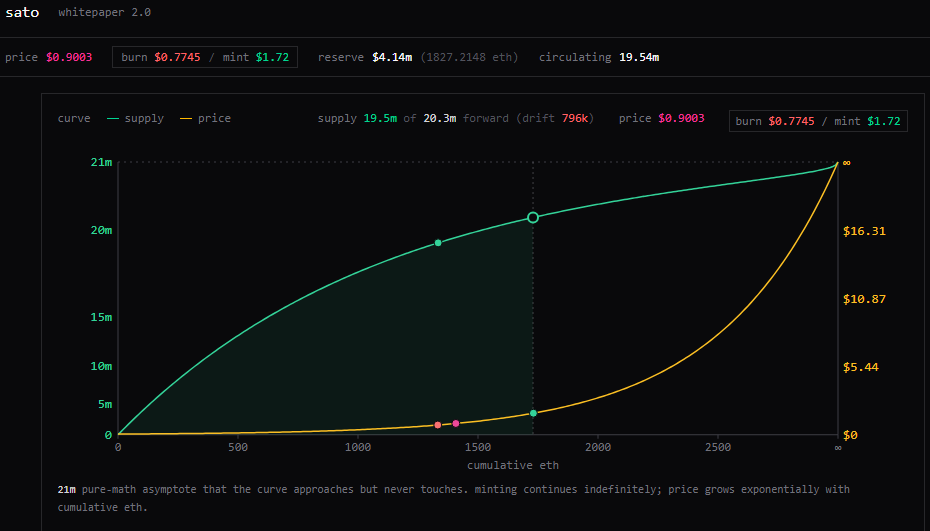
$SATO has multiple price references.
1. Market Price
This is what traders are paying on the open market through DEX or exchange liquidity.
It moves based on supply, demand, panic, whales, bots, liquidity, and sentiment.
2. Mint Price
This is the cost to create new $SATO through the curve.
When mint price is much higher than market price, rational buyers usually prefer buying existing $SATO on the market instead of minting new tokens.
3. Burn Price
This is the quote associated with burning or selling through the curve mechanism.
It is not the same as raw reserve backing, and it is not a guaranteed market floor.
But it matters because it can become a reference zone when price capitulates.
4. ETH Reserve / Backing
The reserve is the ETH value behind the mechanism.
It is not simply divided equally among holders as an exit price.
It supports the curve and burn system, but the actual burn quote is determined by the mechanism.
This is the first major psychological filter for $SATO:
If someone says $SATO is broken because market price, mint price, and burn price are different, they may not understand the mechanism.
They are supposed to be different.
What Happened During the Whale Sell-Off?
A top holder sold a large amount of $SATO at a significant loss.
The sale pushed price downward and triggered panic among smaller holders.
On the chart, this looked bearish.
But the important part is what happened next.
As price moved toward the burn area, a large amount of $SATO was removed from circulation through burn-enabled routing.
In other words, some of the sell pressure did not simply become endless market supply.
It became supply reduction.
That is the part most people miss.
The chart showed fear.
The mechanism showed contraction.
The weak whale exited.
Supply was reduced.
The holder base was tested.
That is why this event matters.
Why a Burn Event Matters
A normal token dump is simple.
Whale sells. Price drops. Retail panics. Supply moves to weaker buyers or sits on exchanges waiting to be sold again.
With $SATO, routed sells through the burn-enabled curve can have a different effect.
When burn activity exceeds mint activity, circulating supply can shrink.
That does not guarantee an instant pump.
It does not make $SATO immune to further downside.
It does not mean every sell automatically burns.
But it does mean one thing:
The mechanism can reduce future sell pressure when tokens are burned.
That changes the psychology.
A normal meme coin dump only damages the chart.
A $SATO dump routed through the mechanism can damage the chart in the short term while reducing supply in the background.
That is why some holders see capitulation differently.
They are not celebrating price pain.
They are watching whether the mechanism survives stress.
The Reserve Is Not a Magic Floor — But It Matters
Some people misunderstand the reserve and think:
“Reserve divided by supply equals the guaranteed exit price.”
That is not correct.
The ETH reserve is not a simple bank account that pays every holder the same amount per token at any time.
The burn or exit quote depends on curve logic, route, size, price impact, and mechanism state.
But the reserve still matters.
It matters because it gives the system a real backing pool instead of pure meme liquidity.
It matters because it supports the burn and buyback side of the mechanism.
It matters because when the market panics, traders can compare market price, burn price, mint price, and reserve behavior.
A reserve does not eliminate risk.
It creates structure.
That structure is part of what separates $SATO from ordinary hype-only meme coins.
Why the Mint Price Matters
When the market price is far below the mint price, buyers have a clear incentive.
Why mint new $SATO at a higher price when existing $SATO is cheaper on the market?
This can create a period where minting slows down dramatically while market buyers absorb existing supply.
That is exactly the type of setup that can become interesting after a sell-off:
- Minting slows
- Burn activity rises
- Supply decreases
- Weak holders exit
- Stronger holders accumulate
- Market price attempts to stabilize
Again, this is not guaranteed bullish.
But it is structurally different from a normal token where selling only creates more panic and nothing else changes.
Why Holder Count Matters
Holder count is one of the simplest ways to measure whether a young token still has belief.
If price falls and holders collapse, confidence is dying.
If price falls, burns happen, and holders remain relatively stable, that looks more like capitulation and redistribution.
For $SATO, the key is not whether holders fluctuate by 20, 50, or 100 wallets in a volatile day.
That is normal.
The key question is:
Does the holder base survive the stress test?
A healthy pattern would look like this:
Price capitulates
Weak hands exit
Large burns occur
Holders stabilize
New holders enter
Price reclaims key psychological levels
That is the pattern $SATO bulls are watching.
The “No Official Socials” Factor
This is one of the strangest and most powerful parts of $SATO.
Most crypto projects rely on official accounts to control the narrative.
$SATO does not.
There is no official X account.
There is no official Telegram.
There is no official Discord.
There is no official community manager telling people what to believe.
That creates risk because scammers and copycats can pretend to represent $SATO.
But it also creates a powerful narrative:
The token is not being driven by a marketing team.
The market itself has to discover, explain, attack, defend, and understand the mechanism.
That is why education matters.
If $SATO spreads, it will spread because holders, traders, analysts, and communities explain what the contract is doing — not because an official team is managing hype.
Copycats Are a Signal — and a Risk
When an idea is weak, nobody copies it.
When an idea is powerful, copycats appear.
$SATO has already inspired imitators, derivative narratives, and competing interpretations.
Some claim to “fix” it.
Some try to copy the smallest-unit narrative.
Some may attempt NFT or claim-based schemes.
This is both bullish and dangerous.
It is bullish because it means the original idea has attention.
It is dangerous because new buyers can get confused, buy the wrong contract, or connect their wallet to fake claim sites.
The original $SATO contract is:
0x829f4B62EEBE12Af653b4dD4fFc480966F7d7f09
If it is not that contract, it is not the original $SATO discussed here.
Why $SATO Is Not Just Another Meme Coin
Most meme coins depend almost entirely on emotion.
$SATO has emotion too.
It has speculation, fear, greed, FUD, whales, bots, panic, and conviction.
But it also has mechanism.
That mechanism includes:
- Curve-based minting
- Burn-enabled exits through the proper route
- ETH reserve dynamics
- Market price vs mint price spread
- Supply contraction during burn-heavy periods
- No visible operator-led social machine
- A scarcity narrative that is easy to understand but difficult to price
That combination is rare.
Not risk-free.
Not guaranteed.
Rare.
The Real $SATO Thesis
The weak version of the thesis is:
“$SATO will pump because burns happen.”
That is too simple.
The stronger thesis is:
$SATO is a live Ethereum scarcity experiment where panic, liquidity, curve pricing, reserve behavior, and holder psychology interact in public. If the market eventually understands the mechanism and demand returns while supply has been reduced, repricing can happen violently.
That is the thesis.
It is not guaranteed.
It is not magic.
It is not a promise.
It is a high-risk, high-conviction mechanism narrative.
What Would Be Bullish From Here?
The strongest confirmations would be:
- Price reclaiming $1.00 and holding
- Price reclaiming $1.15–$1.20
- Holder count stabilizing and growing again
- Burns continuing to exceed mints during stress periods
- Volume returning without holder collapse
- More community education around mint price, burn price, and market price
- Correct contract awareness spreading
- More exchange and data-platform visibility
The market does not need blind hype.
It needs understanding.
What Would Be Bearish?
The risks are real.
$SATO can still fail if:
- Demand disappears
- Holders keep falling aggressively
- Price breaks deeply below the burn zone and cannot recover
- Liquidity dries up
- Copycats confuse the market
- FUD overwhelms understanding
- Wallet drain scams damage community trust
- Major platforms misroute or misprice swaps
- Traders expect a guaranteed floor that does not exist
- This is why $SATO should not be treated as a risk-free asset.
It is experimental.
That is exactly why it is interesting.
Final Thought: The Chart Is Loud, But the Mechanism Is Quieter
Most people will only see the chart.
They will see red candles and call it dead.
They will see a whale sell and call it over.
They will see different mint and burn prices and call it broken.
But the people watching closely are asking different questions.
Did supply shrink?
Did the reserve survive?
Did holders stay?
Did weak whales exit?
Did the market learn the mechanism?
Did the original contract remain the center of the narrative?
That is where $SATO becomes different.
The price can move fast.
The FUD can be loud.
The copycats can multiply.
But the contract remains the contract.
$SATO is not magic.
$SATO is not safe.
$SATO is not guaranteed.
But $SATO is one of the most interesting Ethereum scarcity experiments the market is currently being forced to understand.
And if the market finally understands it, the next move may not look like the last one.
Original $SATO Contract
0x829f4B62EEBE12Af653b4dD4fFc480966F7d7f09
Always verify the contract.
Avoid fake claim links, fake NFT mints, unofficial “support” accounts, and copycat tokens.
