What Makes a DeFi Strategy Actually Sustainable? (The Survival Guide)
--
We’ve all seen the same movie a hundred times in DeFi. A new protocol launches with a 500% APY, capital rushes in like a tidal wave, the yield stays high for exactly four days, and then — silence. The liquidity rotates, the yield compresses to zero, and everyone moves on to the next “opportunity.”
In this environment, the real flex isn’t finding the highest yield for a week. It’s finding the one that actually lasts across market cycles.
The Sustainability Pattern
Most DeFi strategies fail because they are built on a house of cards. They rely on high incentives to attract capital, but as soon as the capital arrives, the rewards get diluted. It’s a loop that almost always ends in a liquidity exit.
For a strategy to be truly “sustainable,” it needs to do three things:
- Generate consistent returns over years, not days.
- Exist independently of token incentives.
- Remain viable when the market isn’t just “up and to the right.”
Real Yield vs. The Emissions Trap
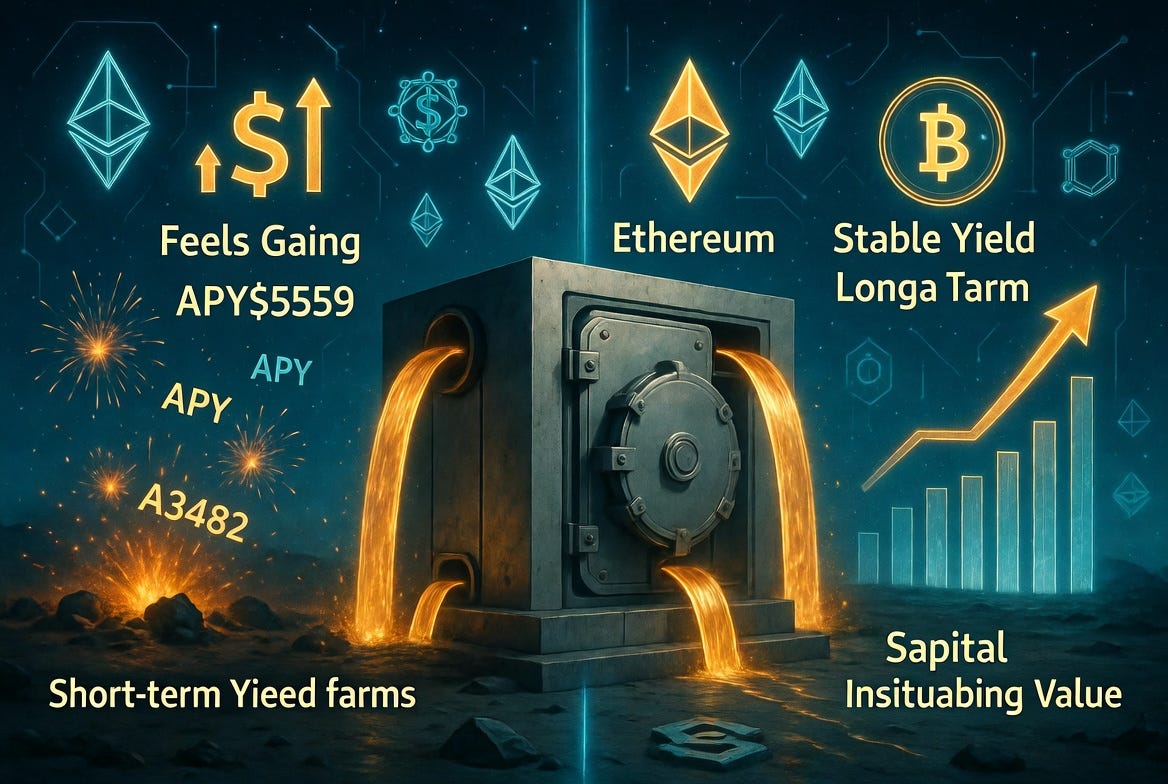
Not all yield is created equal. Most of what we see is “Temporary Yield” — basically just a protocol printing its own token to pay you to stay. When that token price drops, your yield vanishes.
“Real Yield,” on the other hand, comes from actual economic activity: trading fees, lending demand, and arbitrage. This revenue is harder to generate, but it’s far more stable. Sustainable strategies prioritize this real-world demand over the printing press.
The Spreadsheet vs. Reality
A strategy might look incredible on a spreadsheet, but real-world onchain capital has friction. Execution costs, rebalancing, slippage, and shifting correlations between assets can turn a “winning” strategy into a net loss. A sustainable strategy has to be “risk-aware” — it accounts for the fact that market conditions change and that liquidity isn’t always deep.
Engineering Durability with Concrete Vaults
This is where the shift from “yield chasing” to managed DeFi happens. Concrete vaults aren’t trying to win the “highest APY of the week” award. They are built as infrastructure to prioritize sustainable yield sources.
By managing capital across a diversified set of strategies and automating the rebalancing process, Concrete reduces the reliance on short-term incentives. It’s about building a system that adapts when the market gets volatile, rather than one that breaks. This focus on risk-adjusted yield is what separates professional infrastructure from temporary farms.
The 8.5% Reality Check
Look at Concrete DeFi USDT as an example. It offers up to ~8.5% stable yield. In a world of 100% “Degen APYs,” 8.5% might look less exciting — until you realize that 8.5% is consistent. Over time, a stable, reliable return backed by solid infrastructure almost always outperforms a volatile 50% opportunity that disappears after a month. Consistency is what attracts institutional DeFi capital.
The Big Shift
We are moving away from the era of “peak returns” and toward the era of durable systems. The future of DeFi won’t be defined by who can print the most tokens to attract users. It will be defined by the strategies that can survive a bear market, handle a liquidity crunch, and keep capital productive year after year.
Infrastructure will always outlast incentives.
Explore Concrete and start building for the long term at: https://app.concrete.xyz/earn