What Makes a DeFi Strategy Actually Sustainable?
--
DeFi is full of yield.
New strategies launch every week.
APYs spike.
Capital flows in.
For a moment, everything looks extraordinary.
Then something familiar happens.
Yields drop.
Liquidity leaves.
Opportunities disappear.
The cycle repeats again and again across the ecosystem.
Which raises a more important question than most dashboards encourage us to ask:
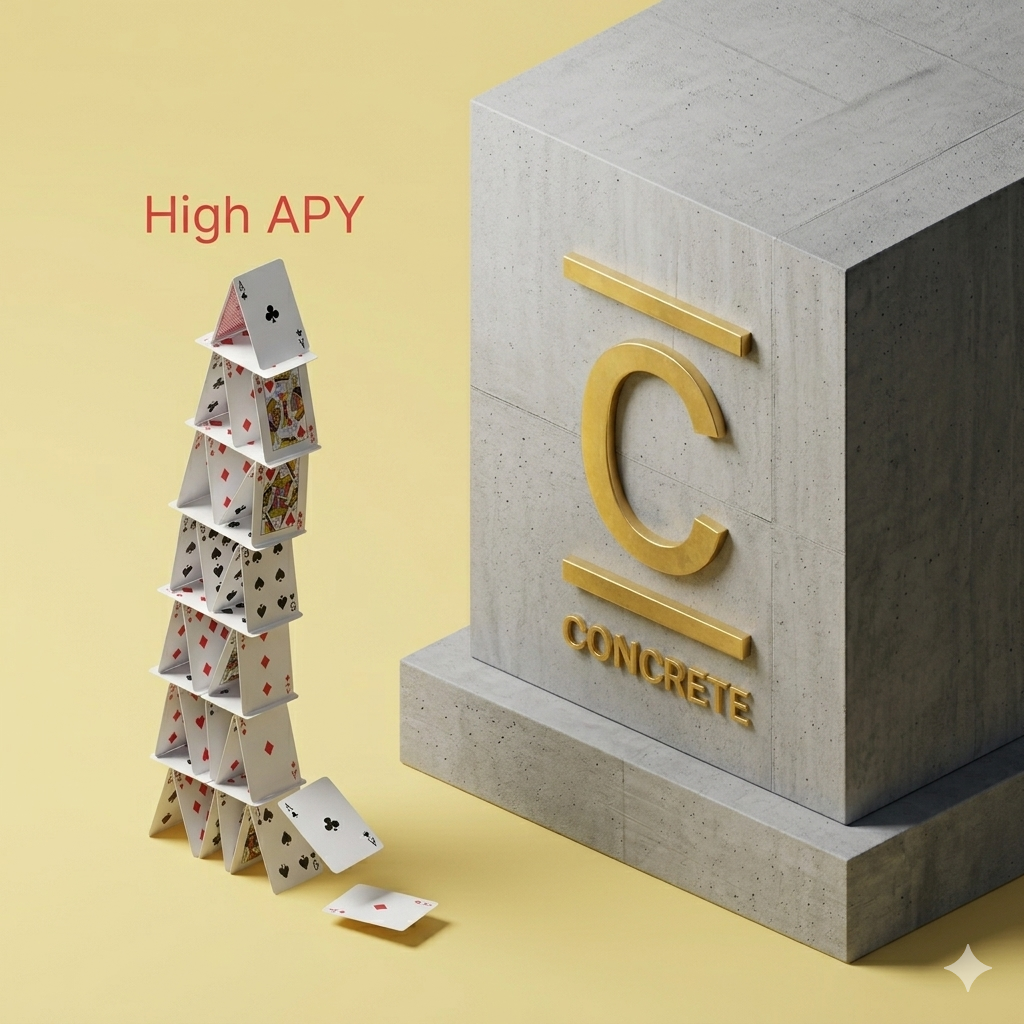
Not “What has the highest yield?”
But rather:
“What actually lasts?”
In mature financial systems, the most valuable strategies are rarely the ones that perform for a week. They’re the ones that survive across market cycles.
Understanding what makes a DeFi strategy sustainable is becoming one of the most important shifts in how on-chain capital is deployed.
Anyone who has spent time in DeFi has witnessed the same pattern.
A new protocol launches and advertises high APYs. Early participants move capital quickly. Liquidity floods the system. For a short period, returns look incredible.
But the moment liquidity increases, something inevitable happens.
Yields compress.
More capital competing for the same opportunity reduces returns. Incentive emissions begin to decline. Traders move on to newer protocols. Liquidity rotates elsewhere.
What looked like a long-term opportunity turns out to be a short-lived spike.
This pattern has repeated across countless DeFi strategies.
The question is why.
Why do most yield opportunities fade so quickly, while a few manage to persist?
A sustainable strategy is not simply one that produces high returns today.
Instead, sustainability is about durability.
A truly sustainable yield strategy should:
- Generate consistent returns over time
- Not to depend entirely on token incentives
- Remain viable across different market environments
- Maintain demand for the underlying activity
In other words, the goal is not just performance — it’s repeatability.
The most effective strategies in finance are those that continue to work even as conditions change.
Sustainable yield is about building exposure to those systems.
One of the clearest ways to evaluate sustainability is to look at where yield comes from.
In DeFi, there are generally two categories.
Real Yield
This comes from genuine economic activity inside the system, such as:
- trading fees
- lending interest
- arbitrage flows
- liquidation mechanisms
These sources exist because users need liquidity, capital, and market efficiency.
As long as those activities continue, yield can persist.
Temporary Yield
Other opportunities rely primarily on incentives, including:
- token emissions
- liquidity mining rewards
- promotional campaigns
These incentives are often designed to attract early liquidity.
But emissions rarely last forever. When they decline, so does the yield.
This is why many strategies appear attractive at launch but quickly lose momentum.
Not all yield is created equal.
Sustainability also depends heavily on market structure.
Certain strategies require specific conditions to remain effective.
For example:
- Thin liquidity may create arbitrage opportunities, but those opportunities shrink as markets mature.
- Some strategies rely on high volatility to generate fees.
- Others depend on constant borrowing demand.
If those conditions disappear, the strategy weakens.
More durable approaches tend to share a few traits:
- deep liquidity pools
- consistent user activity
- adaptability to market shifts
Strategies that depend on a narrow set of conditions often struggle to survive across market cycles.
Another reason many strategies fail to sustain returns is that headline yields rarely include the full cost structure.
Behind every DeFi position are multiple layers of friction:
- transaction fees
- rebalancing costs
- slippage
- changing asset correlations
- volatility exposure
A strategy that appears highly profitable in theory may prove less profitable once these factors are taken into account.
This is why experienced capital allocators increasingly focus on risk-adjusted yield, rather than simply the highest APY.
Net outcomes matter more than surface numbers.
As the ecosystem matures, the way strategies are designed is evolving.
Instead of treating yield as isolated opportunities, many participants are beginning to view DeFi as a system of capital allocation.
Sustainable strategies often include:
- diversification across multiple yield sources
- continuous monitoring of market conditions
- active adjustments as liquidity shifts
- prioritizing net returns over headline APY
This approach begins to resemble traditional portfolio construction — but executed entirely on-chain.
In this sense, the next phase of DeFi may be less about chasing opportunities and more about engineering systems for durable yield.
Managing these dynamics manually can be difficult.
Markets change quickly, liquidity moves rapidly, and strategies require constant adjustment.
This is where DeFi vaults are becoming increasingly important.
Vault infrastructure allows capital to be managed programmatically through structured strategies.
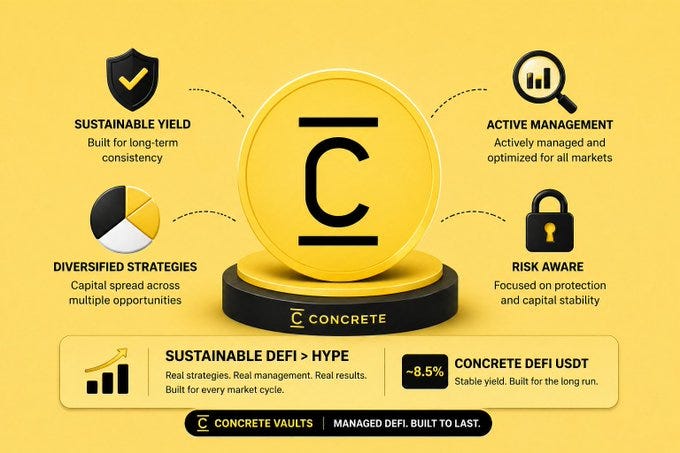
Concrete vaults are designed around this idea.
Rather than focusing only on the highest available yield, they aim to:
- Prioritize sustainable yield sources
- allocate capital across multiple strategies
- adapt to changing market conditions
- reduce dependence on short-term emissions
This approach reflects a broader shift toward managed DeFi, where strategy design and execution become core components of capital deployment.
One way to understand sustainability is to compare two different types of yield.
On one side, there are highly volatile opportunities that promise extremely high APYs but change rapidly.
On the other side are strategies focused on consistency.
Concrete DeFi USDT is an example of the latter.
It offers up to ~8.5% stable yield, designed around durable DeFi strategies rather than temporary incentives.
At first glance, this type of yield may appear less exciting than triple-digit APYs.
But over time, stability often outperforms volatility.
Consistent returns attract long-term on-chain capital, including participants who prioritize reliability and risk-adjusted performance.
Sustainable yield often looks quieter — but it compounds far more effectively across cycles.
Explore Concrete at app.concrete.xyz
The ecosystem is gradually evolving.
Early DeFi was driven by yield chasing. Capital moved quickly between protocols in search of the highest returns.
But as the industry matures, the focus is shifting.
From:
short-term opportunities
To:
long-term capital strategies
In this new phase, sustainability matters more than peak yield.
Durable systems matter more than temporary incentives.
And infrastructure designed for managing capital will outlast the short-lived opportunities that dominate headlines.
The future of DeFi won’t be defined by the highest APY.
It will be defined by the strategies that continue to work when the excitement fades.