What Makes a DeFi Strategy Actually Sustainable ?
--
DeFi is full of yield. New strategies launch every week. APYs spike. Capital flows in. But most of these strategies don’t last. Yields drop. Liquidity leaves. Opportunities disappear.
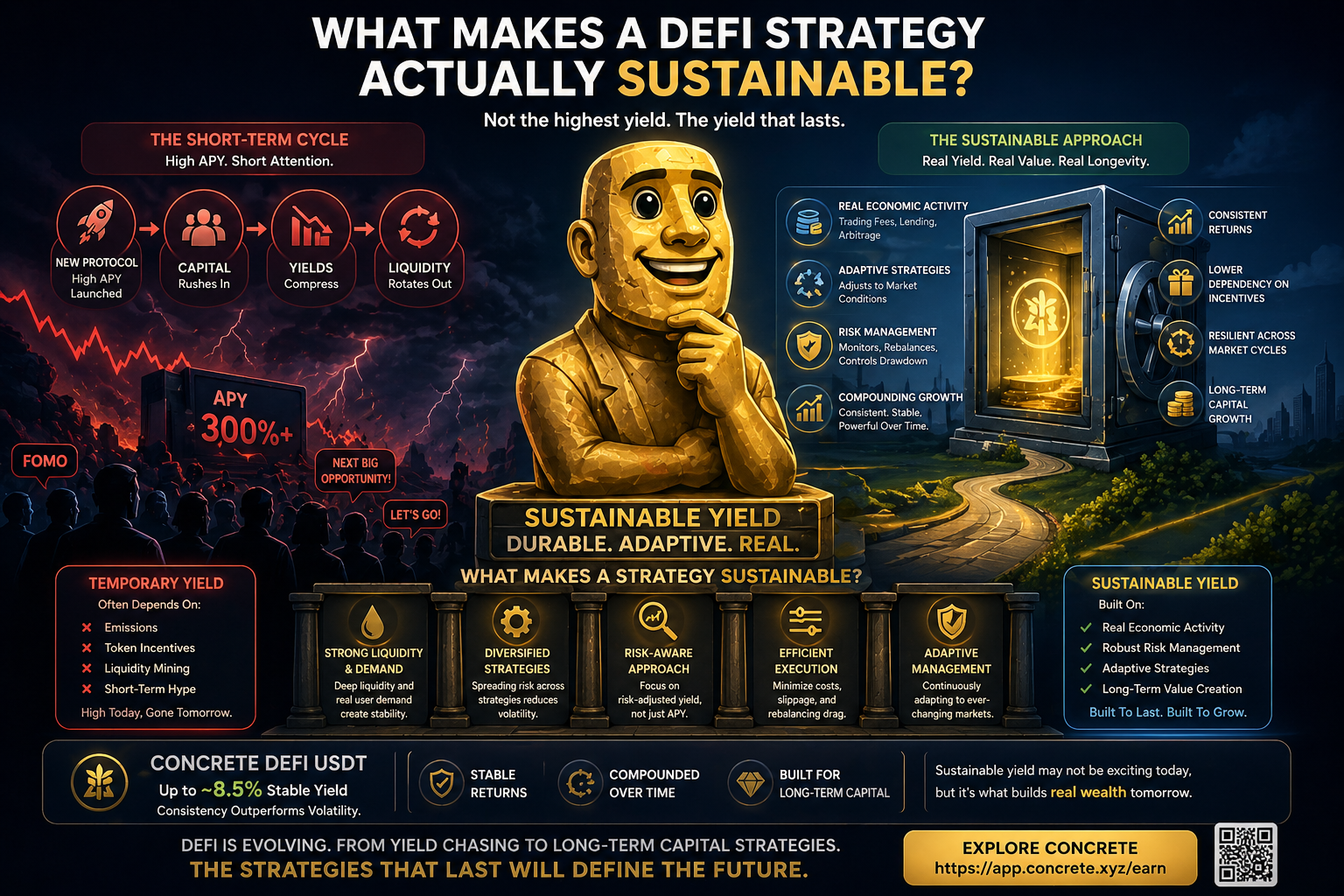
We’ve all seen the cycle: a shiny new protocol drops eye-watering APYs to bootstrap liquidity. Onchain capital rushes in, chasing the headline numbers. Then incentives taper, competition increases, or market conditions shift and the yield compresses hard. Liquidity rotates to the next hot thing, leaving behind impermanent loss, decaying returns, or idle capital. This pattern repeats across DeFi seasons, from liquidity mining booms to points programs and beyond.
The real question isn’t “What has the highest yield?” It’s What actually lasts?
What Sustainable Means in DeFi
A sustainable yield strategy generates consistent returns over time without depending entirely on temporary incentives. It remains viable across different market conditions bull runs, bear markets, and sideways chop. This is about durability, not just peak performance.
Sustainable strategies prioritize risk-adjusted yield: returns that account for volatility, costs, and the probability of drawdowns. They focus on net performance after all frictions, rather than gross headline APY. In mature financial systems, the best DeFi strategies survive cycles because they’re grounded in real economic value, not hype.
Real Yield vs. Temporary Yield
Not all yield is created equal.
- Real yield comes from genuine economic activity: trading fees, lending interest, arbitrage spreads, or other protocol revenue generated by actual user demand.
- Temporary yield (or incentive-driven yield) relies on token emissions, points programs, or subsidized liquidity mining. These can deliver explosive short term APYs, but they often fade quickly once the emissions schedule ends or the token price corrects.
Emissions-driven yield frequently declines because it doesn’t reflect underlying usage, it’s essentially paying users with newly created supply. When the incentives stop or dilution hits, capital flees. Real economic activity is more stable: as long as traders need liquidity, borrowers need capital, or arbitrageurs exploit inefficiencies, the revenue base persists. Sustainable strategies lean heavily on the latter while treating incentives as optional upside.
The Role of Liquidity, Market Conditions, and Adaptation
Sustainability also hinges on liquidity depth, ongoing user activity, and resilience to volatility. Some strategies only thrive in low volatility environments or when specific correlations hold. Others break during stress slippage spikes, correlations flip to one, or liquidity dries up.
Strategies that adapt by dynamically allocating across opportunities, managing exposure, or hedging risks tend to persist. Those locked into rigid mechanics or single-protocol dependence disappear when conditions change.
Risk & Cost Awareness: The Hidden Drags
Many strategies look phenomenal on a dashboard but degrade in practice. Execution costs, rebalancing fees, slippage on entries/exits, gas, and shifting correlations can erode a large chunk of gross yield. A 50% APY that requires constant manual intervention and eats 20–30% in costs becomes far less attractive on a risk-adjusted basis.
Sustainable approaches model these frictions upfront. They emphasize net returns and build in buffers for changing market dynamics.
Building Better DeFi Strategies
This is where DeFi starts to mature from opportunistic plays into more systematic infrastructure. Effective long-term design includes:
- Diversification across multiple yield sources and protocols
- Continuous monitoring and automated rebalancing
- Focus on net, risk-adjusted yield rather than raw APY
- Mechanisms to adapt as correlations or opportunities evolve
Managed DeFi solutions, particularly DeFi vaults, handle much of this complexity on behalf of users. Instead of manually chasing farms and worrying about impermanent loss or depegs, capital deploys into structured products that enforce risk parameters and optimize allocations programmatically.
How Concrete Vaults Prioritize Durability
Concrete vaults are built with this philosophy in mind. They aim to prioritize sustainable yield sources, manage capital across strategies, adapt to changing conditions, and reduce heavy reliance on short-term incentives. Rather than maximizing peak yield at all costs, they focus on consistent, risk-aware performance that can compound reliably for onchain capital including institutional grade flows.
By automating strategy execution, rebalancing, and risk controls within transparent, audited infrastructure, Concrete vaults help turn DeFi strategies into something closer to professional portfolio management.
Concrete DeFi USDT in Practice
A clear example is the Concrete DeFi USDT vault on Ethereum. It targets around ~8.5% stable yield through delta-neutral arbitrage and other low-volatility mechanisms, with recent realized yields in the 7–8% range over 7 and 30-day periods. With over $60M in TVL, it demonstrates how consistency attracts long-term capital.
While 8.5% might not sound as thrilling as a 100% + incentive farm, sustainable yield like this often outperforms volatile opportunities over time especially after factoring in costs, drawdowns, and the mental overhead of constant rotation. In a space where many high-APY plays evaporate, steady risk-adjusted yield on a stable asset like USDT compounds powerfully and draws institutional DeFi interest.
Explore Concrete at: https://app.concrete.xyz/earn
The Bigger Shift Ahead
DeFi is evolving. We’re moving away from pure short-term yield chasing toward more disciplined, long-term capital strategies. As the space matures, sustainability will matter more than fleeting peak returns. Infrastructure that delivers durable performance through real activity, smart risk management, and automation will outlast incentive cycles.
The future of DeFi won’t be defined by the highest APY. It will be defined by the DeFi strategies and DeFi vaults that last.
What do you think makes a strategy truly sustainable? Share your experiences with durable yield sources versus the ones that faded.