What Makes a DeFi Strategy Actually Sustainable?
 Tpaco4 min read·Just now
--
DeFi is full of opportunities.
At any moment, there’s a new strategy offering attractive yield. APYs spike, attention follows, and capital moves quickly to capture the upside.
For a while, it works.
Then things change.
Returns drop. Liquidity shifts. The opportunity fades.
It’s a cycle that keeps repeating — across protocols, across chains, across time.
So instead of asking:
“What’s paying the most right now?”
A better question is:
“What keeps working when everything else changes?”
The Pattern Behind Short-Term Yield
Most DeFi strategies follow a familiar path.
A new opportunity launches with high returns. Early participants benefit. More capital flows in.
As participation increases:
- yields compress
- incentives get diluted
- returns normalize
- liquidity rotates to the next opportunity
What looked like a strong strategy turns out to be temporary.
This isn’t a flaw — it’s how incentive-driven systems behave.
But it also highlights something important:
Not all yield is meant to last.
What Sustainability Actually Looks Like
A sustainable strategy isn’t defined by its peak performance.
It’s defined by its ability to keep delivering over time.
In simple terms, sustainable yield means:
- returns that remain consistent across different periods
- minimal reliance on short-term incentives
- the ability to function under changing market conditions
It’s about durability.
Because in the long run, consistency tends to outperform volatility.
The Difference Between Real and Temporary Yield
At the core of sustainability is the source of the yield.
Some strategies are built on real economic activity:
- trading fees generated by users
- lending demand in capital markets
- arbitrage opportunities across price differences
These tend to be more stable because they’re tied to actual usage.
Other strategies rely on temporary drivers:
- token emissions
- liquidity mining programs
- short-term incentives designed to attract capital
These can create high APYs, but they often decline as incentives decrease.
That’s why risk-adjusted yield is more meaningful than headline returns.
It reflects not just how much you earn — but how dependable that earning is.
The Importance of Market Conditions
No strategy exists in isolation.
Performance depends on the environment.
Some strategies thrive only under specific conditions:
- high volatility
- deep liquidity
- strong user activity
When those conditions change, performance can drop quickly.
More sustainable strategies are flexible.
They can adapt across different market regimes — adjusting to changes rather than relying on a single favorable scenario.
That adaptability is what allows them to persist.
Costs That Shape Long-Term Performance
Another key factor is cost.
Many strategies look attractive at first glance, but their real performance is influenced by:
- execution costs
- rebalancing frequency
- slippage
- changing correlations between assets
These factors aren’t always visible in APY.
But over time, they reduce returns.
A strategy that ignores cost may look strong initially — but struggle to maintain performance in the long run.
From Isolated Trades to Structured Systems
Sustainable strategies are rarely built on a single opportunity.
They’re structured systems.
Instead of relying on one source of yield, they often involve:
- diversification across multiple strategies
- continuous monitoring and adjustment
- adapting to evolving market conditions
- focusing on net returns rather than headline yield
At this point, DeFi becomes less about chasing opportunities and more about managing onchain capital effectively.
Where Concrete Vaults Fit In
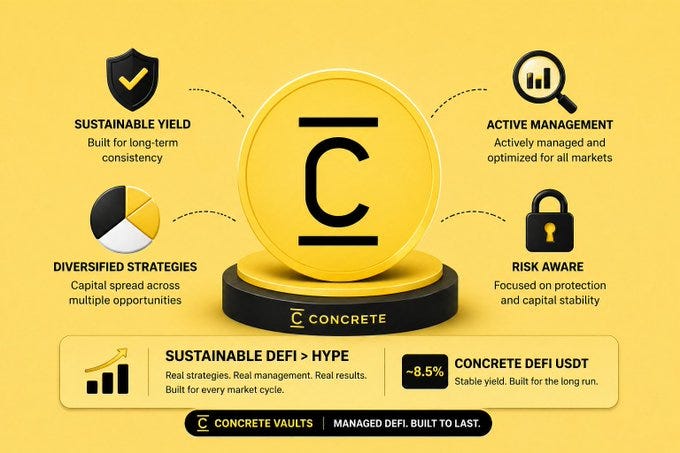
This is where Concrete vaults come into play.
Rather than optimizing for short-term yield, they are designed with sustainability in mind.
Through a managed DeFi approach, Concrete vaults aim to:
- allocate capital across multiple strategies
- focus on more durable yield sources
- adapt to changing market conditions
- reduce reliance on temporary incentives
Instead of constant manual repositioning, users interact with structured DeFi vaults that manage capital over time.
The focus shifts toward consistency and risk-adjusted yield.
A Practical Example: Concrete DeFi USDT
Consider Concrete DeFi USDT, which offers up to around 8.5% stable yield.
Compared to higher APY strategies, it may seem less aggressive.
But over time, stability often matters more than peaks.
A consistent return that performs across different market conditions can outperform volatile opportunities that rely on short-term incentives.
This is especially important as DeFi evolves toward institutional DeFi, where reliability becomes a key factor in capital allocation.
The Bigger Shift
DeFi is entering a new phase.
The early stage was driven by experimentation and high-yield discovery.
The next stage is about sustainability.
- from chasing short-term yield
- to building long-term strategies
- from incentives
- to durable systems
In this environment, the most valuable strategies won’t be the ones that generate the highest returns for a brief moment.
They’ll be the ones that continue to deliver — across cycles, across conditions, and over time.
Because in the end, what defines a great strategy isn’t how high it goes.
It’s how long it lasts.
Explore Concrete at: https://app.concrete.xyz/earn