DeFi’s Real Innovation Was Never Removing Trust — It Was Making Trust Visible
--
DeFi’s Real Innovation Was Never Removing Trust — It Was Making Trust Visible
When people first discovered DeFi, the appeal felt almost philosophical.
A financial system where rules lived on-chain.
Where transactions were transparent.
Where users didn’t need permission from centralized institutions to participate.
For many, it felt like the opposite of traditional finance.
And naturally, one phrase became attached to the movement more than any other:
“Trustless.”
At first, that word sounded revolutionary.
But years later, after hacks, governance failures, bridge exploits, and liquidity crises, the industry is starting to understand something important:
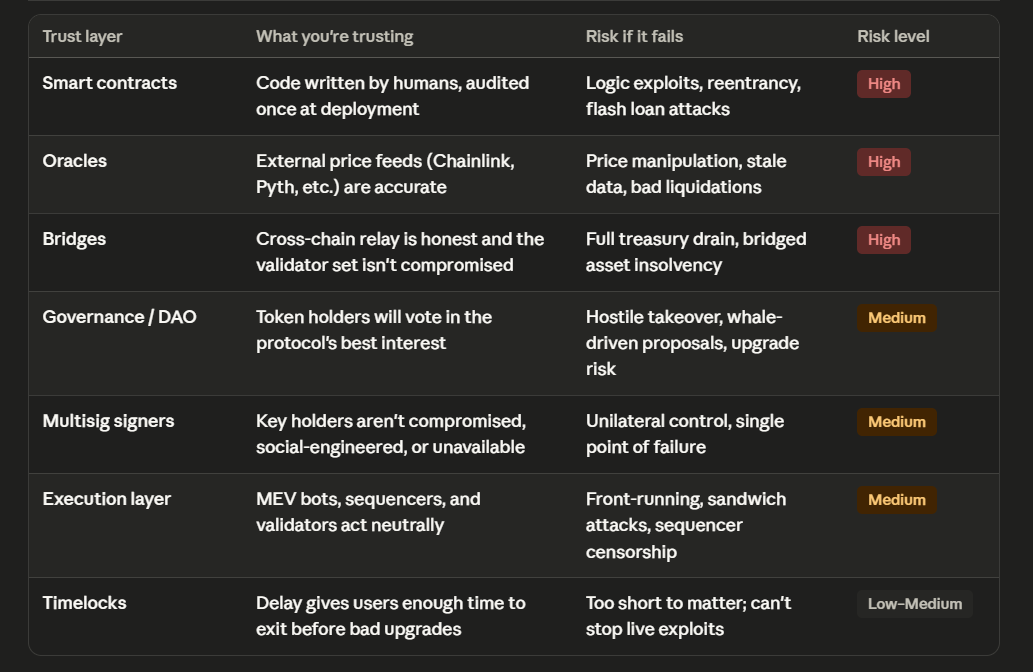
DeFi never removed trust.
What it really did was expose where trust exists.
And that may actually be the bigger innovation.
Traditional Finance Hid Trust Behind Institutions
In traditional systems, trust is abstract.
Most people never think about the operational layers underneath their bank account.
They trust:
- Banks to remain solvent
- Payment systems to process correctly
- Regulators to enforce rules
- Institutions to manage risk responsibly
That trust exists largely behind closed doors.
DeFi changed that dynamic.
For the first time, users could inspect the infrastructure directly.
Smart contracts were public.
Treasuries were visible.
Governance proposals were transparent.
And compared to opaque financial systems, that felt radically different.
But transparency doesn’t eliminate trust.
It simply changes how trust is distributed.
Every DeFi System Still Relies on Human Assumptions
One of the biggest misunderstandings in crypto is the idea that code alone removes human dependency.
In reality, every DeFi protocol still depends on trust assumptions somewhere in the stack.
Users trust:
- Developers to write secure code
- Auditors to identify vulnerabilities
- Oracle systems to provide accurate data
- Governance participants to act responsibly
- Infrastructure operators to maintain uptime
- Security teams to respond during emergencies
The difference is that these trust layers are more visible than they are in traditional finance.
And visibility creates accountability.
Why the “Trustless” Narrative Became Dangerous
The word trustless helped simplify a complicated idea.
But over time, it also created unrealistic expectations.
Because when users believe a system has removed trust completely, they stop asking critical questions.
Questions like:
- Who controls emergency permissions?
- Can the protocol be upgraded?
- How decentralized is governance participation actually?
- What happens during a crisis?
These questions matter because many systems that appear decentralized still depend heavily on operational coordination behind the scenes.
And ignoring those realities doesn’t remove risk.
It hides it.
Decentralization Theatre vs Real Resilience
One of the more important shifts happening in DeFi right now is the distinction between appearance and durability.
Some systems optimize heavily for decentralization optics:
- Large DAOs with minimal active participation
- Timelocks presented as safety guarantees
- Multisigs hidden beneath governance layers
- Protocols unable to react quickly during stress events
This creates decentralization theatre.
Infrastructure that looks decentralized — but may not actually behave resiliently under pressure.
And eventually, markets test every system during periods of volatility.
That’s when operational quality matters far more than branding.
Engineered Trust Is a More Honest Model
The strongest DeFi systems are starting to move away from simplistic “trustless” narratives.
Instead, they’re embracing a more practical reality:
Trust should be explicit, structured, and enforceable.
This is what engineered trust means.
It means:
- Clear operational roles
- Defined permissions
- Transparent constraints
- Layered security systems
- Infrastructure capable of responding under stress
In mature financial systems, this is normal.
Resilience comes from acknowledging operational complexity — not pretending it doesn’t exist.
Why Operational Security Is Becoming Critical
One lesson DeFi continues to learn is that code alone cannot anticipate every scenario.
Attack surfaces evolve constantly.
Market conditions change rapidly.
Unexpected edge cases emerge all the time.
That’s why operational security matters.
Real systems require:
- Continuous monitoring
- Rapid response mechanisms
- Human oversight during abnormal conditions
- Coordination between automated and operational layers
Because resilience is not just about prevention.
It’s about response.
How Concrete Approaches DeFi Infrastructure
Concrete approaches infrastructure from a more operational perspective.
Rather than treating trust as something to hide, Concrete structures it intentionally.
That includes:
- Role-based operational architecture
- Controlled execution environments
- On-chain enforcement mechanisms
- Off-chain monitoring and intelligence systems
- Infrastructure designed for adaptability under stress
This matters because institutional DeFi depends on reliability.
And reliability comes from systems designed to operate effectively during difficult conditions — not just ideal ones.
Concrete prioritizes operational security over decentralization theatre.
The Industry Is Entering a More Mature Phase
The conversation around DeFi is changing.
Less focus on ideological slogans.
More focus on infrastructure quality.
The important questions today are operational:
- How resilient is the system?
- What are the trust assumptions?
- Who can intervene during emergencies?
- How are risks monitored and enforced?
This shift signals maturity.
Because long-term financial infrastructure is judged by how it behaves under stress — not by how simple its marketing sounds.
Final Thought
DeFi’s greatest innovation may not have been removing trust from finance.
It may have been making trust visible for the first time.
Visible systems create accountability.
Accountability creates resilience.
And resilience is what real financial infrastructure requires.
The future of DeFi won’t belong to protocols pretending trust no longer exists.
It will belong to the systems that engineer trust openly, intelligently, and responsibly.
Explore Concrete at https://concrete.xyz/