The Sudden Death of a Merchant Account: Why Automated Underwriting is Failing High-Risk Businesses in 2026
 Chloe Johnson5 min read·Just now
--
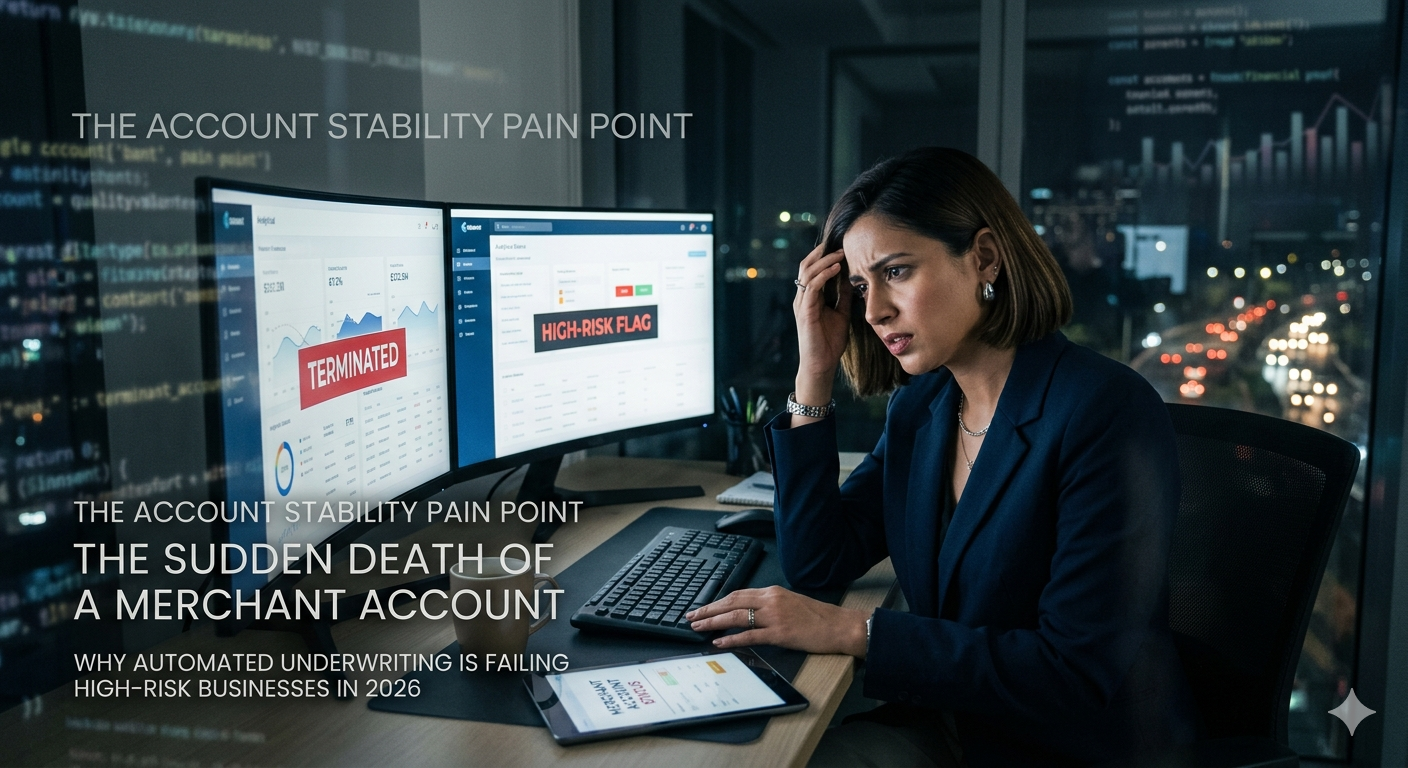
Imagine waking up to find your thriving e-commerce business, travel platform, or SaaS startup completely frozen. Your payment gateway is disabled, your customers are seeing error screens at checkout, and your hard-earned capital is locked in a “risk reserve” for the next 180 days.
You haven’t committed fraud. You haven’t violated your terms of service. What you have done is fall victim to the silent killer of modern commerce: automated underwriting.
In 2026, the rapid shift toward fully automated, AI-driven merchant risk assessment has created an existential crisis for high-risk businesses. While automated algorithms promise split-second approvals during onboarding, they are increasingly prone to “false positives” and sudden account terminations.
Here is why automated underwriting is fundamentally failing high-risk merchants today, and what you can do to protect your business.
1. The Illusion of “Instant Approval”
The financial technology sector loves to pitch friction-free merchant onboarding. With modern machine learning models, a new business can theoretically be approved to accept credit cards in under five minutes.
However, this “instant approval” is largely a marketing illusion.
What actually happens is a process called post-approval underwriting. The automated system conducts a superficial check at signup to get you through the door. The real, rigorous underwriting only begins once you start processing actual transactions.
The moment a high-risk merchant experiences a minor spike in sales, sells a high-ticket item, or receives their first chargeback, the automated system panics. Because the algorithm lacks the contextual understanding of a human underwriter, it defaults to the safest option for the processor: immediate account suspension.
2. The Homogeneity Bias: Why Algorithms Fear the “Different”
Automated underwriting systems are trained on historical datasets dominated by low-risk, highly standardized business models (like traditional retail or standard SaaS). These algorithms are designed to look for patterns of uniformity.
High-risk businesses, by their very nature, are heterogeneous and unique. They often feature:
- Asymmetric billing cycles (such as annual software subscriptions or travel bookings months in advance).
- Fluctuating transaction volumes due to seasonal demand or product launches.
- Irregular ticket sizes that do not fit a neat bell curve.
While machine models perform exceptionally well on low-risk, highly standardized profiles, they struggle with “gray-area” or complex, high-risk cases where human judgment and contextual evaluation are critical. Lacking the capacity to analyze these unique business structures, the automated “robot” underwriter simply flags the account as an anomaly and pulls the plug.
3. The “Black Box” Problem and the Lack of Recourse
One of the most frustrating aspects of modern payment processing is the lack of transparency. When an AI-driven underwriting system shuts down a merchant account, it rarely provides a detailed explanation.
This is known as the “Black Box” problem.
[Merchant Transaction] ➔ [AI Underwriting Engine] ➔ [Result: High Risk Flag]
│
└───> Merchant Account Terminated
(Reason: “Violation of Risk Policy”)
Because the machine learning models utilize thousands of complex, non-linear variables to calculate risk, even the customer support agents of the payment processor often cannot explain why your account was closed. There is no human loop to argue your case, no avenue to submit explanatory documentation, and no path to rehabilitation.
Without explainable AI architectures in place, merchants are left completely in the dark, forced to deal with automated, non-negotiable decisions.
4. Chargeback Volatility vs. Algorithmic Rigidity
For high-risk merchants — such as those in nutraceuticals, gaming, subscriptions, or digital goods — chargebacks are an inevitable cost of doing business.
A human underwriter understands that a 1.2% chargeback rate during a massive holiday scaling phase is normal and manageable. They will look at the merchant’s chargeback mitigation efforts, customer service response times, and overall business health before making a decision.
An automated underwriting system, however, operates on rigid, binary thresholds. If the algorithm is programmed to flag any account exceeding a strict 1.0% threshold, it will trigger an automated freeze the second that limit is breached. It does not care that you have a stellar 5-year processing history; it only sees a metric that violated its hard-coded rules.
How High-Risk Merchants Can Fight Back in 2026
You cannot completely stop processors from using automation, but you can build a defensive moat around your business to survive it.
Build a Multi-Acquiring Architecture (Payment Redundancy)
The single biggest mistake a high-risk merchant can make is relying on a single payment processor. If that sole provider shut you down today, your revenue drops to zero instantly.
- What to do: Implement a payment orchestration platform that routes transactions across multiple merchant accounts (merchant account redundancy). If one account is flagged or frozen, your traffic automatically routes to your backup processors without any downtime.
Seek Out Boutique, Human-Centric Acquirers
While tech giants offer sleek dashboards, they rely almost exclusively on automated, hands-off risk management.
- What to do: Partner with specialized, high-risk merchant account providers who utilize human-in-the-loop (HITL) underwriting. These providers employ experienced human underwriters who take the time to understand your business model, review your financial statements, and establish realistic processing parameters from day one.
Proactively Manage Your Processing Data
Algorithms feed on data. If you feed them erratic data, they will spit out erratic decisions.
- What to do: Keep your processing profile clean. Use pre-chargeback alert systems (like Verifi or Ethoca) to resolve disputes before they turn into official chargebacks. Keep your processing volumes steady, and notify your processor’s risk department before you run a massive marketing campaign or launch a high-ticket product.
The Path Forward: Bringing Humans Back to Finance
Automation and artificial intelligence have revolutionized the speed of global commerce, but speed should never come at the expense of stability. The sudden, unprompted termination of legitimate merchant accounts is a systemic failure of fully automated underwriting.
As we move deeper into 2026, the payments industry must realize that while AI is excellent for processing vast amounts of data, it cannot replace the nuanced, qualitative understanding of a human underwriter. Until that balance is restored, high-risk merchants must remain vigilant, diversified, and prepared.
#MerchantAccounts #HighRiskBusiness #PaymentProcessing #Fintech2026 #AutomatedUnderwriting #SaaS #Ecommerce #BusinessStability