Executive Summary Snapshot
For years, Western governments treated critical minerals as a supply question. Find more mines, approve more projects, diversify a few routes, and the problem would ease. That frame is no longer enough. The current shift is larger and more consequential. In April 2026, Washington began openly arguing for a national security premium for non Chinese critical minerals, the European Commission launched a demand aggregation mechanism for strategic raw materials including defence inputs, and Australia and the United States confirmed more than A$5 billion in backing for Australian projects under their bilateral framework. These are not isolated policy moves. They are early signs that strategic minerals are being pulled out of pure lowest cost logic and into security pricing, coordinated demand, and state backed market design.[1][2][3]
The sharper point is this. Critical minerals are not only a mining problem. They are a processing problem first, a demand problem second, and a pricing problem close behind. The International Energy Agency reported this month that the average market share of the top three refining nations for key energy minerals rose from around 82 percent in 2020 to 86 percent in 2024, with almost all recent supply growth coming from the top single supplier, Indonesia for nickel and China for cobalt, graphite, and rare earths. At the same time, CSIS argued that non Chinese projects will remain underfunded unless governments solve the buyer problem as well, noting that in 2024 the United States accounted for only 4.5 percent of global nickel consumption, 3.6 percent of cobalt, 1.7 percent of rare earths, and 3 percent of gallium. That is not a market ready to finance a rival supply chain on its own.[4][5]
Assessment Window
This assessment covers 2026 to 2030. That is the period in which the emerging policy shift will start to show whether it is serious or cosmetic. It is also the right period for judging whether Australia moves beyond its familiar role as a trusted upstream supplier and into processing, financing, and offtake arrangements that shape the architecture of allied supply chains. For structural comparison, the latest full cross mineral concentration series comes from the IEA’s 2025 outlook using 2024 actuals, while the USGS says its 2026 Mineral Commodity Summaries are the earliest comprehensive source of 2025 world production data by commodity. That makes 2026 the right moment to judge both the live policy turn and the baseline it is trying to change.[4][6]
Cause
The cause is a long running mismatch between how the West described the problem and how China actually built advantage. Western policy language usually started at the mine. China built influence across the chain. The IEA now says refining concentration has moved in the wrong direction, not the right one, and projects only marginal improvement by 2035. China remains the dominant refined supplier for almost all key minerals and, on the IEA’s base case, is set to supply over 60 percent of refined lithium and cobalt and around 80 percent of battery grade graphite and rare earth elements in 2035. That is not just industrial scale. It is market power built into the processing layer that sits between ore and finished capability.[4]
Demand growth has only made the exposure more visible. The IEA reported that lithium demand rose by nearly 30 percent in 2024, while nickel, cobalt, graphite, and rare earth demand each grew by 6 to 8 percent. For battery metals, the energy sector accounted for 85 percent of total demand growth over the same period. In other words, strategic dependence is deepening into markets that sit at the centre of batteries, magnets, semiconductors, and wider industrial electrification. What used to look like a narrow clean energy supply chain issue now sits directly alongside defence, economic security, and advanced manufacturing.[4][2]
Australia enters this period from a position of geological strength, but industrial ambiguity. Geoscience Australia says Australia was the top global producer of lithium in 2024 and the third largest producer of rare earths, while also sitting in the top five global suppliers for 14 mineral commodities. The Department of Industry’s Critical Minerals Strategy is explicit that Australia’s goal is not merely to export more ore. It says Canberra wants Australia to become a globally significant producer of raw and processed critical minerals, build sovereign processing capability, and extract more value onshore. That ambition is right. The gap is that geology alone does not deliver processing depth, buyer certainty, or strategic pricing power.[7][8]
Constraint
The first constraint is processing. New mines outside China do not automatically reduce vulnerability if ore and intermediate products still move back into a concentrated refining system. The IEA’s concentration figures make that point starkly. Even after years of diversification rhetoric, the average share of the top three refining countries rose to 86 percent in 2024. The Western response to this has started to change tone, but the industrial base required to narrow that concentration will take time, capital, energy, infrastructure, skilled labour, and customer commitments. Australia’s own strategy acknowledges as much, noting that downstream processing is capital intensive, technically complex, and often difficult for junior miners to finance.[4][8]
The second constraint is demand. This is the angle most commentary still misses. CSIS argued earlier this month that investors will not finance expensive new mines and processing plants unless they can see credible long term buyers. That is why the demand numbers are so important. The United States is a relatively small direct consumer in several of the minerals it wants to secure, including nickel, cobalt, rare earths, and gallium. Small buyer scale means weak market pull. Weak market pull means projects outside China face a higher financing hurdle, especially when Chinese producers can keep prices low for extended periods. This is precisely why Europe has now launched a mechanism to pool buyers and why Washington is testing the language of a security premium. Both are attempts to build demand power where market depth is absent.[5][1][2]
The third constraint is price. Low cost supply looked efficient while strategic conditions were permissive. It looks different when resilience, defence production, and geopolitical coercion sit in the frame. Reuters reported today that U.S. Trade Representative Jamieson Greer wants allies to accept higher prices for non Chinese critical minerals and is working on a draft proposal for price mechanisms to support diversified supply. That is a remarkable admission. It amounts to saying that secure supply cannot be rebuilt on the old price terms. The free market answer, left to itself, produced concentration. The emerging answer is public finance, pooled demand, strategic premium pricing, and state intervention.[1]
The fourth constraint is producer state leverage. The Democratic Republic of the Congo shows why the market is moving away from pure price competition from both directions. Reuters reported on April 16 that Congo, which accounts for around 70 percent of global cobalt output, created a strategic reserve for cobalt and other critical minerals after earlier using export controls and quota tools to respond to oversupply and weak prices. In the first quarter of 2026, Congo exported 48,800 metric tons of cobalt, far below the 123,000 tons shipped in the same period a year earlier before the temporary export freeze. This is not consumer side coordination alone. Producer states are also becoming more willing to manage supply in strategic terms.[9]
There is a fifth constraint that should not be ignored. Even the United States, despite years of industrial policy activity, remains heavily exposed. The USGS said in February that the United States remained reliant on imports from China as a major source for 14 of the 33 critical minerals for which it most depends on imports. That tells its own tale. New financing facilities and policy declarations have not yet produced strategic insulation at scale. The challenge is larger than one mine, one refinery, or one bilateral deal. It is a system redesign problem.[6]
Consequence
The consequence is that critical minerals are being recast as security assets, not simply traded inputs. Once governments accept that processing concentration, thin non Chinese demand, and weak project economics cannot be solved by market optimism alone, intervention stops being an exception and becomes the operating model. That is where the current evidence points. Europe is aggregating buyers. Washington is testing premium pricing. Australia and the United States are using bilateral state backed project support. Congo is using reserve and quota tools. Across very different political systems, the direction is converging. Critical minerals are becoming a managed strategic market.[1][2][3][9]
For Australia, this opens a genuine strategic choice. Canberra can stay where it has often been most comfortable, a reliable upstream supplier with strong ESG credentials and world class reserves, or it can decide that the next stage of allied industrial competition will be shaped by who controls processing, offtake, and financing. Geoscience Australia’s latest inventory shows the country has the resource base and production relevance to be more than a quarry. The Industry Department’s own strategy says the goal is sovereign processing capability and more value added onshore. The policy language is already there. The pressure now is execution.[7][8]
This also reaches well beyond batteries and electric vehicles. The European Commission’s raw materials mechanism explicitly covers strategic sectors such as rare earths, defence, and battery materials. Rare earth permanent magnets, gallium, graphite, cobalt, magnesium, and related inputs sit inside technologies tied to semiconductors, communications, aerospace systems, drones, guidance, energy storage, and advanced manufacturing. Once those supply chains are judged through a security lens, lowest cost procurement ceases to be the sole benchmark. Availability, controllability, and allied access start to shape price.[2][3][6]
Strategic Outlook
Between now and 2030, the most likely trajectory is not a return to simple commodity market logic. It is a gradual move toward state backed offtake, strategic reserves, demand pooling, export controls, co financing, and premium pricing for trusted supply. The IEA’s concentration data suggests the old system will not unwind by itself. The current policy moves in Washington, Brussels, Canberra, and Kinshasa suggest governments have started to absorb that point. The next phase will turn on who builds enough processing, secures enough buyers, and accepts enough additional cost to create supply chains that are secure rather than merely efficient.[1][2][3][4][9]
Assessment
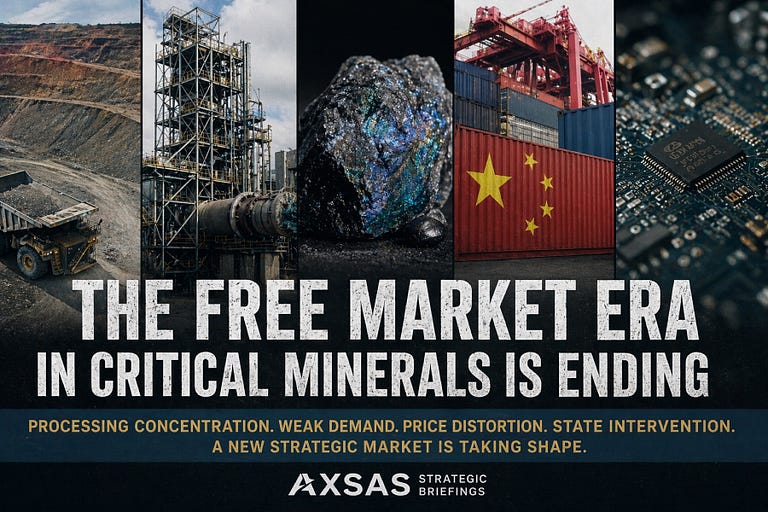
My assessment is straightforward. The free market era in critical minerals is ending because the market, left largely to itself, did exactly what efficient markets often do. It concentrated capacity, rewarded low cost scale, and deepened dependence on the processors and producers willing to dominate price. The West is now trying to correct that outcome after the fact. That correction will not succeed through mining rhetoric alone. It will need processing capacity, credible buyer coalitions, public finance, price support, and a willingness to treat critical minerals as part of national security architecture. Australia is unusually well placed to gain from that turn, but only if it chooses to shape the new system rather than just feed it.[1][3][4][5][7][8]
About AXSAS Strategic Briefings
AXSAS Strategic Briefings assess defence industrial readiness, strategic exposure, and geopolitical market shifts through a cause, constraint, consequence lens. The purpose is to test whether public policy is keeping pace with the operating environment now emerging, and whether the industrial base behind national security is being built on timelines that fit strategic risk rather than political comfort.
Footnotes
[1] Reuters, “USTR Greer urges US allies to pay more for critical minerals,” 22 April 2026. Reuters reported that Jamieson Greer is urging allies to accept a national security premium for non Chinese supply and is developing price mechanism proposals to support diversified supply.
[2] European Commission, “Commission launches platform to aggregate demand of raw materials and boost diversification,” 13 April 2026. The Commission said the Raw Materials Mechanism will allow buyers to aggregate demand and connect with suppliers, financiers, and storage providers, with a focus on rare earths, defence, and battery materials.
[3] Australian Government, joint release, “Australia US Critical Minerals Framework investing in additional projects,” 13 April 2026. Canberra said Australia and the United States are delivering more than A$5 billion to support Australian rare earths and critical minerals projects under the bilateral framework.
[4] International Energy Agency, Global Critical Minerals Outlook 2025, executive summary and overview. The IEA reported that the average share of the top three refining countries for key energy minerals rose to 86 percent in 2024, and that China is projected to remain the dominant refined supplier across most key minerals. It also reported strong 2024 demand growth, including nearly 30 percent for lithium and 6 to 8 percent for nickel, cobalt, graphite, and rare earths.
[5] CSIS, Gracelin Baskaran, “Winning the Minerals Race Requires Building Demand, Not Just Supply,” 3 April 2026. CSIS argued that the critical weakness for non Chinese supply chains is the absence of credible long term buyers, and cited the small U.S. share of global consumption in several strategic minerals.
[6] U.S. Geological Survey, Mineral Commodity Summaries 2026 and related release, February 2026. USGS said the 2026 edition is the earliest comprehensive source of 2025 world production data by commodity and noted that the United States remained reliant on China as a major source for 14 of the 33 critical minerals for which it most depends on imports.
[7] Geoscience Australia, Australia’s Identified Mineral Resources 2025 and associated release. Geoscience Australia said Australia was the top global producer of lithium in 2024, the third largest producer of rare earths, and a top five global supplier of 14 mineral commodities.
[8] Australian Department of Industry, Science and Resources, Critical Minerals Strategy 2023 to 2030. The strategy states that Australia’s objective is to become a globally significant producer of raw and processed critical minerals, build sovereign processing capability, and extract more value onshore.
[9] Reuters, “Congo creates strategic cobalt reserve to influence supply and prices,” 16 April 2026, and follow up reporting on export quotas and reduced 2026 shipments. Reuters reported that Congo, responsible for around 70 percent of global cobalt output, has created a strategic reserve and used quota and export control tools to influence supply and prices.
The Free Market Era in Critical Minerals Is Ending was originally published in DataDrivenInvestor on Medium, where people are continuing the conversation by highlighting and responding to this story.