The AI Organization — Source Code Included
This is the future. The new company will be a composite of human employees and AI agents working together. The open source Kikubot framework connects humans and agents at scale to multiply your organization's productivity without incurring significant costs.
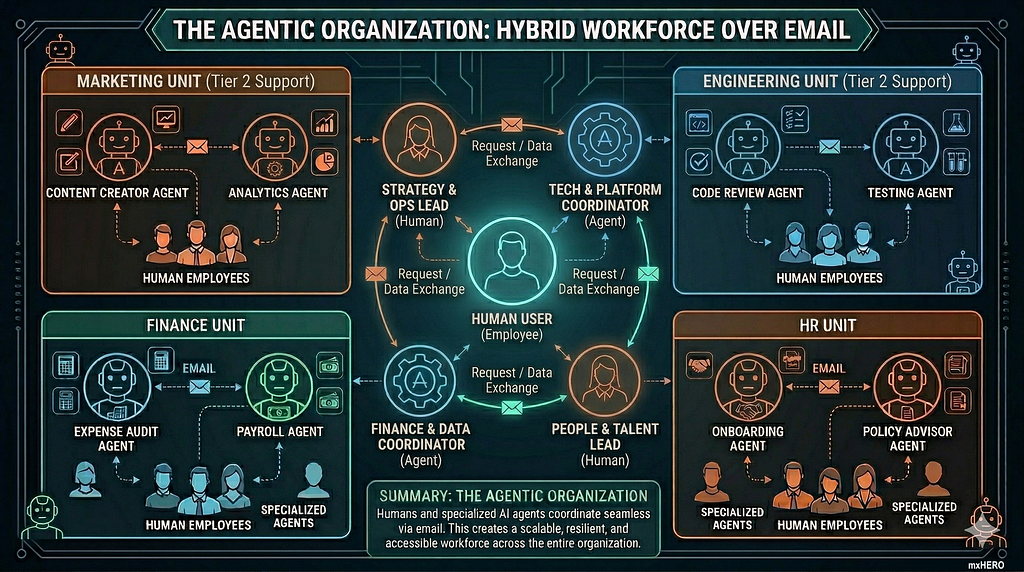
Despite the promise of AI, organizations are struggling to harness the incredible power of this new technology (RTSLabs).
Integration complexity, talent gaps, change management, security concerns — the list of obstacles reads like a checklist of reasons to do nothing. And for most organizations, that is exactly what is happening. The technology exists. The capability is real. Yet the gap between what AI can do and what organizations are actually doing with it remains staggering.
A Solution
mxHERO Labs has developed and is using an AI agent deployment architecture, named Kikubot, that addresses many of these challenges. The key insight? Don’t reinvent the wheel. Use the one that’s been rolling for fifty years.
At the highest level, the Kikubot architecture leverages email to distribute and interconnect specialized agents. These agents engage, and are engaged by, each other through email. Not all agents are accessible to employees directly — only coordinator agents. These coordinators, in turn, are supported by a cluster of “internal” agents, each with its own specialties. Think of it as a department. You email the department head, and she marshals the right people to get the job done. You only need to communicate with one person.
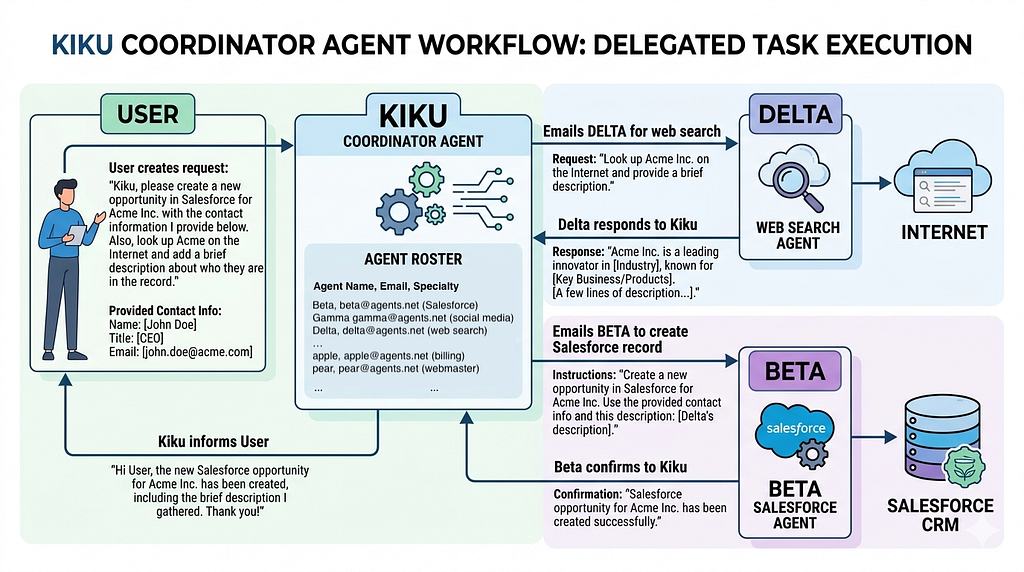
For example, a user sends a request to the coordinator agent, named Kiku:
“Kiku, please create a new opportunity in Salesforce for Acme Inc. with the contact information I provide below. Also, look up Acme on the Internet and add a brief description about who they are in the record.”
Kiku maintains a roster of other agents — a list of email addresses and their areas of specialty. In this case, Kiku knows that Agent Delta handles web searches and Agent Beta manages Salesforce. After receiving the user’s request, Kiku emails Delta asking for general web information about Acme. Once Delta responds, Kiku forwards the gathered information to Beta with instructions to create the Salesforce opportunity. When Beta confirms the task is done, Kiku informs the user. A workflow of this type typically takes only a couple of minutes.
If this model looks exactly like how we humans work in organizations today, you’re right. What surprised us is how well this architecture works with the LLM models already available at the time of this writing. In hindsight, this shouldn’t have been surprising. Email turns out to be a particularly good medium for agentic labor because it meets several key LLM requirements:
First, email is text. Text is an LLM’s most natural medium — the primary data type on which these models are trained.
Second, email is designed to preserve and provide context. LLMs are stateless. Every query needs context to perform well. Providing the right context is one of the most important determinants of AI performance. Email is a repository of messages, each classified with a subject and organized into threads. An email thread is analogous to an AI chat thread — a labeled collection of messages grouped by topic. Whether chat or email, threads create the conditions for excellent AI performance.
Third, email is a system for collaboration. A recent Google research paper, "Agentic AI and the next intelligence explosion" (Evans, Bratton, Agüera y Arcas, 2026), argues that intelligence is fundamentally social and emerges from the interaction of distributed perspectives. The researchers found that even within a single reasoning model, improved performance comes from simulating multi-agent-like debates internally — what they term a “society of thought.” If intelligence is inherently social inside a model, it stands to reason that organizing multiple models socially — as Kikubot does — would amplify this effect.
Architecting agents over email not only benefits LLM performance, but also the integration of AI within the organization.
Benefits of Email-Connected Agents
Email as an Interface
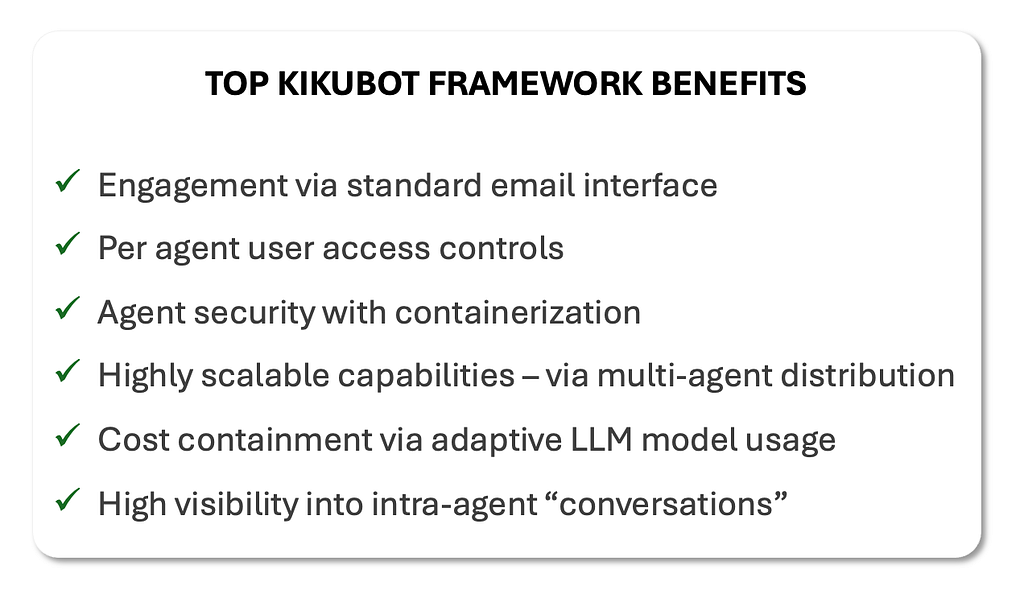
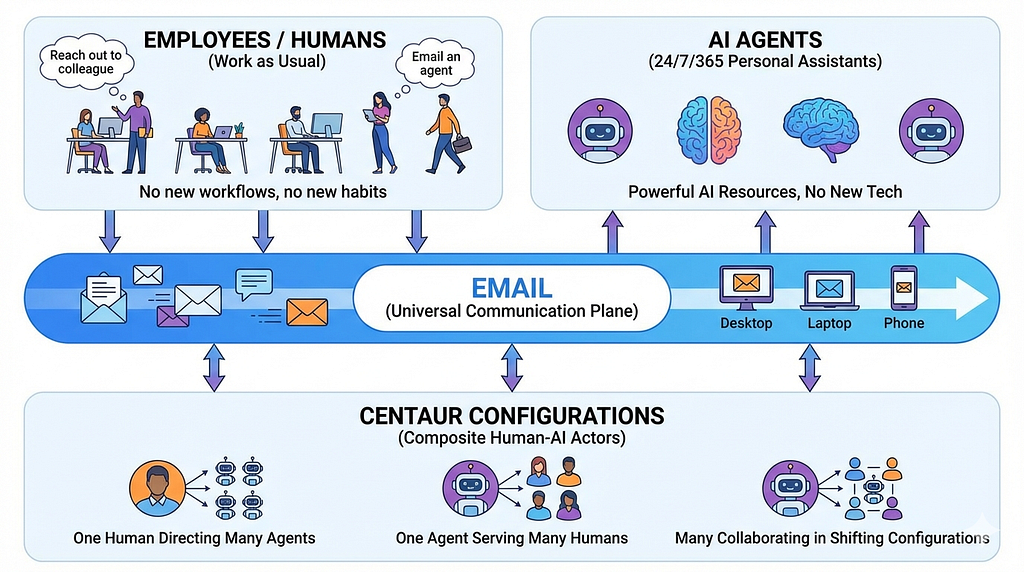
The Kikubot solution extends AI resources through the most ubiquitous interface in the organization: email. To leverage powerful AI, employees need only email an agent, like reaching out to any other colleague. No new workflows, no new habits, no new user-interface, nor technology to deploy or learn. It is work as usual, except a 24/7/365 assistant (that understands your organization) has joined the team — accessible from the desktop, laptop, or the phone in your pocket.
Conversely, email makes it just as easy for agents to engage with humans. The ubiquity of email creates a universal communication plane over which humans and AIs interact seamlessly. As the Google research paper puts it, we are entering an era of “centaur” configurations — composite human-AI actors that shift fluidly. One human directing many agents. One agent serving many humans. Many of each, collaborating in shifting configurations.
Multi-Agent Collaboration
The Google paper observes that intelligence derives from the coordination among multiple actors, not from any single mind scaling upward. The Kikubot architecture is built on this principle.
Agent Specialization: Loose Coupling and High Cohesion
The Kikubot model divides agents into specializations. This follows the fundamental software design principles of loose coupling and high cohesion — principles aimed at creating maintainable, flexible, and scalable systems. In our context, high cohesion means an agent focuses on a small set of related tasks, while loose coupling ensures agents are independent, minimizing dependencies so that changes in one part don’t break others.
It is work as usual, except a 24/7/365 assistant (that understands your organization) has joined the team — accessible from the desktop, laptop, or the phone in your pocket.
With multiple agents, any individual agent can be maintained or updated without disruption to the overall system — a single agent is only a small part of the whole. Each agent is connected asynchronously to the network over email, further minimizing perceived disruption if one goes down.
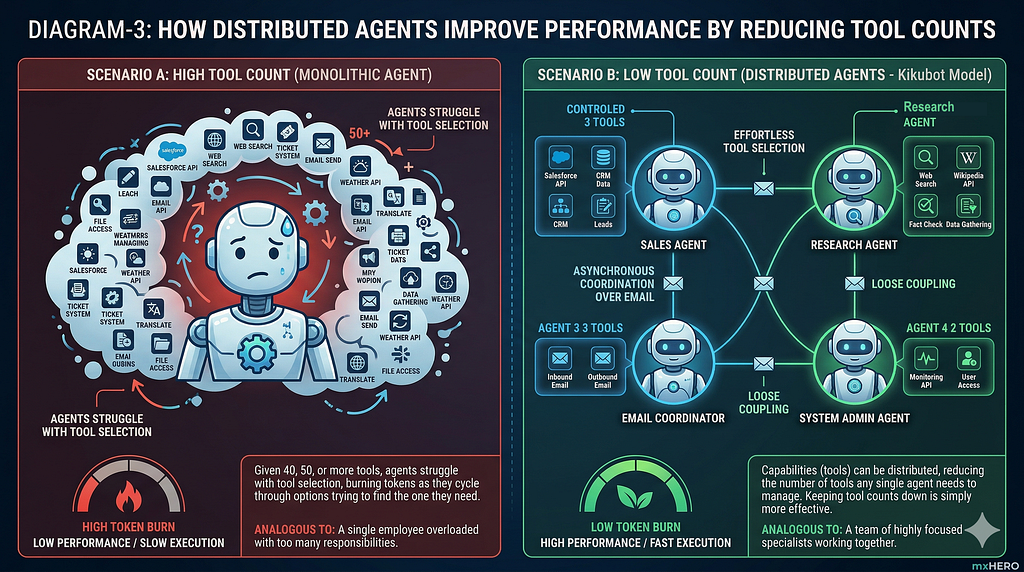
Better Performance from Reduced Tool Counts
With multiple agents working together, capabilities (tools) can be distributed, reducing the number of tools any single agent needs to manage. This matters since agentic performance degrades significantly as tool counts grow. When given 40, 50, or more tools, we’ve observed agents struggling with tool selection, burning valuable tokens as they cycle through options trying to find the one they need. Keeping tool counts down is simply more effective. This is much like us humans — having too many responsibilities isn’t always better than a focused set.
High Scalability with Nested Agents
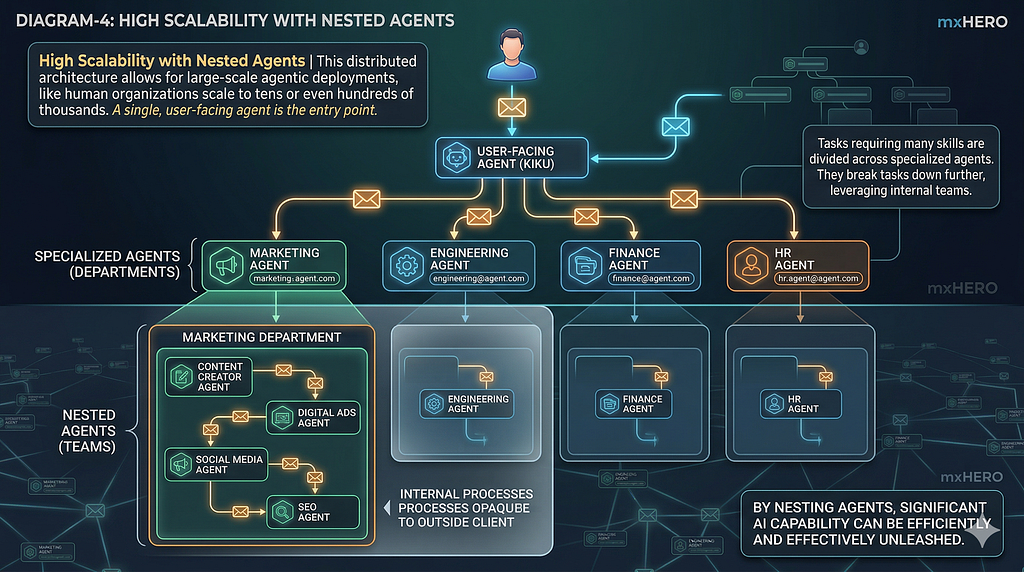
This distributed architecture allows for large-scale agentic deployments. Much like how organizations today scale to tens or even hundreds of thousands of individuals, so can Kikubot agentic systems. A single, user-facing agent can be the entry point to a vast agentic network.
Tasks requiring many skills are divided across multiple specialized agents. As tasks are handed off, those agents can break them down further and leverage their own internal teams — exactly how organizations work today. When a marketing task needs to be done, it goes to the marketing department, which handles it using its own internal teams (copy, graphics, channels). The internal process is opaque to the outside client. By nesting agents, significant AI capability can be efficiently and effectively unleashed.
Lower Costs from Model Selection Efficiency
Spreading a task across multiple agents also allows for more efficient and lower-cost use of LLMs. In our Kikubot cluster, Agent Kiku — the coordinator — is configured with a top-tier model (Opus 4.6 at the time of this writing), while Agent Beta runs on Haiku 4.5, a less capable but much cheaper model. Kiku manages the orchestration of tasks. She’s the strategist and benefits from more intelligence. Beta only needs to search and fill Salesforce fields — a task requiring less “thinking.”
This is analogous to human roles where different positions require different levels of expertise. In home construction, the architect requires more education than the bricklayer. Hiring university-educated bricklayers would not only be very expensive, but a misallocation of resources.
By matching models to the requirements of each agent role, costs stay down and overall performance improves —furthermore, smaller models like Haiku, though less capable, perform much faster.
Decentralized Agentic Deployment
Each agent is independently deployed. They are not part of a single monolithic system. An agent can be created at any moment and in any part of the organization anywhere in the world, then added to the cluster. This flexibility allows for a start-small-and-grow methodology that makes deployment far more approachable. Instead of a monolithic system where capabilities must be compiled into a single application, the agentic cluster can grow organically across the organization. Each new agent added like a new employee.
Importantly, agentic capabilities can be deployed from the business units that best understand the agent’s domain. The finance agent is designed by the finance department. The sales agent by the sales department. This ensures that the knowledge and systems each agent requires are managed by those most qualified to do so.
Finally, unlike tools like Claude Cowork or Clawdbot, a Kikubot deployment doesn’t require end-user involvement or installation. To benefit from agentic AI, end users need only know the agent's email address.
Improved Agentic Visibility
One common issue with agentic systems is the lack of transparency in their “thought” processes. Typically, understanding how agents execute tasks requires careful analysis of logs — a developer’s exercise. By moving the inter-agent conversation to email, following how tasks are executed is as simple as opening the agent’s mailbox. When agents orchestrate their actions over email, anyone with permission can review the system’s behavior, not just the developers. Agentic oversight becomes accessible to the business, not locked behind a terminal.
User Time Savings from Asynchronous Communication
Unlike a chat client, email is an asynchronous communication medium. Users don’t need to sit and wait for responses. Instead of watching a spinner for 10 minutes while a complex task completes, users are free to spend their time elsewhere. The agent works and responds when ready — just like a colleague.
Scheduled Tasks
Scheduled tasks also work naturally over email. Send a request that a task be done every Monday at 8am, and every Monday you get an email in your Inbox with the results. No cron jobs. No configuration. Just an email.
System Resilience
No other Internet communication technology is as resilient as email. Built in the earliest days of the pre-commercial Internet, email is the poster child of proven, robust architecture. Building an agentic system on email imparts that resilience to the whole.
If an agent goes offline — for maintenance or failure — tasks wait for it in its Inbox, ready to be picked up when it comes back online. A down agent is a delay, not a systemic failure. Backup agents can be deployed for redundancy. Coordinator agents can be instructed to fall back on alternatives if they wait too long for a particular agent to respond. This is how organizations already handle employee absence. The architecture mirrors the solution.
Better Security
One current impediment to AI adoption is the valid concern around security. AI can be unpredictable and even prompted to act against the organization. The email-based agentic framework addresses this in two important ways.
Email Access Control. Email is your identity on the Internet. It is one of the primary mediums for establishing identity, used by all major services — including banking — as a means of user validation. The Kikubot architecture leverages email-based, per-agent access controls to ensure only authorized users can reach specific services. No new identity system to deploy. No new access controls to learn.
mxHERO's deployment is configured at the email server level to only allow agents to receive and send to the mxHERO domain.
Containerization. Tools like Clawdbot have demonstrated and popularized the immense capabilities of agents. However, improperly configured, such installations can have access to the user’s entire computer. Few organizations accept the risk of giving AI access to potentially sensitive files and systems. In the Kikubot architecture, agents run in their own containers, isolated from corporate systems, with access limited to what is explicitly granted through API permissions. Each agent is sandboxed.
Kikubot Source Code
mxHERO’s Kikubot framework, the experimental basis of this article, is available on GitHub (https://github.com/mxaiorg/kikubot). The project can be used to quickly deploy a cluster of agents interconnected via email. The system includes basic tools for services like Salesforce and Buffer, connectors for MCPs and Bash scripts, core tools for agents to work with email, and snooze services for scheduled tasks.
We invite you to try it, break it, and build on it. The organizations that figure out how to harness AI effectively won’t be the ones waiting for the next silver bullet platform. They’ll be the ones that put AI to work the way they already work — over email.
Some Ways mxHERO Uses Kikubot
Social Media Posting
A week of social media programming done in the first 15 minutes of the week.
Every week get company relevant social media ideas. Select which are most of interest and how many posts to make of each. Review the posts staged in Buffer.com — review and click post.
Email message:
Kiku, I need to collect ideas for the company's social media posts.
To this end, every Monday at 7am, please do the following:

- Search the email records from the last week for mxHERO product
releases, improvements, articles, papers and AI insights connected
with email or AI use by organizations.

You might need to conduct multiple searches to get the best results.
Once collected, please send the results back to me.
- Secure company email search is done with mxMCP
- We receive an email with many ideas organized by topics.
- We send back email stating what topics I am most interested with instructions.
- We receive email when everything is staged in Buffer (minutes later).
- We review posts in Buffer and submit to the publish queue.
Website Updating
Webpages edited with the latest news or other updates over a simple email exchange.
Email message:
Kiku, add the following press release to the top of our /news page.
- Kiku updates the staging website.
- Once reviewed, the changes are published.
Knowledge Base Access + Updating
Getting answers from our internal knowledge base and enriching the knowledge base in the process.
If we need the answer to how our latest product works, or our list of integrations. When we want to know where product specific videos are posted, etc.
Email messages:
Kiku, Does mxHERO work with Salesforce?

Kiku, get me a list of product videos for our attachment
protection feature.
- Kiku searches the knowledge base.
- If the answer is not in the knowledge base, Kiku reaches out to a domain expert in the company for the response. Upon receiving the update the agent responds to the user's query and updates the knowledge base for future reference.
This use-case shows how the Kikubot system seamlessly engages between agents and humans.
Salesforce Updating
Adding a new sales opportunity, update a record, record a meeting, pull a sales report — all over an email exchange.
Email message:
Kiku, move all deals that have not closed this quarter to the
end of next quarter.

Kiku, get me a list of all lower funnel deals for this quarter.
- Kiku accesses Salesforce to make updates or retrieve information.
Customer Success Management
Help us check in on our customers and create context relevant email drafts.
Email message:
Kiku, Get me a list of customers who are up for renewal in May and June.
For each include the value of the renewal and the name and email of
the “Service Administrator”.

Create “check in” emails for the renewals. Check for emails from or to
the contacts of these customers. If you find anything, incorporate
the topics of those emails into the “check in” emails.
- Kiku accesses Salesforce for customers up for renewal.
- Kiku looks for email communications with the customers to provide context for "check in" emails.
- Kiku sends back draft emails.
Kikubot Internal Conversations
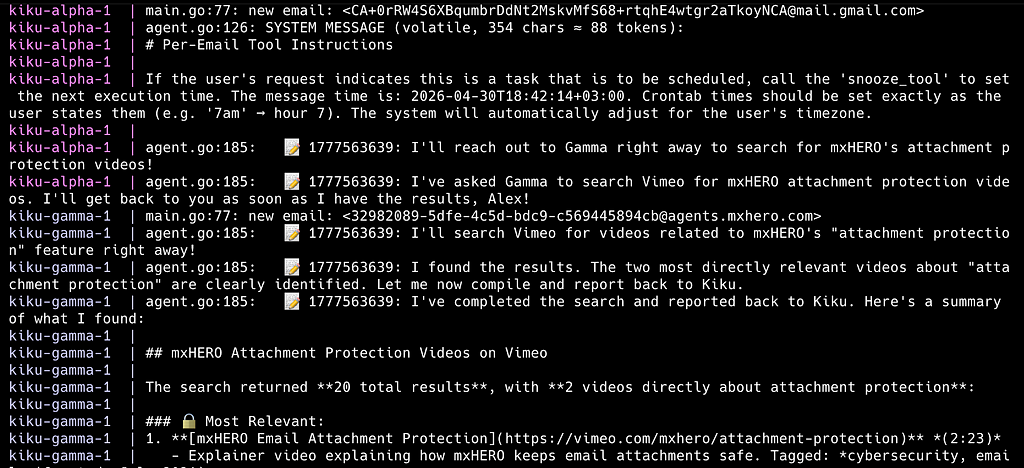
Below is a snapshot of a Kikubot log illustrating the internal "thinking" and coordination between two agents in response to a email request to: "Get me a list of videos for mxHERO’s attachment protection." In this cluster, Gamma is the "video archivist". Below we see Agent Alpha sending a request to Gamma to search the Vimeo archive.
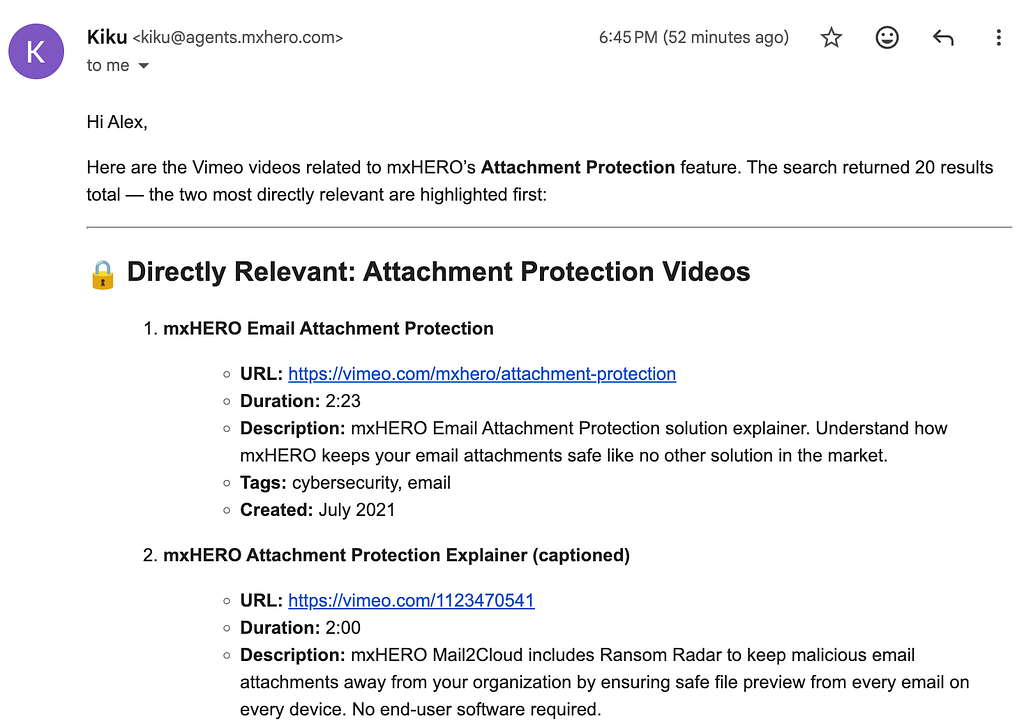
The final response email…
— -
References
- Evans, J., Bratton, B., & Agüera y Arcas, B. (2026). Agentic AI and the next intelligence explosion. arXiv:2603.20639.
The AI Organization — Source Code Included was originally published in DataDrivenInvestor on Medium, where people are continuing the conversation by highlighting and responding to this story.