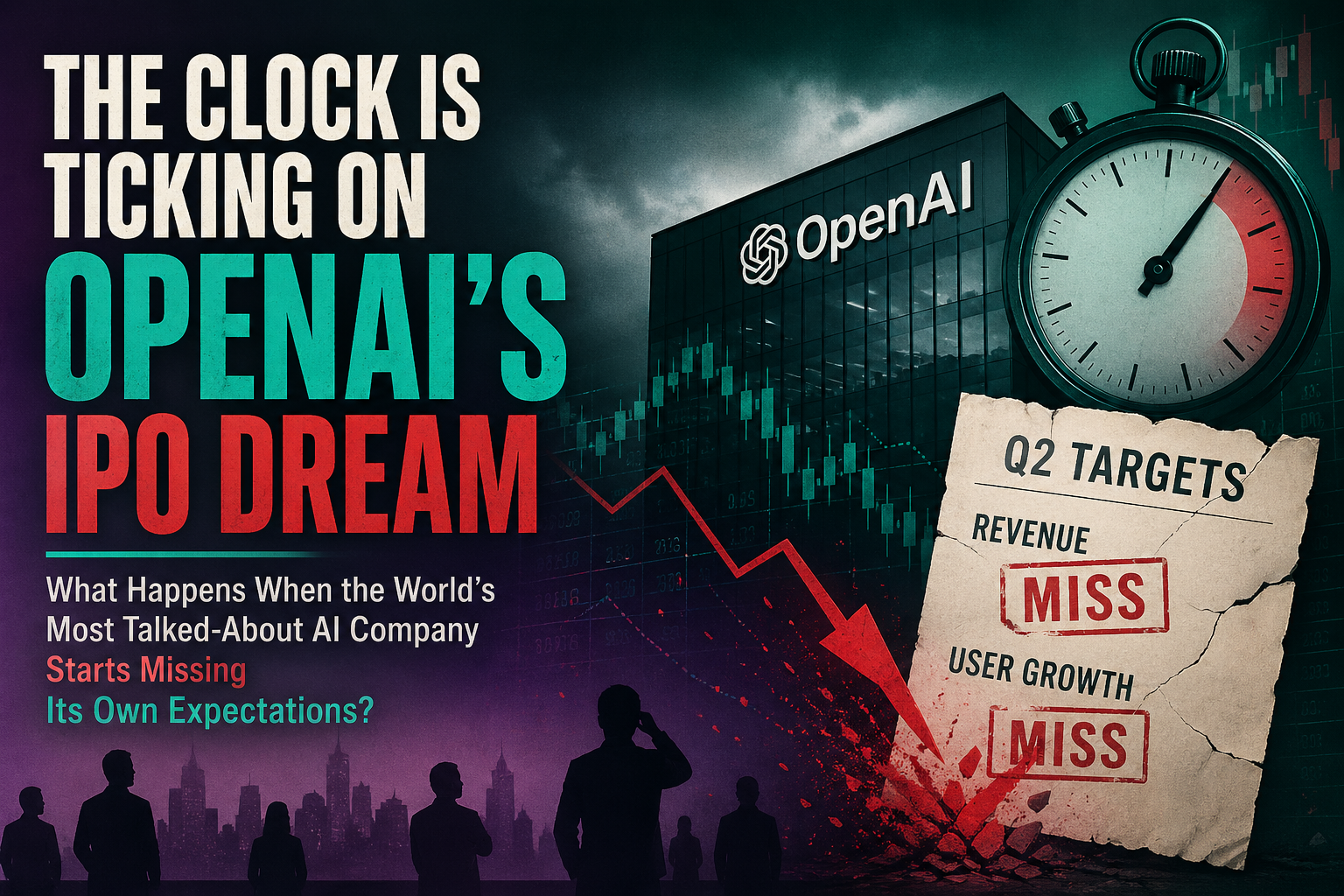
The Clock Is Ticking on OpenAI’s IPO Dream
What happens when the world’s most talked-about AI company starts missing its own expectations?
--
Personal Angle
For the past two years, it has felt like the AI boom could only move in one direction: up.
Every product update felt bigger than the last. Every funding round felt historic. Every headline hinted that artificial intelligence had officially become the next internet.
And at the centre of that momentum sat OpenAI.
But here’s the uncomfortable truth about high-growth tech companies:
Hype buys attention. Revenue buys survival.
Recent signals suggest OpenAI is facing a reality that every fast-scaling company eventually encounters — expectations grow faster than execution. Reports indicate the company missed key revenue and user growth targets during a crucial phase of its sprint toward a future IPO.
This doesn’t mean the AI story is collapsing.
It means the story is entering its most interesting chapter.
Because the moment growth stops looking effortless is the moment the real business begins.
Hypergrowth Sets a Dangerous Baseline
AI adoption didn’t grow. It exploded.
ChatGPT became one of the fastest-growing consumer products in history. Enterprise adoption surged. Governments began drafting AI policy. Entire startups formed around AI APIs almost overnight.
The problem with explosive growth is that it quietly rewrites expectations.
When a company grows too fast, the market stops asking:
“Is this successful?”
Instead, it asks:
“Why isn’t this growing even faster?”
That shift is subtle but brutal.
Missing targets in a traditional industry is normal. Missing targets in AI right now feels like breaking gravity.
And this is the trap OpenAI now finds itself in.
Not failing.
Not declining.
Simply not growing as fast as the future everyone imagined.
That difference matters more than most people realise.
The Revenue Reality of AI Is More Complex Than Hype Suggests
AI looks like pure software.
But under the hood, it behaves more like infrastructure. And infrastructure is expensive.
Training and running large language models requires:
- Massive GPU clusters
- Enormous electricity consumption
- Constant retraining and optimization
- Heavy cloud partnerships
- Ongoing research costs
Every new user doesn’t just generate revenue.
They generate computing costs. This flips the traditional SaaS model on its head.
Most SaaS companies become cheaper to run as they scale.
AI companies often become more expensive as usage increases. Which creates a strange paradox: Growth can hurt margins before it helps them.
This is likely a key reason revenue hasn’t scaled as smoothly as the market expected. Monetising AI at a global scale is still an unsolved economic puzzle.
And investors know it.
Enterprise AI Moves Slower Than Consumer AI
Consumer AI adoption was instant.
Enterprise AI adoption is cautious.
Companies don’t deploy AI the way individuals do. They worry about:
- Data privacy
- Security risks
- Compliance requirements
- Internal governance
- Long-term vendor lock-in
A person can try AI in seconds.
A corporation may take 6–18 months to deploy it.
That time gap creates a dangerous perception gap.
Public excitement suggests AI revenue should skyrocket immediately.
Corporate reality says: “We need pilots, policies, and approvals first.”
This lag between excitement and enterprise spending is likely another reason OpenAI’s targets became harder to hit.
The demand exists.
The procurement cycle is slow.
And IPO timelines don’t wait patiently for procurement cycles.
Competition Quietly Changed the Growth Equation
Two years ago, OpenAI felt like the only serious player in the generative AI spotlight.
Today, the landscape looks very different.
Major tech companies, open-source communities, and startups have all entered the race. Enterprises now have options, leverage, and bargaining power.
More competition means:
- Pricing pressure increases
- Enterprise negotiations get tougher.
- Market share becomes harder to capture quickly.
- Differentiation becomes essential
The narrative shifted from “AI is here” to “Which AI provider should we choose?”
And that’s a completely different market dynamic.
Hypergrowth is easier when you are the only obvious choice.
It becomes harder when you are one of several strong options.
This isn’t a failure signal.
It’s a maturity signal.
The market is moving from discovery to competition.
IPO Pressure Changes How Growth Is Measured
Private companies optimise for vision.
Public companies optimise for predictability.
The transition between those two worlds is brutal.
An IPO introduces a new audience: public market investors.
And public markets don’t reward hype — they reward:
- Predictable revenue
- Stable margins
- Clear business models
- Long-term defensibility
Missing targets becomes more meaningful in this context.
Because the question shifts from:
“Is this technology groundbreaking?”
To:
“Is this a predictable, scalable business?”
That is the real challenge of OpenAI’s IPO path.
Turning a revolutionary technology into a dependable financial engine.
Pattern Interrupt
Here’s the truth few people say out loud:
The biggest risk to AI isn’t technical.
It’s economic.
And the economics of AI are still being written in real time.
The AI Market Is Entering Its “Reality Phase”
Every major technology wave follows a pattern:
- Breakthrough
- Hype
- Over-expectation
- Reality check
- Sustainable growth
AI is now moving from phase 3 to phase 4.
This phase feels uncomfortable. Headlines sound more sceptical. Growth feels less explosive. Expectations feel heavier.
But historically, this phase is where the strongest companies are built.
Because hype fades.
Business fundamentals remain.
If OpenAI successfully navigates this transition, it won’t just be an AI pioneer. It will become an AI institution. And institutions are what IPO investors actually want.
Missing Targets Doesn’t Mean Missing the Future
It’s easy to misread signals like these as signs of trouble. They’re not. They’re signs of scale.
When companies reach global importance, the margin for error shrinks. The scrutiny intensifies. Every metric becomes a headline.
But stepping back, the larger picture remains unchanged:
AI adoption is accelerating globally.
Enterprise demand continues to grow.
AI is becoming embedded in everyday workflows.
The long-term opportunity remains enormous.
Short-term expectations and long-term potential often move at different speeds.
And right now, expectations were simply moving faster.
Memorable Conclusion
The narrative around AI is evolving.
The question is no longer:
“Will AI change the world?”
The question now is:
“Who will build the companies that can sustain it?”
OpenAI’s missing revenue and user targets don’t signal the end of the AI boom. It signals the end of the easy part.
The next chapter isn’t about proving AI works.
It’s about proving AI businesses work.
And that story is just getting started.