The Transfer That Took 12 Days and the Number That Changed Everything
It started with something painfully ordinary.
--
A freelance designer in Lisbon had just finished a project for a client in Dubai. Nothing unusual — logos, revisions, late-night calls across time zones. The work was done, the client was happy, and the invoice was sent.
€3,200. Payable in 3–5 business days.
Or so he thought.
Three days passed. Then five. Then ten.
Still nothing.
The client insisted the payment had been made. The freelancer checked his bank account obsessively, refreshing it like it might change its mind if he looked at it enough times.
It didn’t.
What followed wasn’t just frustration, it was confusion. Because somewhere between “payment sent” and “payment received,” the money had simply… disappeared into the system.
The culprit, as he would later discover, was not fraud, not error, not even delay in the usual sense.
It was a single string of characters he had never paid attention to before:
IBAN.
The Invisible Language of Money
Most people don’t think about how money moves internationally.
We imagine it as a button: click “send,” and somewhere in the world, it arrives.
But in reality, cross-border payments are less like clicking a button and more like sending a letter through a chain of postal offices across countries, each speaking a slightly different language.
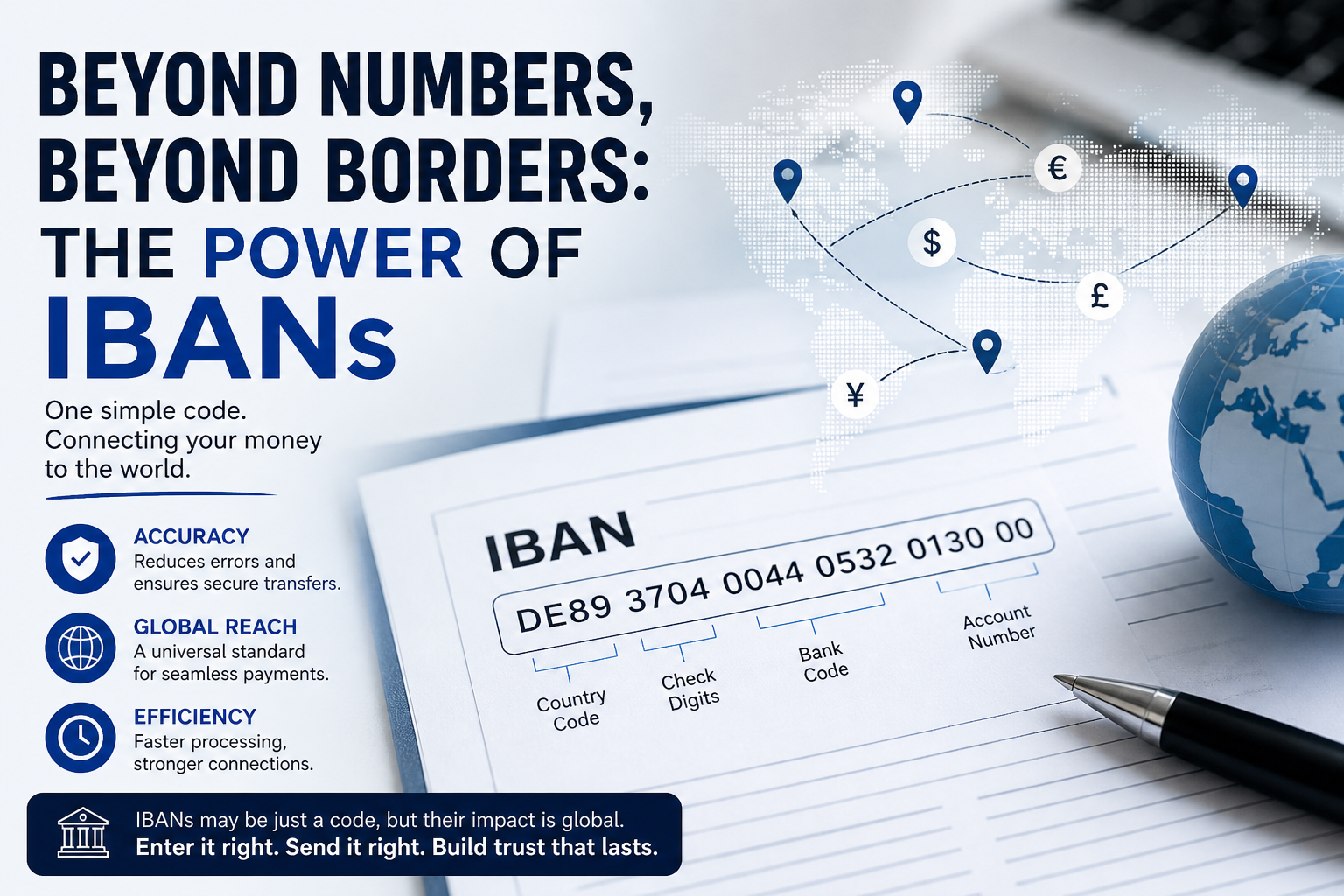
And in this system, the IBAN, the International Bank Account Number — is the address written in a universal format.
It looks harmless enough:
• DE89 3704 0044 0532 0130 00
• GB29 NWBK 6016 1331 9268 19
• AE07 0331 2345 6789 0123 456
But behind those letters and numbers is a global coordination system designed to make sure money doesn’t get lost between borders.
The freelancer didn’t know it yet, but his issue wasn’t about money leaving the client’s account.
It was about money not knowing exactly where to go.
Where Things Started to Break
The client in Dubai had entered the IBAN incorrectly by a single character.
Just one.
Not enough to trigger an obvious failure. Not enough to immediately bounce the transaction.
Enough to send the payment into what banks quietly call “investigation routing.”
That sounds technical. But in reality, it means:
The money is in limbo.
Not returned. Not delivered. Just waiting.
And waiting in banking systems is expensive.
Every intermediary bank in the chain pauses, checks, verifies, and sometimes forwards manually. Days pass. Sometimes weeks.
In this case, it became twelve days.
Twelve days for a single freelance payment.
Why IBAN Exists in the First Place
To understand the story fully, you have to understand why IBAN was created.
Before IBAN, international transfers were chaos.
Banks relied on local account formats, inconsistent identifiers, and manual interpretation. A single mistake could send funds to the wrong country entirely.
So the financial world introduced IBAN as a standard, a structured way to identify accounts across borders.
An IBAN contains:
• Country code (e.g., DE, GB, AE)
• Check digits (to validate accuracy)
• Bank identifier
• Account number
That structure is what makes it powerful. It’s also what makes it fragile.
Because while IBAN reduces human error, it doesn’t eliminate it. It just standardizes it.
A wrong digit doesn’t always mean rejection.
Sometimes, it means delay.
The Silent Cost of “Almost Right”
When the freelancer finally called his bank, the answer came slowly, as most banking answers do.
“There is no error in the system,” they said.
“There is only a pending investigation.”
That phrase stuck with him.
Pending investigation.
It sounded serious. Formal. Final.
But what it really meant was: someone somewhere is trying to match an almost-correct number to the right destination.
And until they succeed, the money is frozen in motion.
This is one of the least talked-about realities of global banking:
• Money doesn’t just move, it translates
• Translation takes time
• Time costs trust
In digital economies where freelancers rely on speed, that delay isn’t just inconvenient. It can be damaging.
Rent doesn’t wait for banking investigations.
The Moment Everything Clicked
On day twelve, the payment arrived.
No apology note. No explanation. Just a simple credit notification.
€3,200.
But by then, the story had already changed meaning.
Because the freelancer didn’t just see a payment, he saw a system he had been unknowingly dependent on his entire career.
He started researching IBANs that night.
What he found surprised him.
IBAN isn’t just a number format. It’s a coordination layer between thousands of banks across dozens of countries. It reduces friction in a system that otherwise would collapse under its own complexity.
And yet, despite all that engineering, it still depends on one fragile thing:
Human accuracy.
Why One Small Mistake Breaks a Global System
The irony is simple.
We built IBAN to eliminate chaos.
But we still operate it.
And anything operated by humans inherits human flaws.
A missing digit. A swapped character. A copied number from the wrong invoice.
Each one creates a ripple:
• Payment delay
• Manual verification
• Intermediary routing
• Temporary fund freezing
The system doesn’t fail loudly.
It slows down quietly.
The Real Cost Isn’t Just Time
Most people assume a delayed transfer is just an inconvenience.
But in practice, delays create cascading effects:
• Cash flow disruptions for freelancers
• Delayed payroll for small businesses
• Strained client relationships
• Additional banking fees in some corridors
And perhaps most importantly, uncertainty.
Uncertainty is the hidden cost no invoice shows.
When a freelancer doesn’t know if a payment will arrive in 3 days or 12, planning becomes guesswork.
A System Built for Safety, Not Speed
IBAN was designed in a different era of finance.
An era where:
• Transactions were fewer
• Verification mattered more than speed
• Manual oversight was considered a feature, not a bottleneck
Today, money moves faster than ever.
But the infrastructure underneath it still carries old assumptions.
That mismatch is where friction lives.
And friction, in financial systems, always shows up as delay.
What Changed After That Payment
The freelancer didn’t stop using IBAN, of course he didn’t. No one really can.
But he changed how he used it.
He started double-checking every digit. He built templates. He stopped copying numbers from screenshots. He added verification steps before every invoice.
• One check for format
• One check for accuracy
• One confirmation before sending
It wasn’t complicated. But it was intentional.
And that made all the difference.
Because in systems like IBAN, precision isn’t optional. It’s infrastructure.
The Quiet Power of Standardization
Despite its flaws, IBAN does something remarkable.
It allows money to move across countries that don’t share banking systems, languages, or even regulatory frameworks and still arrive correctly most of the time.
That’s not trivial.
It’s one of the reasons global freelancing, remote work, and cross-border commerce exist at scale today.
Without it, every payment would require negotiation between banks.
With it, at least the structure is agreed upon.
Even if humans still have to get it right.
The Lesson Hidden in 34 Characters
The freelancer eventually framed the experience differently.
It wasn’t a story about delay anymore.
It was a story about precision hiding inside complexity.
Because IBAN looks like a random string, but it carries enormous responsibility. A single character isn’t just data, it’s direction.
And direction, in finance, determines whether money arrives in hours… or disappears into a twelve-day silence.
He now tells other freelancers a simple rule:
Treat every IBAN like a destination address you cannot afford to get wrong.
Because in global payments, there is no “close enough.”
Only correct… or waiting.
If there’s one thing the story reveals, it’s this:
The global financial system is incredibly advanced, but still deeply human at its edges.
And sometimes, the difference between smooth payment and silent delay is not technology.
It’s attention.