
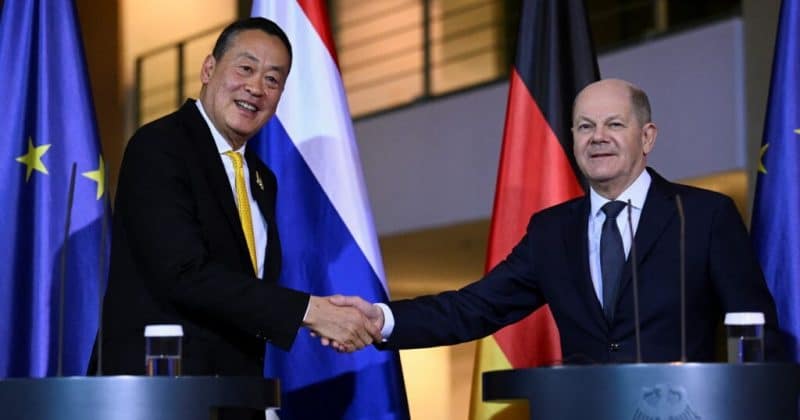
Thailand accelerates EU free trade deal to diversify from US tariffs
After a decade of false starts, Bangkok is rushing to finalize an EU trade agreement as American tariff pressure reshapes Asia-Pacific supply chains.
Share
Add us on Google by Editorial Team Jun. 9, 2026Thailand is pushing hard to lock down a free trade agreement with the European Union, a move designed to reduce the country’s exposure to volatile US tariff policy and loosen its dependence on both American and Chinese supply chains.
FTA negotiations between Thailand and the EU originally launched in March 2013. Then a military coup in 2014 hit the pause button for nearly a decade. Talks didn’t resume until March 2023, and now Thai officials are targeting a deal by the end of 2025 or mid-2026.
Under a US-Thailand reciprocal trade framework established in October 2025, Thailand agreed to eliminate tariffs on approximately 99% of US goods. In return, the US maintained a reciprocal tariff of 19% on Thai imports.
AdvertisementOn February 16, 2026, Thai Industry Minister Thanakorn Wangboonkongchana met with EU Ambassador Luisa Ragher to discuss accelerating the negotiation timeline. The conversation reportedly included alignment on green economy standards, a topic the EU has increasingly woven into its trade agreements as a condition for market access.
A broader diversification strategy
The EU deal isn’t happening in isolation. Thailand is simultaneously pursuing FTAs with South Korea and an ASEAN-Canada agreement. Bangkok has also signed an FTA with the European Free Trade Association, the four-country bloc comprising Switzerland, Norway, Iceland, and Liechtenstein. That deal was pending entry into force as of early 2026.
What this means for investors
The sectors most likely to benefit from an EU FTA are agriculture and industrial goods. Thai agricultural exports, including rice, rubber, and processed seafood, currently face EU tariffs that a comprehensive deal would reduce or eliminate. Industrial goods, particularly automotive components where Thailand is a regional manufacturing hub, could also see improved access to European buyers.
The EU has increasingly tied trade preferences to environmental and sustainability standards. For Thai manufacturers, meeting those standards will require investment in cleaner production processes and supply chain transparency.
The risk is that ambitious timelines rarely hold in trade negotiations. The original EU-Thailand talks were supposed to progress quickly back in 2013 before political upheaval derailed them entirely. Finalizing a comprehensive FTA by mid-2026 would be unusually fast by historical standards, and if negotiations drag into 2027 or beyond, the immediate diversification benefits Thailand is counting on get delayed while the 19% US tariff continues to bite.
Disclosure: This article was edited by Editorial Team. For more information on how we create and review content, see our Editorial Policy.