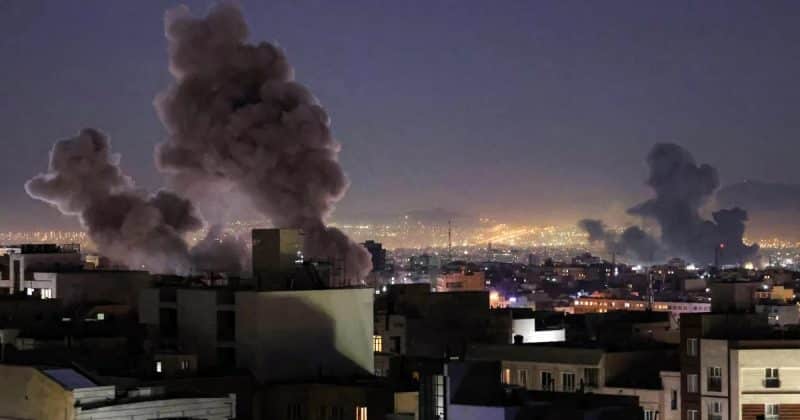
Jordan military intercepts five missiles launched from Iran as Middle East conflict rattles markets
The interception near a US military base underscores escalating regional tensions that crypto investors can't afford to ignore.
Share
Add us on Google by Editorial Team Jun. 10, 2026Jordan’s Armed Forces shot down five Iranian missiles on June 10, targeting the al-Azraq area in eastern Jordan. No casualties or property damage were reported, though debris from the intercepted projectiles fell onto Jordanian territory.
The target area is home to the Muwaffaq Salti Air Base, a facility that hosts US military personnel and assets.
What happened in Azraq
The five missiles were launched from Iranian territory and tracked toward al-Azraq, a relatively remote area in Jordan’s eastern desert. Jordan’s military intercepted and destroyed all five before they could reach their targets.
This wasn’t an isolated event. Jordan has intercepted hundreds of projectiles since the broader conflict escalated in late February 2026, when US and Israeli forces conducted military strikes on Iranian soil. Iran has since responded with a sustained campaign of missile and drone attacks aimed at US and allied interests across the Middle East.
AdvertisementPrevious Iranian assaults in the region have resulted in civilian injuries and infrastructure damage, making this particular interception a best-case scenario for Jordanian defense forces.
The 2026 Iran war, in context
The current conflict traces back to late February 2026. US and Israeli military strikes on Iranian soil triggered what has become a prolonged exchange of hostilities. Iran’s response has been a grinding campaign of missile and drone launches targeting American and allied positions scattered across the region.
Jordan hosts US military infrastructure, sits between Israel, Iraq, Syria, and Saudi Arabia, and has carried out hundreds of interceptions since February.
What this means for crypto investors
Geopolitical instability in the Middle East has historically triggered risk-off sentiment across global financial markets. When investors get nervous about real-world conflict, they tend to pull back from assets perceived as higher-risk.
Major military escalations in oil-producing regions create uncertainty about energy supply chains, which ripples into inflation expectations, which shifts central bank calculus, which moves bond yields, which reprices risk assets.
Short-term volatility in digital assets tends to spike during acute geopolitical crises. The initial hours after a major escalation often see Bitcoin move in tandem with traditional risk assets. The “digital gold” narrative, where Bitcoin acts as a safe haven, has shown up in some past crises but remains inconsistent.
Extended military engagement tends to increase government spending, which feeds into fiscal deficit concerns, which can weaken dollar confidence over longer time horizons. That dynamic has historically been constructive for Bitcoin, but it plays out over quarters and years, not days.
Disclosure: This article was edited by Editorial Team. For more information on how we create and review content, see our Editorial Policy.