BYD to invest €2B in 5-minute flash chargers across Europe
The Chinese EV giant is building a network of 1.5 MW charging stations that can push 400 km of range into a car in five minutes, starting with Germany and the UK.
Share
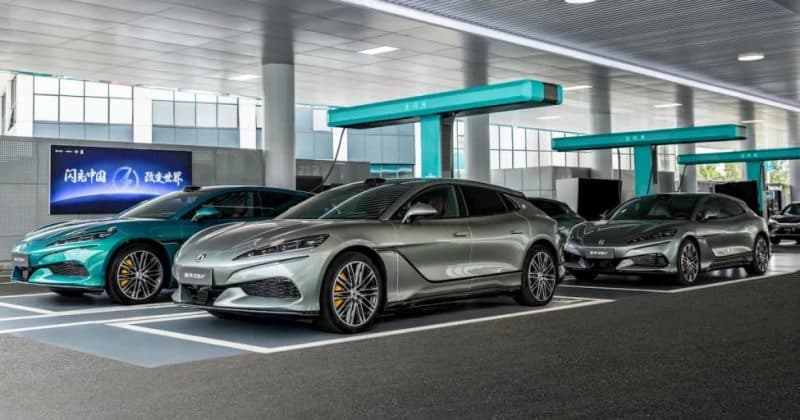
Add us on Google by Editorial Team Jun. 10, 2026BYD is pouring €2 billion into building out a network of ultra-fast “Flash Charging” stations across Europe. The first public stations, each capable of delivering a staggering 1.5 MW through a single connector, went live in Germany and the UK in early June 2026.
To put 1.5 MW in perspective: Tesla’s Supercharger V3 tops out at 250 kW. BYD’s chargers deliver six times that power.
Five minutes, 400 kilometers
The Flash Charging system pairs with BYD’s second-generation Blade Battery and its Super e-Platform architecture. Compatible vehicles running 800V+ systems can go from 10% to 70% state of charge in roughly 5 minutes. Push that to 9 minutes and the battery fills from 10% to 97%.
BYD claims that a 5-minute session delivers approximately 400 km of range on supported vehicles. The Denza Z9 GT is among the first models in Europe capable of tapping into the full speed of the network.
AdvertisementThe stations use on-site battery storage, which means the station draws from pre-charged batteries that replenish during off-peak hours, rather than slamming the local electrical grid every time someone plugs in.
BYD is targeting 3,000 charging stations across Europe by the end of 2026, with 300 of those specifically in the UK. Installations are happening at both Denza dealerships and third-party locations. Initial vehicles in Europe will receive 18 months of free charging in the UK.
Why Europe, why now
BYD launched the underlying technology alongside its Blade Battery 2.0 in March 2026. Version 2.0 adds the thermal and chemical stability needed to absorb megawatt-level charging.
The move also comes as European automakers are still catching up on charging speed. Most current-generation European EVs top out at 200-350 kW peak charging rates.
BYD’s approach couples battery storage with extreme power delivery, which means these stations can theoretically be deployed in locations where grid capacity would otherwise be a dealbreaker, opening up rural highways, suburban shopping centers, and other spots where running a dedicated high-voltage line would be prohibitively expensive.
What this means for investors
For the existing European charging players, this is a serious competitive threat. Companies like Ionity, Fastned, and BP Pulse have spent years building networks that top out at 350 kW. BYD’s stations deliver more than four times that power.
There’s a risk angle here too. BYD’s ambition to deploy 3,000 stations by end of 2026 is aggressive. Supply chain constraints, permitting delays, and the sheer logistics of battery storage procurement could slow things down. Europe’s regulatory environment for Chinese companies has also grown more scrutinous, with tariff discussions and subsidy clawback debates ongoing in Brussels.
Disclosure: This article was edited by Editorial Team. For more information on how we create and review content, see our Editorial Policy.