If You Can’t Explain Yield, You Are the Yield
--
The Yield Illusion: Why the APY You See Isn’t the Return You Get
In the neon-lit dashboards of decentralized finance, yield is presented as a destination. You see a triple-digit APY, a “Deposit” button, and a simple promise: put your assets here, and they will grow. This “set-and-forget” flow has become the industry standard, offering a frictionless interface that masks the chaotic financial machinery humming beneath the surface.
But in DeFi, simplicity is often a mask for complexity. While the dashboard shows a straight line up, the reality is a tug-of-war between protocol mechanics and market volatility.
Breaking the Mirror: The Gap Between Displayed and Real Yield
The number on your screen is rarely what ends up in your wallet. The “Displayed Yield” is a theoretical maximum, while the “Real Yield” is what remains after the market takes its cut.
- Gross vs. Net Return: Most dashboards show gross emissions. They don’t subtract gas fees, platform performance fees, or the cost of compounding.
- Impermanent Loss (IL): In liquidity pools, if the price of your deposited assets diverges, the loss in value can easily outpace the trading fees you’ve earned.
- Execution Friction: Entering and exiting positions involves slippage and swap fees. If you’re chasing a “hot” 100% APY but lose 2% on entry and 2% on exit, your short-term yield is effectively erased.
- The Volatility Tax: Earning 20% on a stablecoin is vastly different from earning 20% on a volatile governance token that drops 50% in value during the farming period.
Where Does the Money Actually Come From?
To find sustainable returns, you must look past the “How much?” and ask “From whom?” Yield is not created out of thin air; it is generated through specific economic activities:
SourceSustainabilityNatureTrading FeesHighOrganic revenue from DEX volume.Lending ActivityHighInterest paid by borrowers (leverage seekers).LiquidationsVariableBonuses earned for keeping the system solvent.ArbitrageModerateCapturing price inefficiencies across markets.Token EmissionsLowMarketing spend used to bootstrap liquidity (inflationary).
Not all yield is equal. Organic yield (fees/interest) is a sign of a healthy ecosystem. Incentive-heavy yield (emissions) is often a timer — if you aren’t the one selling, you might be the one providing the exit liquidity.
The Hidden Value Transfer
There is an old adage in poker: If you’ve been at the table for thirty minutes and you don’t know who the sucker is, it’s you.
In DeFi, if you don’t understand where the yield comes from, you are likely the one subsidizing the system. You might be providing “dumb” liquidity that sophisticated arbitrageurs feast upon, or absorbing massive downside risk in exchange for a few percentage points of inflationary tokens. Without modeling your outcomes, you aren’t an investor; you are a backstop for someone else’s strategy.
Same System, Different Outcomes
Why do two users in the same pool have vastly different year-end results?
- The Chaser: Optimizes for the highest displayed APY, moves frequently, and loses a significant portion of their principal to fees and IL.
- The Engineer: Analyzes the pool structure, models the cost of rebalancing, and accounts for the correlation between assets.
The difference isn’t luck — it’s the shift from Yield Chasing to Yield Engineering.
The Rise of Engineered Yield with Concrete
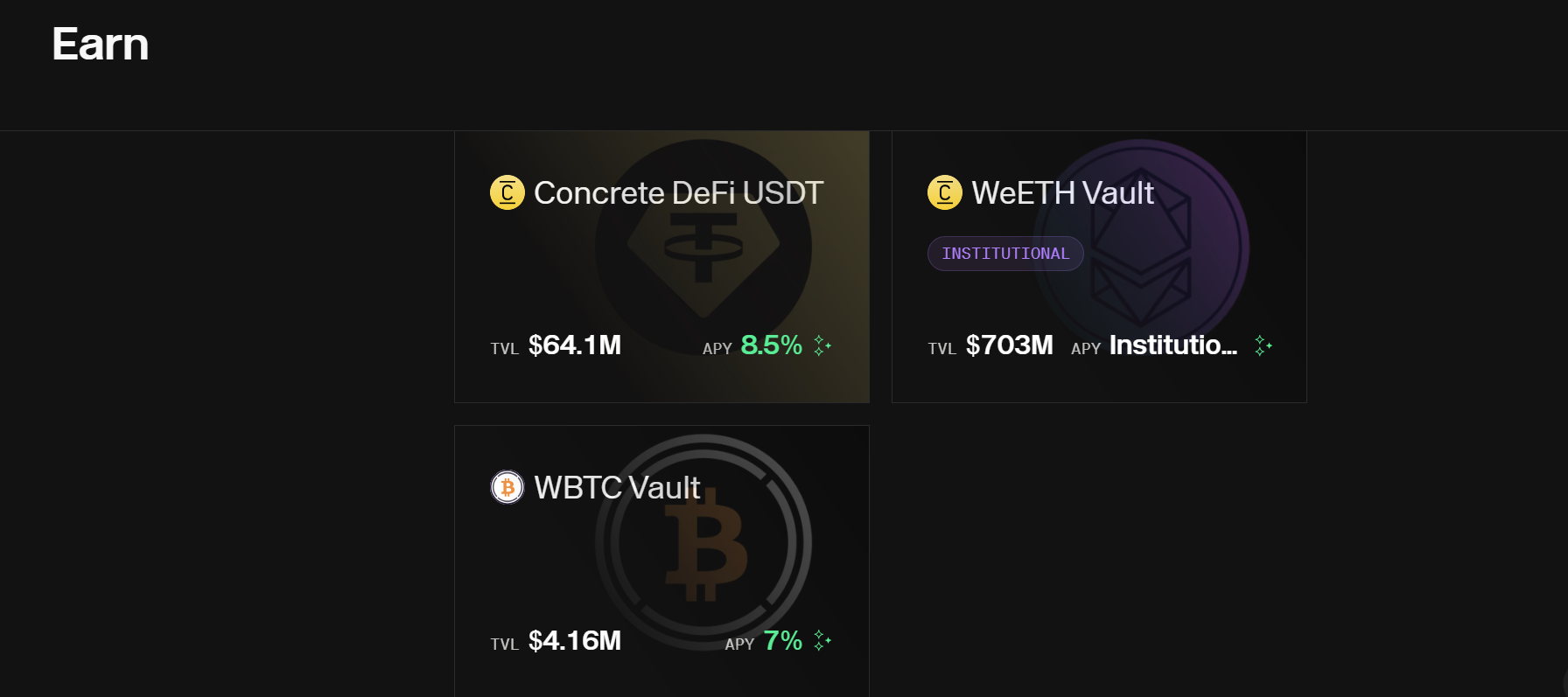
The future of DeFi belongs to those who move from guessing to structured exposure. This is the core philosophy behind Concrete Vaults.
Rather than requiring users to manually calculate delta, monitor liquidation thresholds, or time rebalances, Concrete Vaults provide a sophisticated infrastructure to handle the “dirty work” of yield generation.
Concrete Vaults help solve the yield gap by:
- Automating Allocation: Moving capital to the most efficient sources of organic yield.
- Active Strategy Management: Executing complex positions that would be too gas-intensive or time-consuming for an individual.
- Risk Mitigation: Dynamically rebalancing positions to protect against volatility and minimize impermanent loss.
By utilizing app.concrete.xyz, users can move away from the “illusion” of high APY and toward a framework of Net Sustainable Return.
The Core Insight
Yield is not just a number on a dashboard. It is a formula:
$$Real\ Yield = (Revenue — Cost) \pm Risk\ Adjustment$$
When you stop chasing the headline figure and start looking at the net architecture of the trade, you stop being a subsidy and start being a participant. Stop guessing, and start engineering your DeFi future at app.concrete.xyz.