--
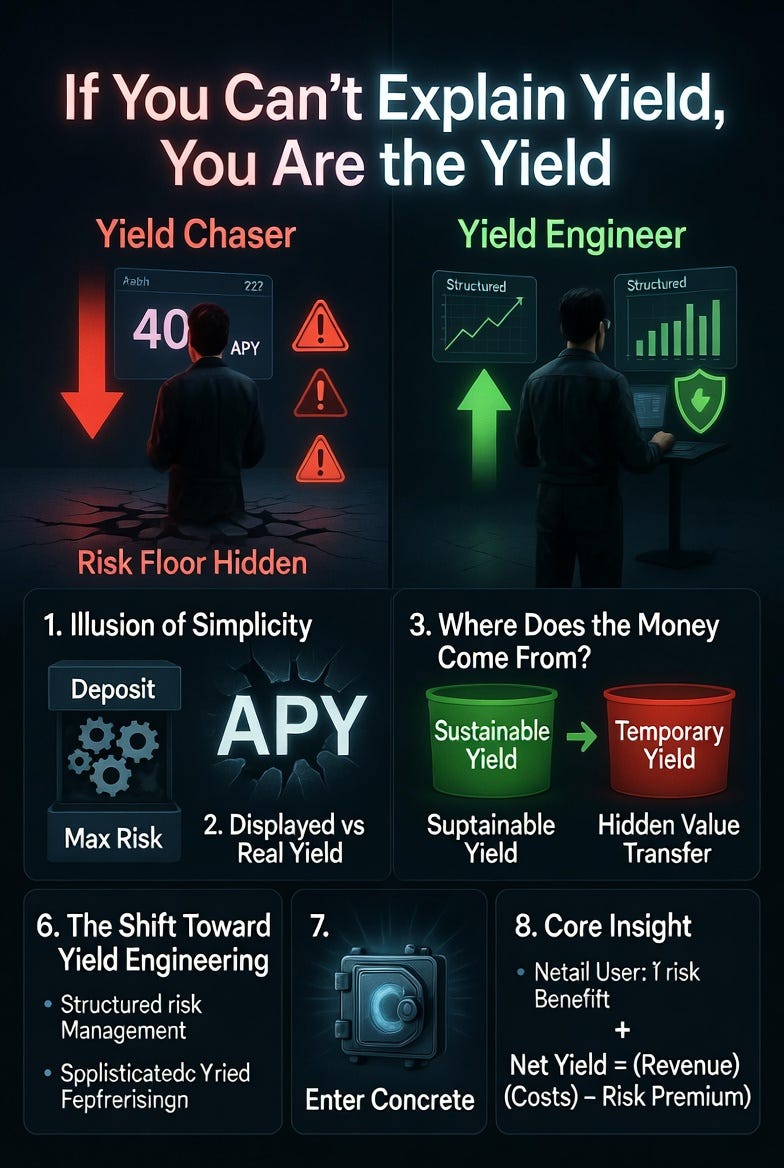
If You Can’t Explain Yield, You Are the Yield
1️⃣ The Illusion of Simplicity
DeFi interfaces are designed for clarity and speed.
You deposit assets.
You see yield.
You watch your balance grow.
No friction. No complexity. No explanation.
But that’s the illusion.
What looks like a straightforward return is often the result of multiple interacting mechanisms — fees, volatility, incentives, and market structure — all layered beneath a single number.
Yield appears simple on the surface, but underneath, it is anything but.
2️⃣ The Gap Between Displayed and Real Yield
The number you see is rarely the number you actually earn.
Displayed APY is often gross yield, not net outcome.
Once you look deeper, several factors begin to eat into returns:
Impermanent loss from price divergence
Rebalancing costs in active strategies
Execution friction like slippage and gas fees
Volatility drag affecting compounding
Strategy inefficiencies over time
A vault showing 80% APY might deliver significantly less in practice — sometimes even negative returns under certain conditions.
The gap between expectation and reality is where many users lose without realizing why.
3️⃣ Where Yield Actually Comes From
Yield is not magic. It is always sourced from somewhere.
In DeFi, the primary drivers include:
Trading fees paid by market participants
Lending activity where borrowers pay interest
Arbitrage opportunities exploited across markets
Liquidations in over-leveraged positions
Token incentives and emissions
But here’s the key insight:
Not all yield is equal.
Some yield is organic and sustainable (e.g., trading fees, lending demand)
Some is temporary and inflationary (e.g., token emissions)
Understanding the difference is critical.
Because unsustainable yield doesn’t disappear — it gets redistributed.
4️⃣ Hidden Value Transfer
This is where things become uncomfortable.
If you don’t understand the system, you may be subsidizing it.
This happens when users:
Provide liquidity without fully understanding exposure
Earn incentives while unknowingly absorbing downside risk
Enter positions without modeling possible outcomes
In these cases, yield is not just earned — it is transferred.
From the uninformed…
To the informed.
That’s the real meaning behind the idea:
If you can’t explain your yield, you are the yield.
5️⃣ Why Outcomes Differ
Two users can interact with the same protocol — and walk away with completely different results.
Why?
Because they approach it differently.
Some optimize purely for headline APY
Others evaluate structure, cost, and embedded risk
More advanced participants model scenarios before deploying capital
Same system. Same opportunities.
Different outcomes.
The difference is not luck.
It’s understanding.
6️⃣ From Yield Chasing to Yield Engineering
DeFi is evolving.
We are moving from:
Yield chasing → Yield engineering
This shift changes everything.
Instead of blindly pursuing high APYs, users are starting to:
Model expected outcomes
Actively manage risk exposure
Optimize strategies over time
Focus on net returns, not headline numbers
Yield is no longer something you stumble into.
It becomes something you design.
7️⃣ The Role of Concrete Vault Infrastructure
This is where structured systems like Concrete Vaults come in.
Rather than leaving users to navigate complexity alone, vault infrastructure helps by:
Automating capital allocation
Managing multi-layered strategies
Rebalancing positions dynamically
Reducing human error and inefficiencies
Instead of guessing what might happen, users gain structured exposure to well-defined strategies.
It bridges the gap between raw DeFi complexity and usable financial outcomes.
8️⃣ The Core Insight
At its core, yield is not just a number on a screen.
It is:
Revenue
– Cost
Adjusted for Risk
Once you understand this, everything changes.
You stop chasing numbers.
You start analyzing systems.
You stop reacting.
You start positioning.
Because in DeFi, the real edge isn’t access.
Explore Concrete at app.concrete.xyz