I Read Arcium’s Dark Pool Article From a Year Ago. It Underestimated One Thing!
--
In May 2025, Arcium published a piece called “Redefining DeFi With On-Chain Dark Pools”. It opened with a fact that most DeFi people don’t know: roughly 40% of daily U.S. equity trading runs through dark pools. It walked through how those pools work, why they’re so broken (Credit Suisse, Barclays, Merrill Lynch — all fined for manipulating the very systems their clients trusted), and why Arcium’s MPC infrastructure could finally build one that didn’t require trusting a Goldman Sachs to keep the secrets.
It was a good article. It got the market opportunity right. It correctly identified why on-chain dark pools are one of the most valuable products that don’t exist yet.
But twelve months on, with a lot more data and a mainnet now live, I think it understated one specific thing: the MEV problem on Solana was far more structural than the article implied — and that actually makes the case for encrypted compute stronger, not weaker.
What the Article Got Perfectly Right
Let me start with what held up. The core argument was simple: dark pools prevent front-running by keeping trade details hidden until after execution. In TradFi, this solves a real problem for institutional traders who can’t show their hand. In Web3, the same logic applies — maybe more urgently, because blockchains are radically transparent by design.
The original article pointed out that Solana already had serious DEX volume: Jupiter passing $240 million in spot trading, Raydium at $2.1 billion. The argument was that even routing a fraction of that through an encrypted dark pool would represent an enormous opportunity.
That framing was correct, and the numbers have only grown since. By the end of 2025, roughly 415 million SOL was staked — about 75% of total supply — and institutional inflows in Q3 2025 alone were estimated at $530 million. The market is there. The demand for better trade execution is there.
The article also correctly identified the Arcium-specific advantage: MPC enables shared private state, meaning two traders can interact with the same encrypted order book without either of them — or any single node — seeing the full picture. This is structurally different from a zero-knowledge proof, which can verify something happened correctly but doesn’t enable the kind of multi-party coordination that a real order book requires.
What the Article Underestimated
Here’s the part the original article glossed over: the MEV problem on Solana in 2025 turned out to be significantly worse than anyone publicly acknowledged at the time it was written.
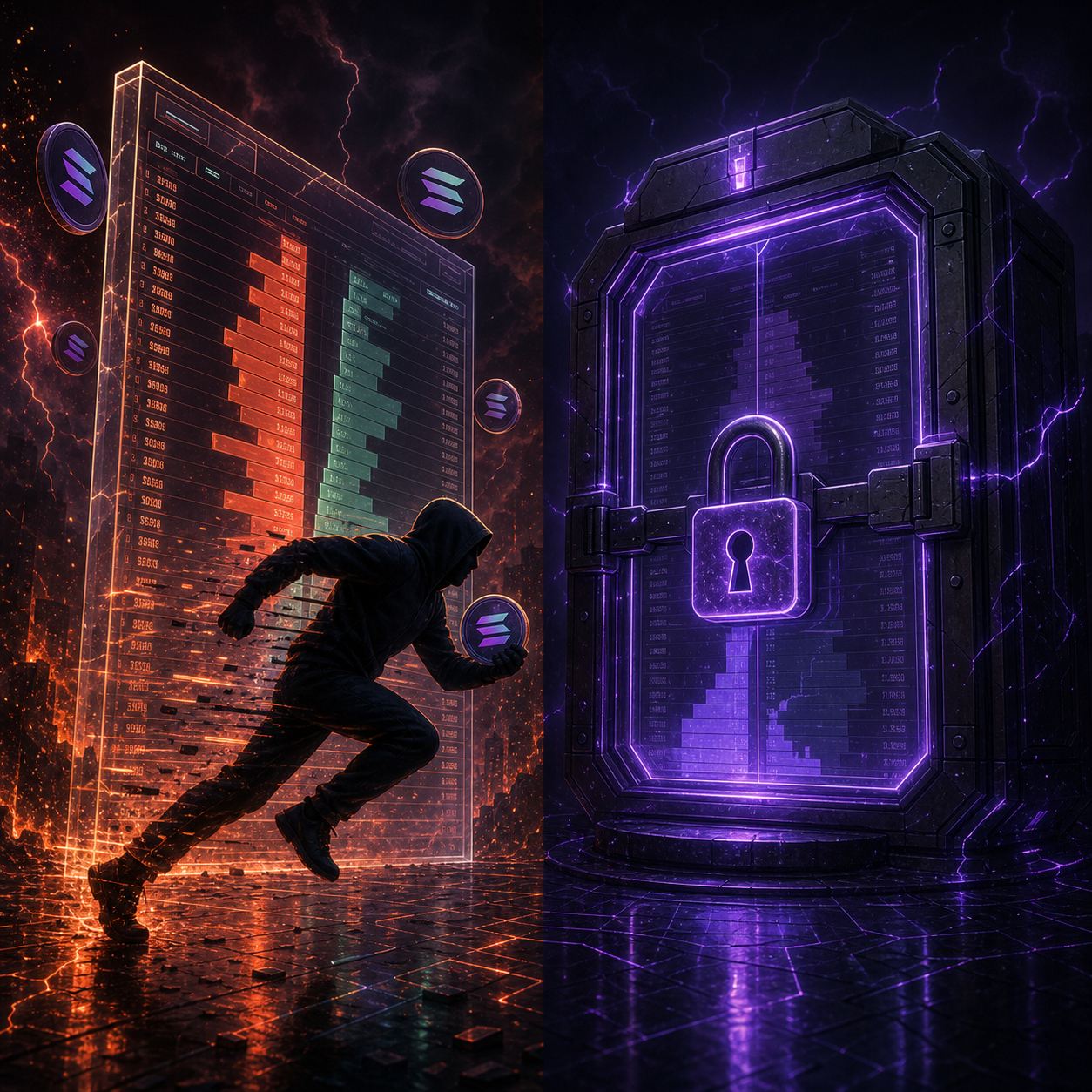
Research published later in 2025 estimated that sandwich attacks had extracted between $370 million and $500 million from Solana users over a 16-month period. Some validators were including sandwich attacks in up to 27% of the blocks they produced. Wide sandwiches — where the front-run and back-run occur across different leader slots — accounted for 93% of all attacks by the end of the year, specifically because they evaded single-slot detectors that the ecosystem had deployed as a fix.
In other words, the MEV problem on Solana wasn’t just bots in the mempool. It had moved to the validator level. Jito Foundation closed its public mempool in March 2025, which removed the easiest attack surface. But the broader pattern — validators using their leader position to extract value from trades they could see — is precisely the kind of structural problem that zero-knowledge alone doesn’t solve.
ZK proofs can hide your inputs before a transaction. What they can’t do is hide shared state between multiple parties executing simultaneously. That gap is exactly why Arcium’s partnership with Darklake — announced in April 2025 — structured things the way it did. Darklake’s zkAMM handles pre-trade privacy. Arcium handles post-trade confidentiality and shared order book state. ZK protects you from bots seeing your individual order. MPC protects you from anyone seeing the collective book.
The original Arcium article mentioned front-running and MEV in passing. The actual severity of the problem — $500 million extracted, validator-level coordination attacks, 93% of sandwiches being wide — wasn’t in those pages. If it had been, the article would have argued the case for encrypted dark pools harder, not softer.
What Happened Next
A few things are worth tracking since the original piece was published.
The dark pool concept moved from demo to production. During Public Testnet Phase 1, Arcium shipped a working dark pool application as one of the first four applications on the network — alongside Umbra, Hidden Warrior, and Arcane Hands. The team flagged performance bottlenecks in the dark pool during Phase 1 and specifically called them out in the October 2025 roadmap update as something they’d resolved heading into Phase 2.
The Darklake partnership formalized a division of labor that the original article only hinted at. Darklake handles execution logic, Arcium powers the encrypted coordination between users. Together they cover what neither could cover alone.
And in April 2026, Arcium published a “Request For Products” post that expanded the dark pool concept significantly. It’s worth reading alongside the original article. Where the 2025 piece focused specifically on order-book dark pools, the RFP post extends the vision to:
· Private perpetuals — because public onchain perp positions let third parties target your liquidation, and the James Wynn incident in 2025 was a public example of exactly how this gets exploited
· Private lending and borrowing — loan-to-value ratios and collateral positions being public make users vulnerable to targeted liquidations in ways they can’t control
· Blind auctions — sealed-bid mechanisms for token launches, bond sales, and procurement, which is precisely what Crafts is now building on Arcium’s mainnet infrastructure
· Confidential DAO treasuries — because the current model of a DAO’s full balance sheet being publicly visible creates competitive and strategic disadvantages that no company in TradFi would accept
The thread connecting all of these is the same one the original dark pool article identified: full transparency is a double-edged sword. It enables trustlessness, but it also enables exploitation. Dark pools were the first application. They’re not the last.
The Institutional Timing Question
One thing the original article mentioned but didn’t dwell on was the timing question: are institutions actually moving on-chain? If not, dark pools are a solution to a problem that doesn’t have enough volume yet to matter.
Since May 2025, this has clarified considerably. Institutional inflows to Solana in Q3 2025 were estimated at $530 million. The TRADE’s 2026 predictions series, published in December 2025, identified institutional digital asset adoption as the dominant theme for 2026 — specifically calling out tokenized real-world assets and on-chain derivatives as the fastest-moving categories. Consensus 2026, held in May 2026, was widely described as the most institutionally focused crypto conference in several years.
The dark pool article’s opening thesis — that institutional capital is moving on-chain and will need the same privacy infrastructure it has in TradFi — has held up. If anything, it’s arriving faster than the article implied.
What’s Still Unproven
I don’t want to oversell this. Dark pools built on encrypted compute on Solana are still very early. There is no production dark pool on Arcium with real institutional order flow running through it today. The bottlenecks that were resolved in Phase 1 will face new stress tests at scale. Getting risk-averse institutional traders to trust a new piece of cryptographic infrastructure — even one with an excellent track record in traditional enterprise settings via the Inpher acquisition — takes time and proof.
The Darklake partnership is a real step, but Darklake itself is still a young protocol. And the broader DeFi ecosystem still has MEV mitigation options that will continue improving — Jito’s mempool closure, validator blacklisting, protocol-level protections — that reduce (though don’t eliminate) the urgency for any single solution.
The honest version is: the market is real, the technology works in controlled settings, the timing with institutional flows is good, and there’s still meaningful product risk in getting from a working dark pool demo to an institutional-grade venue with real volume.
Why This Matters for the Encrypted Echo
What struck me about going back to the original article a year later is how the events since have validated its central argument and raised the stakes beyond what it described.
The article said: front-running and market manipulation are why TradFi dark pools exist, and they’re just as real — maybe more so — on-chain.
What 2025 added: the specific mechanism by which they’re real (validator-level coordination, $500 million extracted) is more severe and more structurally embedded than the article suggested. The solution isn’t just “build a dark pool.” It’s “build infrastructure where the matching and order book live in encrypted shared state that validators themselves can’t read.”
That’s what Arcium enables. The original article was right about the destination. The road there turned out to be more urgent than it looked at the time.
This article directly builds on Arcium’s May 2025 blog post: “Redefining DeFi With On-Chain Dark Pools”. Additional references below.
References
1. Arcium — “Redefining DeFi With On-Chain Dark Pools” (May 2025)
https://www.arcium.com/articles/redefining-defi-with-on-chain-dark-pools
2. Arcium — “Arcium Partners with Darklake to Advance Encrypted DeFi” (April 2025)
https://www.arcium.com/articles/arcium-partners-with-darklake-to-advance-encrypted-defi
3. Arcium — “Request For Products: What To Build On Arcium” (April 2026)
https://www.arcium.com/articles/request-for-products
4. Arcium — Roadmap Update (October 2025)
https://www.arcium.com/articles/arcium-roadmap-update
5. bloXroute — “A New Era of MEV on Solana” (October 2025)
https://bloxroute.com/pulse/a-new-era-of-mev-on-solana/
6. MEXC / CryptoNinjas — “Solana Slashes $500M Sandwich Attacks as 75% of SOL Gets Staked in 2025 Security Overhaul” (December 2025)
https://www.mexc.com/news/339517
7. Cryptopolitan — “Solana is no longer threatened by sandwich attacks” (April 2026)
https://www.cryptopolitan.com/solana-no-longer-threatened-sandwich-attacks/
8. The TRADE — “2026 Predictions: The Institutionalisation of Digital Assets” (December 2025)
https://www.thetradenews.com/the-trade-predictions-series-2026-the-institutionalisation-of-digital-assets/