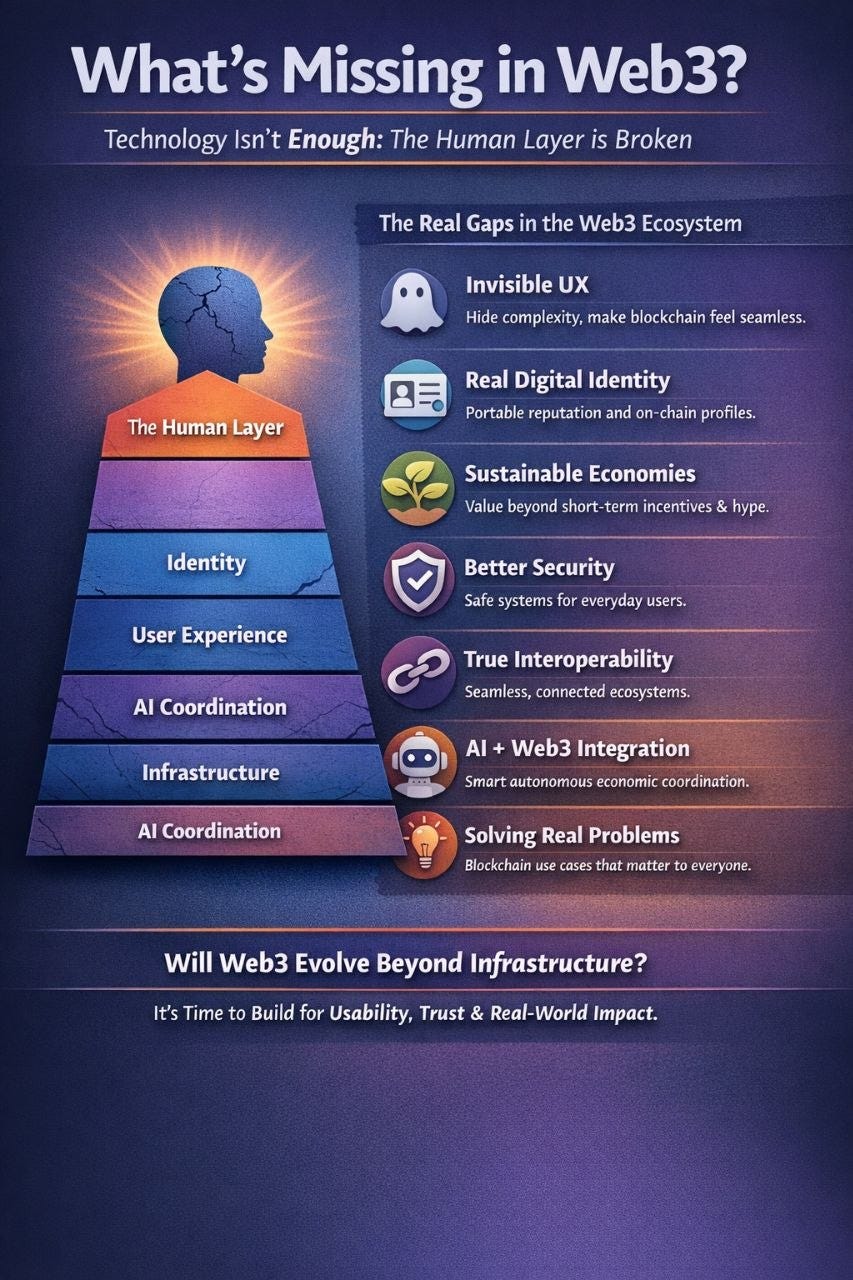
What Builders Are Overlooking in Web3.
 Estylsmart4 min read·Just now
--
The Web3 industry has evolved fast.
We now have faster blockchains, better wallets, AI integrations, real-world asset tokenization, and ecosystems processing millions of transactions daily.
But despite all this progress, one uncomfortable truth remains:
Most people still do not need Web3.
That is not because the technology is weak. It is because too much of the ecosystem is still built around infrastructure instead of human experience.
The next phase of Web3 growth will not come from who builds the fastest chain. It will come from who solves the deepest usability and trust problems.
Here are the major things missing from today’s Web3 ecosystem that builders should focus on more seriously.
1. Invisible User Experience.
One of the biggest problems in Web3 is that users are constantly reminded they are using blockchain technology.
Gas fees. Seed phrases. Bridge risks. Wallet approvals. Network switching. Transaction signing.
For crypto-native users, this feels normal. For everyone else, it feels exhausting.
The best technology usually disappears into the background.
People do not think about TCP/IP when sending messages online. They simply use apps that work.
Web3 needs the same transition.
The winning products of the future may not even market themselves as “crypto apps.” They will simply provide better ownership, payments, identity, or coordination without forcing users to understand blockchain mechanics.
Builders should focus less on exposing complexity and more on hiding it intelligently.
2. Real Digital Identity.
Today’s Web3 identity is still fragmented.
A wallet address alone is not a meaningful identity layer.Users need portable reputations, achievements, contribution history, and social trust that move across ecosystems.
Imagine:
- Your gaming reputation follows you across games.
- Your governance participation becomes verifiable credibility.
- Your work across DAOs builds an on-chain professional profile.
- AI agents can recognize trusted economic behavior.
This creates continuity across the internet.
Without a strong identity layer, Web3 remains transactional instead of relational.
The future ecosystem will likely reward reputation more than speculation.
3. Sustainable Economies Instead of Short-Term Incentives.
A lot of Web3 ecosystems still rely heavily on emissions, token rewards, and temporary hype cycles.
That model attracts attention quickly. But it rarely builds long-term economic stability.
Many projects optimize for:
- TVL spikes.
- Airdrop farming.
- Yield extraction.
- Temporary liquidity.
Instead of:
- Durable user behavior.
- Real utility.
- Long-term retention.
- Ecosystem productivity.
Builders should ask a harder question:
“If token incentives disappeared tomorrow, would users still stay?”
That question exposes whether a product creates genuine value or simply financial activity.
The strongest ecosystems of the next decade will likely behave more like digital nations than speculative casinos.
4. Better Security for Normal People.
Security in Web3 still assumes users are highly technical.
That is unrealistic.
Most people should not have to worry about:
- Malicious approvals.
- Phishing signatures.
- Wallet drainers.
- Bridge exploits.
- Fake interfaces.
The industry often treats security as the user’s responsibility.
But mainstream adoption requires systems that protect users by default.
Builders should think beyond decentralization alone and focus on resilient trust architecture:
- Smart recovery systems.
- Transaction simulations.
- AI-powered fraud detection.
- Human-readable permissions.
- Safer wallet design.
The easier it becomes to lose everything with one click, the harder mass adoption becomes.
5. Interoperability That Actually Feels Seamless.
Web3 talks constantly about interoperability.
But in practice, ecosystems still feel isolated.
Users bridge assets manually. Communities remain chain-specific. Liquidity fragments across networks.
Most interoperability today is technical infrastructure. Very little of it feels natural to ordinary users.
The future likely belongs to ecosystems where:
- Assets move seamlessly.
- Identities travel freely.
- Applications communicate intelligently.
- Users barely notice chain boundaries.
Builders should stop thinking in terms of “winning chains” and start thinking in terms of connected digital economies.
6. Meaningful AI + Web3 Integration.
Right now, many AI + crypto projects feel forced.
Adding a token to an AI product does not automatically create value.
The deeper opportunity is economic coordination between intelligent systems.
Imagine:
- AI agents hiring other AI agents autonomously.
- Agents paying for data access instantly.
- Decentralized compute marketplaces.
- Verifiable AI behavior on-chain.
- Autonomous business operations.
Web3 can provide:
- Ownership.
- Payments.
- Verification.
- Coordination infrastructure.
AI provides:
- Intelligence.
- Automation.
- Decision-making.
Together, they could create entirely new economic systems.
Builders paying attention to this intersection early may help define the next internet economy.
7. Products That Solve Non-Crypto Problems.
This may be the most important missing piece.
Too many Web3 products solve crypto problems for crypto users.
Mass adoption probably comes when users benefit from blockchain technology without caring about blockchain itself.
People care about:
- Earning income.
- Sending money.
- Protecting ownership.
- Identity.
- Gaming.
- Education.
- Community.
- Opportunity.
Web3 succeeds when it improves these experiences better than traditional systems.
Not when it simply introduces more tokens.
Final Thoughts.
Web3 does not necessarily need more chains. It needs better experiences.
The infrastructure era is slowly maturing. Now the focus shifts toward usability, trust, coordination, and real-world utility.
The projects that dominate the next cycle may not be the loudest. They may simply be the ones that make decentralized technology feel invisible, safe, useful, and human.
That is the gap builders should pay more attention to now.
Visual / Infographic Ideas.
1. “The Missing Layers of Web3.”
A layered ecosystem graphic showing:
- Infrastructure.
- Identity.
- Security.
- UX.
- AI Coordination.
- Real Utility.
With the top “human layer” highlighted as the weakest point.
2. “Why Mass Adoption Hasn’t Happened Yet.”
Split-screen comparison:
Left: complex wallet approvals, bridges, gas fees
Right: simple seamless user experience
Caption:
“Technology isn’t enough. Experience decides adoption.”
3. “Speculation vs Sustainable Economies.”
A chart comparing:
- Short-term hype cycles.
- Long-term ecosystem retention.
Showing why sustainable systems matter more.
4. “Future AI + Web3 Economy.”
Futuristic network of AI agents exchanging value autonomously using blockchain rails.
5. “The Invisible Blockchain Future”
An illustration where users interact naturally with apps while blockchain infrastructure runs quietly beneath the surface.