How Traders Can Use Live Signals for Indices, Commodities, FX, and Crypto
 a11 min read·Just now
--
Trading is not only about knowing what to buy or sell. It is also about knowing when to enter, when to exit, when to wait, and when to protect capital. Many traders spend years learning charts, indicators, price action, macroeconomic trends, and market psychology. Still, when real money is involved, even experienced traders can struggle with execution.
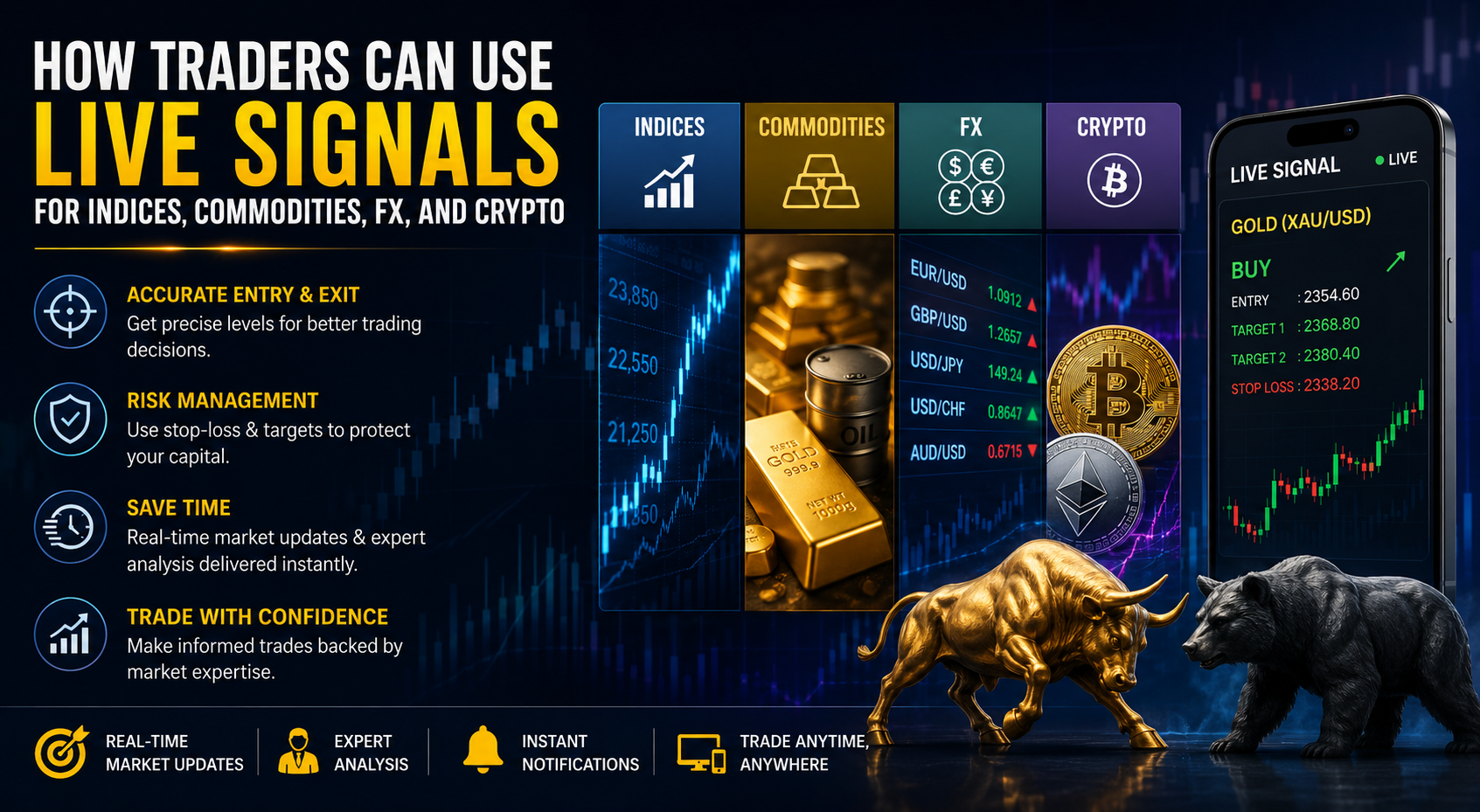
This is where live signals become useful. A live signal is a timely trading alert that gives traders a specific view of the market. It may include an entry zone, target levels, stop-loss level, risk warning, trend bias, or market timing window. Instead of reacting randomly to price movement, traders can use live signals as part of a planned strategy.
Live signals are especially valuable in markets such as indices, commodities, FX, and crypto because these assets often respond quickly to global events. Inflation data, central bank speeches, employment reports, geopolitical developments, crude oil inventory data, dollar movement, and risk sentiment can all create sudden volatility. Traders who receive timely signals can stay better prepared.
However, live signals should not be treated as guaranteed profit calls. They work best when traders use them with proper risk management, capital discipline, and market awareness. A good signal helps traders improve timing, but the trader must still manage position size, stop loss, and emotional control.
What Are Live Trading Signals?
Live trading signals are real-time or near real-time alerts that guide traders about possible market opportunities. These signals may be generated through technical analysis, price behavior, macro triggers, quantitative models, sentiment indicators, or cycle-based timing methods.
A signal may say that a particular index looks bullish above a certain level. Another signal may suggest that crude oil could weaken below a support zone. A crypto signal may highlight a breakout pattern, while an FX signal may warn that a currency pair is near a major resistance area.
The best signals are simple, clear, and actionable. Traders do not need long explanations during market hours. They need clarity. A useful live signal should help answer four key questions: what asset is being tracked, what is the direction, where is the entry zone, and where should risk be controlled?
For example, an index signal may guide traders to watch a support zone in the S&P 500, Nasdaq, Nifty, or Dow Jones. A commodities signal may focus on gold, silver, crude oil, or natural gas. An FX signal may track EUR/USD, GBP/USD, USD/JPY, or USD/INR. A crypto signal may cover Bitcoin, Ethereum, or major altcoins.
Why Live Signals Matter for Modern Traders
Markets are more connected than ever. A move in the U.S. dollar can affect gold. A change in bond yields can affect technology stocks. A sudden rise in crude oil can influence inflation expectations. A sharp movement in Bitcoin can affect the wider crypto market. Because of this, traders need fast and structured information.
Live signals help reduce confusion. Instead of watching too many charts at the same time, traders can focus on selected opportunities. This helps them avoid overtrading and emotional entries.
Another benefit is discipline. Many traders lose money not because their market view is always wrong, but because they enter too early, exit too late, ignore stop losses, or chase price after a breakout. Live signals can create a framework where every trade has a reason, a level, and a risk plan.
Live signals also help traders save time. Not every trader can monitor global markets all day. Some traders are professionals, business owners, analysts, or part-time market participants. For them, timely alerts can act as a market companion.
Using Live Signals for Index Trading
Index trading is popular because indices represent the broader market. Traders often track instruments such as the S&P 500, Nasdaq 100, Dow Jones, Russell 2000, Nifty 50, Bank Nifty, FTSE 100, DAX, CAC 40, and Nikkei 225. These markets react strongly to macroeconomic data, earnings trends, interest rates, and investor sentiment.
Live signals for indices can help traders identify market direction. For example, if the Nasdaq is trading above a key support level and technology stocks are strong, a live signal may suggest a bullish bias. If the S&P 500 breaks below an important moving average or support zone, a signal may warn traders to reduce long exposure or consider short setups.
Index signals are useful because indices often move in trends. When institutional money flows into equities, indices can rally for several sessions. When risk appetite weakens, indices can fall quickly. A live signal can help traders avoid entering against the dominant move.
For intraday traders, index signals may focus on support and resistance levels, opening range breakouts, volatility zones, and trend continuation setups. For swing traders, the signals may focus on multi-day movement, macro event timing, sector rotation, and broader risk sentiment.
A trader using index live signals should always watch position size. Indices can move sharply during CPI releases, Federal Reserve meetings, jobs data, and earnings season. Signals can help with timing, but risk control remains essential.
Using Live Signals for Commodities
Commodities are among the most important markets for traders because they reflect global demand, supply, inflation, and geopolitical risk. Gold, silver, crude oil, natural gas, copper, and agricultural commodities can create strong opportunities for active traders.
Gold often reacts to the U.S. dollar, bond yields, inflation expectations, central bank policy, and safe-haven demand. A live signal in gold may highlight whether the metal is likely to break higher, consolidate, or correct. Traders can use these signals to time entries near support, resistance, or breakout levels.
Crude oil signals are also valuable because oil prices respond to OPEC decisions, inventory reports, geopolitical tension, demand expectations, and currency movement. Crude oil can be highly volatile. Therefore, traders need clear stop-loss levels and target zones.
Silver and copper often reflect industrial demand and liquidity cycles. When global growth expectations improve, these metals may attract buying interest. When demand concerns rise, they may weaken. Live signals can help traders identify these shifts earlier.
Commodity traders should be careful during data-heavy periods. Crude oil inventory reports, inflation data, central bank meetings, and geopolitical news can cause sharp movements. Live signals should be used with disciplined risk management, especially in leveraged commodity trades.
Using Live Signals for FX Trading
The foreign exchange market is one of the largest and most liquid markets in the world. FX traders focus on currency pairs such as EUR/USD, GBP/USD, USD/JPY, USD/CHF, AUD/USD, USD/CAD, and USD/INR. Currency prices move based on interest rates, inflation, economic growth, capital flows, and central bank policy.
Live FX signals help traders track currency strength and weakness. For example, if the U.S. dollar is strengthening because of rising yields, signals may favor USD-based trades. If the euro is weakening due to poor economic data, a signal may suggest caution on EUR/USD long positions.
FX signals are useful because currency markets often move around key sessions. The London session, New York session, and Asian session can each create different trading conditions. A live signal can help traders understand when momentum is building and when the market is likely to remain range-bound.
FX traders should pay close attention to economic calendars. Central bank rate decisions, inflation reports, employment data, GDP numbers, and speeches by policymakers can change currency direction quickly. A good live signal service should help traders prepare for such volatility rather than react after the move is over.
Risk management is especially important in FX because leverage can magnify both gains and losses. Traders should use live signals as guidance, not as permission to over-leverage.
Using Live Signals for Crypto Trading
Crypto markets are open 24 hours a day, seven days a week. This makes them exciting, but also risky. Bitcoin, Ethereum, Solana, XRP, BNB, and other crypto assets can move sharply at any time. Unlike traditional markets, crypto does not close for weekends or holidays.
Live crypto signals help traders manage this constant movement. A signal may highlight a Bitcoin breakout, Ethereum support zone, or altcoin momentum setup. It may also warn traders when the market is overextended or when volatility is likely to increase.
Crypto signals are valuable because the market is highly sentiment-driven. News, ETF flows, regulatory updates, whale movements, liquidations, and social media trends can create fast price action. Traders who wait too long may enter after the move has already happened.
However, crypto traders must be extra careful. False breakouts are common. Liquidity can disappear quickly in smaller coins. Stop-loss hunting and sudden reversals are frequent. Therefore, live signals should be combined with strong risk control.
For Bitcoin and Ethereum, traders may use signals to track trend direction, support and resistance, funding rates, liquidation zones, and macro correlation with risk assets. For altcoins, traders should use smaller position sizes because volatility is usually higher.
How Live Signals Improve Timing
Timing is one of the hardest parts of trading. A trader may correctly identify that gold is bullish, but if the entry is too late, the trade may fail. Another trader may believe that an index will fall, but if the short position is opened too early, the market may move higher first and trigger the stop loss.
Live signals improve timing by giving traders specific market windows. Instead of guessing, traders receive structured alerts based on price levels, momentum, trend behavior, or market cycles.
Good timing helps traders in three ways. First, it reduces emotional decisions. Second, it improves risk-reward. Third, it helps traders avoid unnecessary trades.
For example, buying near support with a clear stop loss is usually better than chasing price after a large rally. Selling near resistance with confirmation is usually better than shorting randomly. Live signals help traders wait for better levels.
Live Signals and Risk Management
No signal is perfect. Even the best market analysis can fail because markets are uncertain. This is why risk management is more important than prediction.
Every trader using live signals should decide how much capital to risk per trade. Many disciplined traders risk only a small percentage of their account on a single trade. This helps them survive losing streaks and remain active when better opportunities appear.
Stop-loss levels are also important. A signal without a stop-loss plan can be dangerous. Markets can move against any view. A clear exit level protects the trader from emotional decision-making.
Traders should also avoid taking every signal blindly. They should consider their trading style, capital size, risk appetite, and time horizon. A scalper, intraday trader, swing trader, and positional trader may all use signals differently.
The goal is not to win every trade. The goal is to create a repeatable process where profits from good trades can outweigh losses from failed trades.
How Beginners Should Use Live Signals
Beginners should use live signals as a learning tool, not only as trade alerts. Each signal can teach something about market structure, timing, support, resistance, volatility, and risk control.
A beginner should start with small position sizes. Before using real capital aggressively, they should observe how signals perform across different market conditions. They should track entries, exits, stop losses, and results in a trading journal.
Beginners should also avoid trading too many assets at once. It is better to focus on one or two markets first. For example, a trader may begin with gold and Nasdaq, or Bitcoin and EUR/USD. Once they understand signal behavior, they can expand to more markets.
The most important lesson for beginners is patience. Not every market movement requires a trade. Live signals are most useful when they help traders wait for high-quality setups.
How Experienced Traders Can Use Live Signals
Experienced traders can use live signals as confirmation, diversification, and market timing support. Many skilled traders already have their own methods. They may use technical analysis, options flow, macro research, or quantitative models. Live signals can add another layer of insight.
For example, a trader may already be bullish on gold due to macro conditions. If a live signal also confirms a bullish setup near a support zone, the trader may gain more confidence. If the signal warns of short-term weakness, the trader may wait for a better entry.
Experienced traders can also use live signals across asset classes. If indices are weakening, the dollar is rising, and gold is approaching resistance, a trader may see a broader risk-off pattern. This multi-market view can improve decision-making.
Professional traders understand that signals are not magic. They are tools. When used correctly, they can help sharpen timing, reduce noise, and improve execution discipline.
Common Mistakes Traders Make With Live Signals
One common mistake is overtrading. Some traders believe every signal must be traded. This is not true. Traders should filter signals based on their own strategy, risk profile, and market conditions.
Another mistake is ignoring stop losses. A signal may have a strong setup, but if the market moves against it, the trader must respect the risk level. Holding a losing trade without a plan can damage capital.
A third mistake is using too much leverage. This is especially dangerous in commodities, FX, and crypto. High leverage can turn a small market move into a major loss.
Another common mistake is chasing late entries. If a signal gives an entry zone and price has already moved far away from that zone, the trader should wait. Poor entries reduce the quality of the trade.
Traders should also avoid emotional averaging. Adding to a losing position without a clear plan can increase risk. Signals should support discipline, not impulsive behavior.
What Makes a Good Live Signal Service?
A good live signal service should be clear, timely, and practical. Traders should not receive vague comments that create more confusion. A strong signal should provide useful market direction and actionable levels.
It should also cover risk. A signal that only gives targets without risk guidance can mislead traders. Markets can reverse quickly, so every trade idea needs protection.
Another important quality is consistency. Traders need signals that follow a structured approach. Random alerts can create confusion. A consistent process helps traders understand the logic behind the market view.
A good service should also explain the broader market context when needed. For example, if gold is moving because of U.S. dollar weakness, traders should know that context. If crypto is rallying due to risk-on sentiment, that should be clear.
For multi-asset traders, coverage across indices, commodities, FX, and crypto is useful because markets often influence one another. A trader watching only one asset may miss the bigger picture.
Why Multi-Asset Live Signals Are Powerful
Many traders focus only on one market. However, global markets are connected. A strong U.S. dollar can pressure commodities. Rising bond yields can affect indices. Weak risk sentiment can hurt crypto. Oil movement can influence inflation expectations. Gold can react to both safe-haven demand and interest rate expectations.
Multi-asset live signals help traders see these connections. Instead of looking at one chart in isolation, traders can understand how different markets are interacting.
For example, if indices are falling, the dollar is rising, and Bitcoin is weakening, the overall market may be moving into risk-off mode. In that case, traders may reduce aggressive long positions. If indices are rising, commodities are firm, and crypto is breaking higher, market sentiment may be improving.
This broader view can help traders avoid contradictory trades. It also helps them identify stronger opportunities.
Conclusion
Live signals can be a valuable tool for traders who want better timing, clearer execution, and stronger market discipline. They can help traders navigate indices, commodities, FX, and crypto with more structure. Instead of reacting emotionally to every price movement, traders can follow planned alerts, defined levels, and risk-controlled setups.
However, live signals should never replace risk management. Traders must still control position size, follow stop losses, avoid over-leverage, and respect market uncertainty. The real value of live signals comes when they are used as part of a disciplined trading process.
For beginners, live signals can act as a learning guide. For experienced traders, they can provide confirmation and timing support. For active multi-asset traders, they can create a clearer view of global market movement.
To explore live signals for indices, commodities, FX, and crypto, visit the official page here: https://finance.rajeevprakash.com/products/live-signals/