From RPC Pain in Lagos to Sub-Slot Alpha: Why GetBlock’s Solana Infrastructure Is Built Different
--
As a Nigerian builder, I learned the hard way that milliseconds decide who eats. Here’s the hidden engineering that finally gave me an edge on Solana.
It was 2AM in Lagos.
I had done the research.
Timed the launch perfectly.
Then… nothing.
Transaction failed.
Price already up 40%.
I blamed my internet. Restarted the router. Said a few things I won’t repeat here.
Turns out — my internet was fine.
The problem was the RPC.
Slow. Overloaded. Competing with thousands of other users.
That night, I started digging.
What I found was GetBlock’s low-latency Solana infrastructure — and the layers most people never talk about.
This isn’t another “fast RPC” post.
This is what actually happens when you need to win on Solana.
The Real Problem Most Builders Ignore
Solana doesn’t use a mempool like Ethereum.
Blocks are split into tiny 1,280-byte “shreds” and pushed through a system called Turbine — a hierarchical validator network.
If your node receives those shreds late…
You’re already behind.
Most public RPCs sit at the edge of that network.
By the time data reaches you, the move is gone.
GetBlock flips that.
They connect to high-stake validators early in the Turbine tree and aggregate shreds from multiple sources.
Result:
• 140–150ms earlier block visibility
• +25–30ms faster via Yellowstone gRPC
In a 400ms slot environment, that’s not small.
That’s the edge.
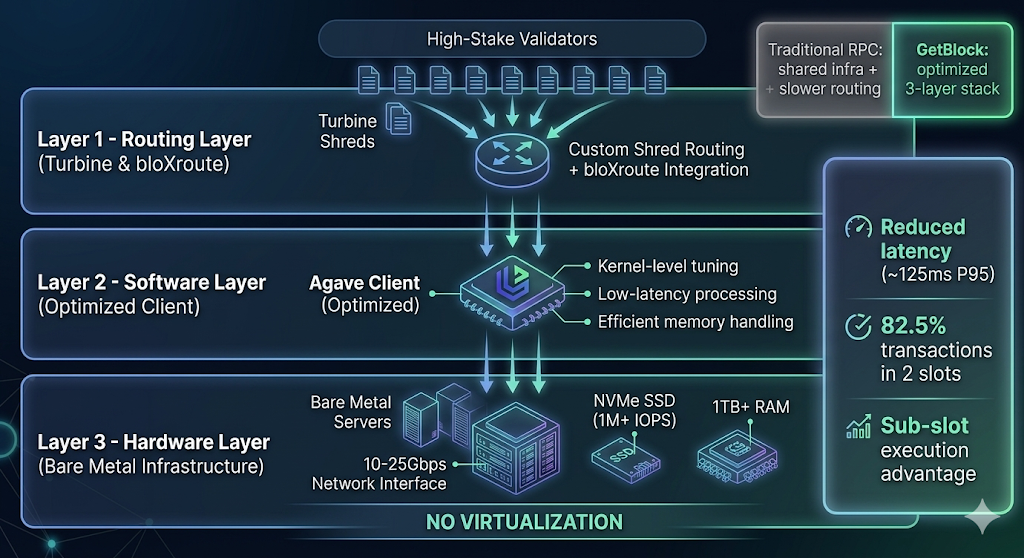
The 3-Layer Engineering Most Threads Skip
This isn’t just “faster nodes.”
GetBlock built a full stack:
1. Routing Layer
Custom Turbine shred paths + bloXroute integration
Priority access through optimized delivery routes
2. Software Layer
Kernel-level optimizations to the Agave client
Faster processing at the OS level
3. Hardware Layer
Pure bare-metal infrastructure:
• 10–25Gbps uplinks
• NVMe SSDs (1M+ IOPS)
• 1TB+ RAM
• No virtualization
No shared environments. No shortcuts.
Just raw performance.
Real Benchmarks (Not Theory)
This is where it gets real.
• P95 latency: ~125ms
• 82.5% of transactions land in 2 slots
• Frankfurt: as low as 6ms (#1 in Europe)
• Global average: <100ms across 27 locations
• Africa (MEA): ~100ms, #1 regionally
For builders in Nigeria…
This hits different.
No more getting wrecked by distance from EU/US nodes.
They Don’t Just Sell Nodes — They Teach You
This part surprised me.
On April 15, GetBlock ran a hands-on workshop:
Building a real-time NFT indexer using Yellowstone gRPC
Streaming directly from validator memory.
No polling. No delays.
Same architecture used by:
• MEV bots
• High-frequency traders
• Real-time dashboards
And the best part?
The code + materials are public.
You’re not just buying infra.
You’re learning how to use it properly.
LandFirst, TradeFirst & The Full Stack
Execution matters just as much as data.
GetBlock’s LandFirst routing sends transactions through 3 parallel paths:
• Native SWQoS connections
• bloXroute BDN
• Jito Block Engine
This boosts landing probability to ~95%+ in optimized setups.
And it’s included.
No extra charge.
Full stack (TradeFirst)
For serious teams:
• End-to-end pipeline (data → execution)
• Fully managed infrastructure
• No ops overhead
Pricing: ~$4,000–5,000/month
Plugins
• Yellowstone gRPC → ~$400/month
• bloXroute WS → ~$700/month
• MEV Protection → ~$50/month
Even solo builders can plug in.
Who This Is Actually For
Let’s be real.
This isn’t for casual users.
If you’re just swapping tokens with public RPCs — you’re fine.
But if you’re:
• Running MEV/searcher bots
• Building real-time analytics
• Trading size where milliseconds matter
• Building from Nigeria or Africa
Then this changes everything.
Final Thought
That 2AM trade failed because of infrastructure I couldn’t see.
Not my strategy.
Not my timing.
Infrastructure.
GetBlock showed me what happens when someone actually builds for sub-slot execution, not just marketing speed.
If you care about being early — not just fast — this is where you start.
Explore GetBlock Solana nodes → https://getblock.io/chains/solana
@getblockio
All benchmarks sourced from CompareNodes and GetBlock engineering publications (March 2026). Performance reflects optimized environments and may vary.