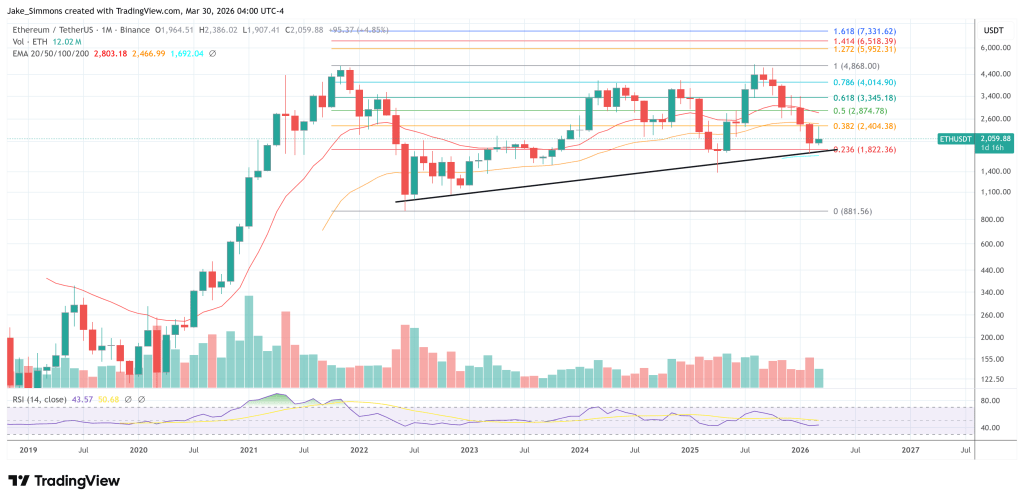
Standard Chartered’s Global Head of Digital Assets Research Geoffrey Kendrick said Ethereum could climb to $40,000 by 2030 and outperform Bitcoin along the way, arguing that the next wave of tokenization, stablecoin growth, and institutional blockchain buildout is likely to land first on Ethereum.
Speaking in a Milk Road interview with John Gillen, Kendrick tied his ETH thesis directly to how traditional finance is approaching on-chain infrastructure. His argument was not that Ethereum wins because of narrative momentum, but because it looks like the safest place for banks, asset managers, and large institutions to start building.
Why Ethereum Could Outperform Bitcoin
Back in January, Kendrick had published a report titled Ethereum outperformance expected. In the interview, he acknowledged that ETH has struggled on price since then, but said the underlying setup remains intact. “The interesting part here for Ethereum is as tradfi gets involved, tradfi is okay to build stuff on Ethereum,” he said. “It’ll be very safe to say I’m going to build on Ethereum layer one, right? Because it’s never gone down. So I think a lot of this stuff in its first instance happens on Ethereum layer 1.”
He pointed to BlackRock’s rollout strategy as a model for how that adoption could unfold. In Kendrick’s view, institutions are likely to launch first on Ethereum mainnet, then expand to other chains and layer-2s later. That sequencing matters, because he sees activity flowing to the network before value disperses elsewhere.
Kendrick said he increasingly views protocol and application fees relative to market cap as one of the more useful ways to think about ETH valuation. More activity in the Ethereum ecosystem, he argued, should translate into a higher token price. “I think that means ETH outperforms now, let’s say for the foreseeable actually,” he said. He added that the ETH/BTC ratio, currently around 0.03 by his framing, could rise to 0.04 this year. Longer term, he said, “I’ve got $500,000 Bitcoin by 2030 and $40,000 Ethereum by 2030. So, a massive outperformance, obviously, a massive absolute potential upside from here.”
The broader engine behind that call is tokenization. Kendrick said stablecoins could rise from roughly $300 billion today to $2 trillion over the next few years, and argued that this would create knock-on demand for tokenized money market funds. Corporate treasurers, he said, will not want to hold only tokenized cash if the rest of their idle capital remains trapped in slower off-chain systems.
“Tomorrow, if you want to get access to stablecoins because of their 24/7 instantaneous, near-free benefits, you want to take all the million dollars onchain,” Kendrick said. “You don’t want to go out of stable coins and back into idiotic fiat, which is ridiculously slow by comparison. Rather, you’d like to have all of your off-chain money market funds onchain as well.”
That leads to one of his bigger numerical calls. Tokenized money market funds, which he said are about $10 billion today, could reach $750 billion by the end of 2028. He based that on the assumption that even if only 10% of transactions move into stablecoins over the next few years, a similar share of money market fund exposure would likely need to come on-chain too. He also forecast that other tokenized assets could grow from around $40 billion today to $2 trillion by the end of 2028, describing that as a 50x move in three years.
From there, Kendrick sees a path into DeFi. If regulatory clarity improves, he said, traditional finance and DeFi could begin meeting in the middle, with consumer-facing apps using blockchain rails in the background to route cash into products like Aave, Morpho, or Compound. “There’s a huge financial fairness and financial inclusion stuff that I think we circle back to from DeFi,” he said. “Most people won’t know where it’s coming from, but you’ll get that style of stuff, I think, in the next few years.”
For Kendrick, that is the core of the Ethereum trade. If tokenized dollars, tokenized funds, and eventually tokenized equities pull institutional liquidity on-chain, the first phase of that buildout is likely to happen where compliance teams are most comfortable. In his telling, that still points to Ethereum.
At press time, ETH traded at $2,059.