
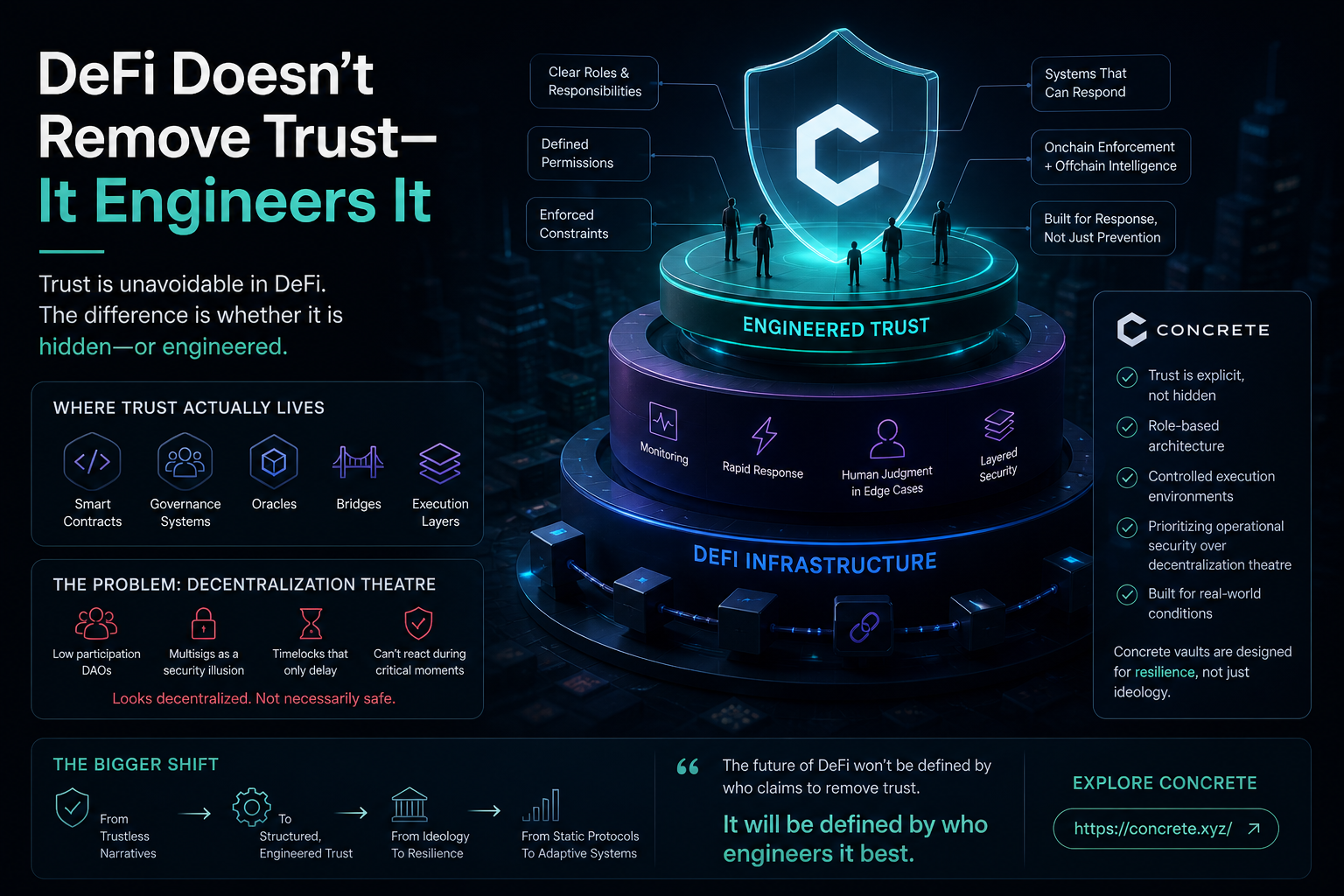
DeFi Doesn’t Remove Trust — It Engineers It.
--
DeFi was built on a simple idea:
“Don’t trust people. Trust code.”
For a while, that worked. The rise of protocols on Ethereum introduced a new paradigm one where financial systems could operate without traditional intermediaries.
- No banks.
- No brokers.
- No centralized control.
Just code.
But as the system evolved, something became clear:
Trust didn’t disappear. It just moved.
___
The Myth of “Trustless” Systems
“DeFi is trustless.”
“Code is law.”
“No intermediaries needed.”
These ideas became foundational narratives for the space. But in reality, no system is fully trustless.
Even in decentralized environments, users still place trust just in different places.
The real question isn’t:
“Does trust exist?”
It’s:
“Where does it exist and how is it managed?”
___
Where Trust Actually Lives in DeFi.
Behind every “trustless” protocol lies a network of assumptions.
In practice, users are trusting:
- Smart contracts to behave exactly as written.
- Governance systems to make sound decisions.
- Oracles to provide accurate external data.
- Bridges to securely move assets across chains.
- Execution layers to process transactions correctly.
Each of these layers introduces its own form of dependency. Trust isn’t removed it’s abstracted. And often, that abstraction makes it harder to see.
---
The Problem With Decentralization Theatre.
Not all decentralization is created equal.
Some systems appear decentralized—but lack real resilience.
This is where the idea of **“decentralization theatre”** comes in.
Examples include:
- Multisigs presented as full security models.
- DAOs with minimal active participation.
- Timelocks that delay actions—but don’t prevent harmful ones.
- Systems that cannot react quickly during critical failures.
These structures create the appearance of safety, without guaranteeing it.
There’s a difference between:
- Looking decentralized
- And actually being secure
---
From Trustless to Engineered Trust.
If trust cannot be removed, the next step is obvious:
It must be engineered.
Engineered trust means designing systems where:
- Roles and responsibilities are clearly defined
- Permissions are structured and transparent
- Constraints are enforced not assumed
- Systems can respond when things go wrong
This is how mature financial infrastructure works. And increasingly, it’s how advanced DeFi infrastructure is being built.
---
Why Operational Security Matters.
Code is powerful but it isn’t enough.
Real-world systems require:
- Continuous monitoring
- Rapid response mechanisms
- Human judgment in edge cases
- Layered security across components
This is the foundation of operational security.
Because in practice, failures don’t happen in clean, predictable ways.
They happen in edge cases.
In unexpected interactions.
In moments where static code cannot adapt.
---
How Concrete Approaches Trust Differently.
This is where Concrete introduces a different model.
Instead of hiding trust behind “trustless” narratives, Concrete makes it explicit.
Its approach is built on:
- Engineered trust, not assumed safety
- Systems designed for response, not just prevention
- A combination of onchain enforcement and off-chain intelligence
- Role-based architecture with clear permissions
- Controlled execution environments for managing risk.
This is the foundation of institutional DeFi where systems are built not just to operate, but to endure.
Rather than relying on decentralization theatre, Concrete vaults focus on something more important:
Resilience under real conditions.
---
The Bigger Shift in DeFi
DeFi is entering a new phase. The narrative is evolving:
From:
- “Trustless systems”
To:
- Structured, engineered trust
From:
- “Ideological decentralization”
To:
- Practical resilience
From:
- “Static protocols”
To:
- Adaptive financial systems
In this next phase, DeFi security will not be defined by who claims to eliminate trust But by who designs it best.
Because in the end:
Trust is not the problem.
Unstructured trust is.
---
🚨 Explore Concrete : https://concrete.xyz/🚨