DeFi users love saying:
“my money works for me.”
--
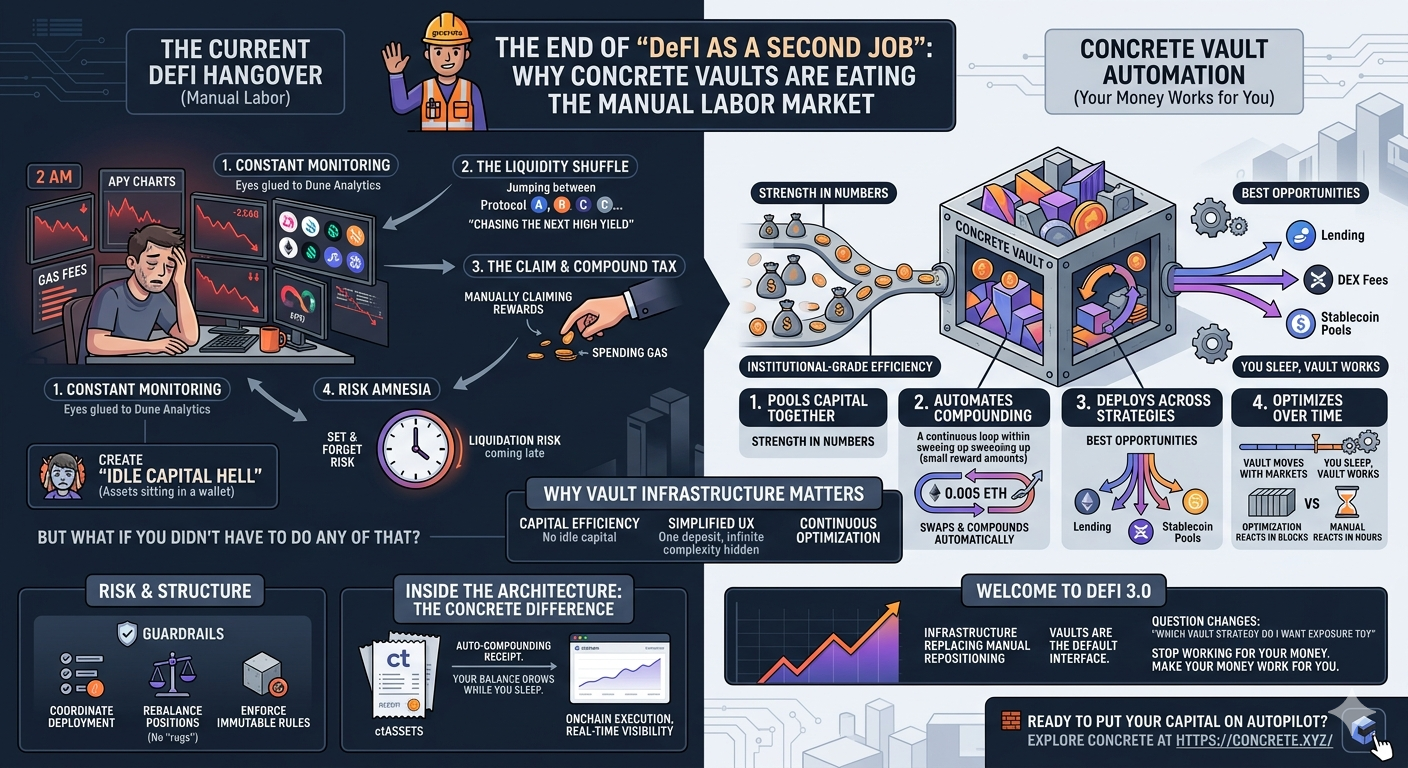
Meanwhile their actual routine looks like this:
09:00 — check APYs
10:00 — move liquidity
12:00 — claim rewards
14:00 — rebalance LP range
17:00 — bridge assets
22:00 — panic because another protocol launched “better yield”
Congratulations.
Your portfolio now has a work schedule.
That’s the current DeFi experience.
And honestly?
It’s becoming unsustainable.
🧱 1️⃣ The problem with modern DeFi
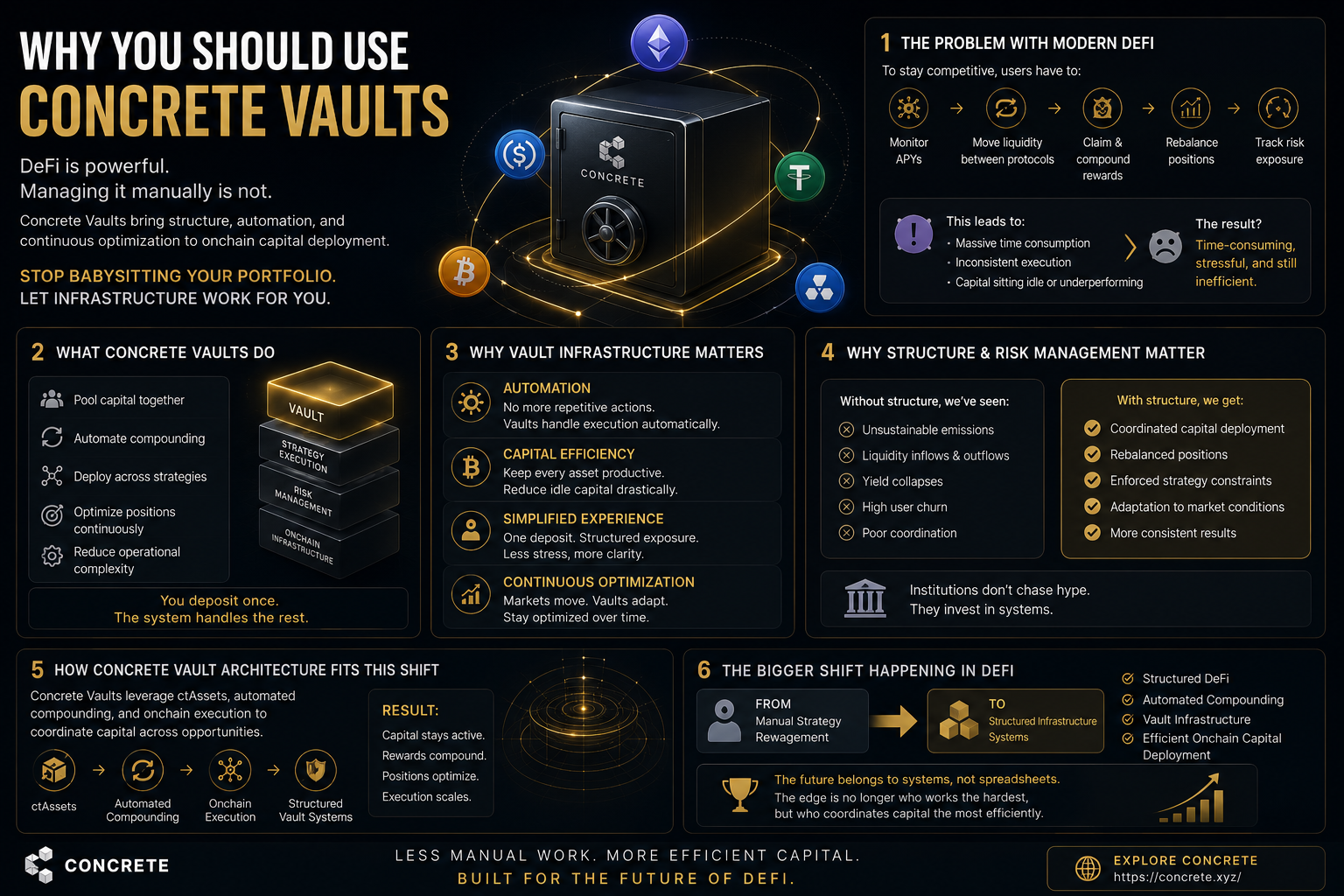
To stay competitive in DeFi today, users constantly need to:
— monitor APYs
— move liquidity between protocols
— compound rewards manually
— rebalance positions
— track risk exposure themselves
This creates two major problems.
First:
it consumes ridiculous amounts of time.
Second:
most users still manage capital inefficiently anyway.
Because humans are inconsistent.
People forget to compound.
Forget to rebalance.
Miss opportunities.
React emotionally during volatility.
One real example was the rise of concentrated liquidity systems like Uniswap V3.
The model improved capital efficiency dramatically compared to traditional AMMs.
But suddenly liquidity providers had to actively manage ranges.
If price moved outside your LP range:
your capital stopped earning effectively.
So users either:
— monitored positions constantly
— or accepted weaker performance
That’s when many people realized:
DeFi was evolving faster than manual strategy management could handle.
🧱 2️⃣ What a Concrete Vault actually does
Concrete Vaults are designed to remove much of this operational burden.
Instead of manually repositioning funds across opportunities every day, users deposit into structured vault systems designed to coordinate onchain capital deployment automatically.
Concrete Vaults help users:
— pool capital together
— automate compounding
— deploy across strategies
— optimize positions continuously
— reduce operational complexity
The important idea here is structure.
Users are no longer manually executing every individual action themselves.
The vault system handles ongoing optimization behind the scenes.
Think about how much DeFi capital currently sits inefficiently:
— rewards left unclaimed
— idle stablecoins
— LP positions drifting out of range
— fragmented liquidity across chains
Vault infrastructure exists to reduce this inefficiency.
🧱 3️⃣ Why vault infrastructure matters
A lot of people still view DeFi vaults as simple “yield aggregators.”
But modern vault infrastructure is becoming much more important than that.
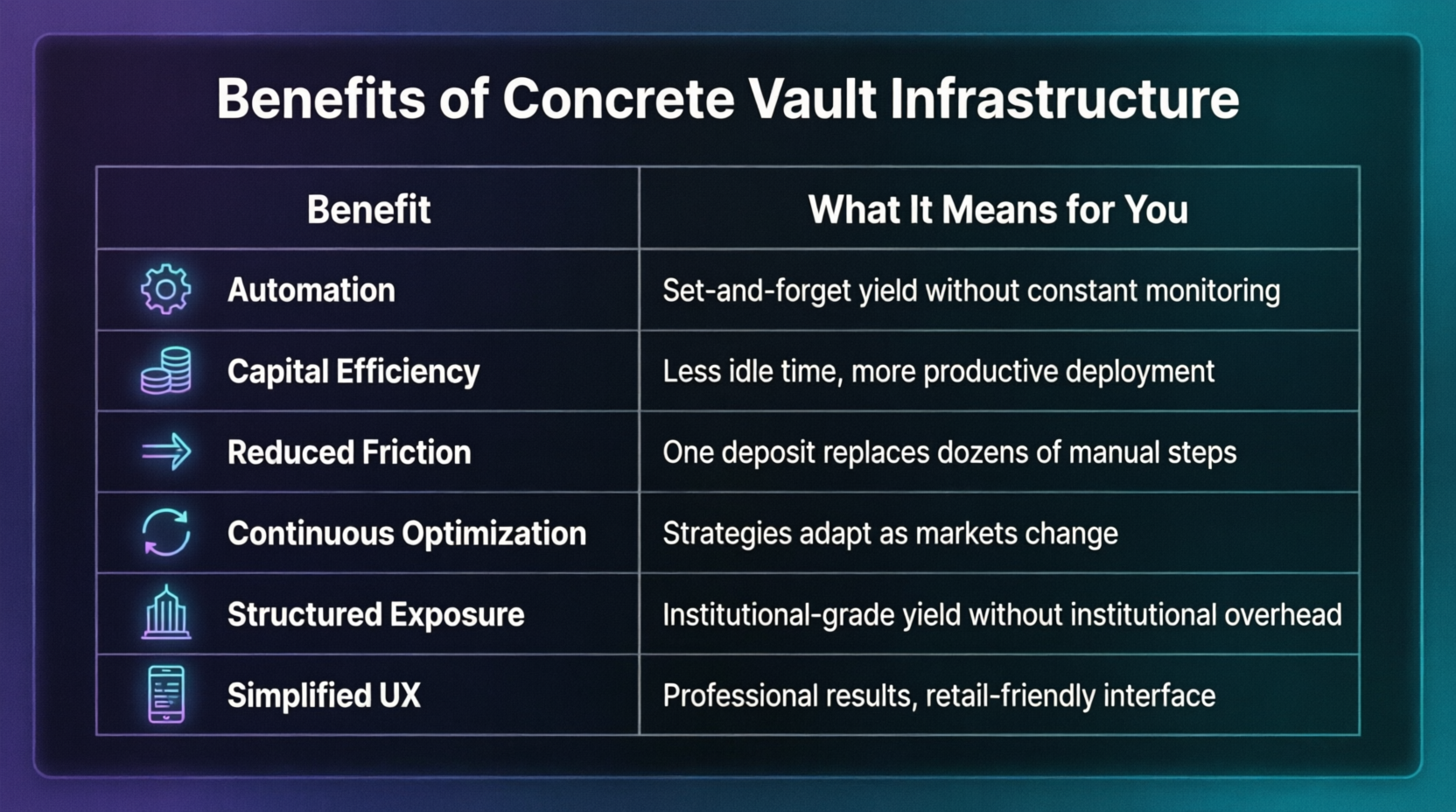
Vaults create systems for:
— automation
— continuous optimization
— structured execution
— coordinated capital deployment
This improves capital efficiency significantly.
And capital efficiency matters more than ever.
Because in DeFi, idle capital is expensive.
A wallet sitting inactive earns nothing.
Unclaimed rewards compound nothing.
Poorly managed liquidity underperforms.
Vault systems reduce these problems by keeping assets productive over time.
This also creates a much simpler user experience.
Instead of spending hours manually managing strategies, users gain exposure to structured DeFi systems that optimize positions continuously.
Less babysitting.
More efficient deployment.
🧱 4️⃣ Why structure & risk management matter
Concrete Vaults are not simply “yield wrappers.”
The underlying structure matters.
Good vault systems need mechanisms to:
— coordinate capital deployment
— rebalance positions
— enforce strategy constraints
— adapt to changing market conditions
Without structure, DeFi strategies eventually become unstable.
We already saw this during the 2021 yield farming boom.
Protocols offered huge emissions.
Liquidity flooded in rapidly.
Then rewards collapsed and capital rotated elsewhere just as quickly.
The problem wasn’t only unsustainable APY.
The problem was weak coordination.
That’s why institutional DeFi increasingly focuses on structured systems instead of short-term farming hype.
Institutions don’t want random yield spikes.
They want:
— scalable execution
— operational consistency
— efficient capital deployment
— controlled exposure
And vault infrastructure helps move DeFi in that direction.
🧱 5️⃣ How Concrete Vault architecture fits this shift
Concrete Vaults use systems like ctAssets, automated compounding, and onchain execution to coordinate capital more efficiently across strategies.
Instead of users manually chasing every opportunity themselves…
The vault architecture becomes the operational layer.
That means:
— capital can remain active continuously
— rewards can compound automatically
— positions can rebalance systematically
— strategy execution becomes scalable
This is especially important as DeFi grows more complex across chains, protocols, and liquidity systems.
Because eventually, manual optimization stops scaling.
No serious financial system grows infinitely through spreadsheets, browser tabs, and sleep deprivation.
Infrastructure eventually replaces manual coordination.
🧱 6️⃣ The bigger shift happening in DeFi
This is the real evolution happening right now.
DeFi is transitioning from:
manual strategy management
to:
structured infrastructure systems.
The future likely belongs to:
— structured DeFi
— automated compounding
— vault infrastructure
— efficient onchain capital deployment
Not endless repositioning.
Not users clicking between 14 protocols forever.
The winners in the next phase of DeFi may not be the people working hardest manually…
They may be the people using systems designed to coordinate capital most efficiently.
And that’s the direction Concrete Vaults are building toward.
Explore Concrete at https://concrete.xyz/