Concrete Vaults and the Future of DeFi Capital
 arsadk64 min read·Just now
--
Why More DeFi Users Are Turning to Concrete Vaults
DeFi was supposed to make finance more open and efficient.
And in many ways, it did.
But anyone who has spent enough time onchain knows the reality is a little different.
To stay competitive, users often need to constantly monitor APYs, move liquidity between protocols, claim rewards, rebalance positions, and manage risk manually. What started as “decentralized finance” can quickly turn into a full-time job.
The deeper DeFi grows, the more fragmented and complex it becomes.
That’s exactly why vault infrastructure is becoming increasingly important.
And it’s also why systems like Concrete are gaining attention.
The Problem With Manual DeFi Management
Right now, many DeFi users operate in a reactive cycle.
A new yield opportunity appears → liquidity moves there → APYs drop → users rotate somewhere else → repeat.
To maximize returns, users are expected to:
- monitor market conditions constantly
- manually reposition capital
- track rewards across protocols
- compound earnings themselves
- manage changing exposure and risks
The issue isn’t just inconvenience.
Manual positioning creates inefficiency.
Capital often sits idle between moves. Users miss compounding windows. Strategies become difficult to maintain consistently, especially across multiple chains and protocols.
As DeFi expands, managing everything manually simply doesn’t scale.
This is where DeFi vaults come in.
What Exactly Does a Concrete Vault Do?
At a basic level, vaults simplify capital management.
Instead of every user individually managing positions all day, capital is pooled into a structured system that can execute strategies more efficiently.
Concrete Vaults are designed to help users:
- pool capital together
- automate compounding
- deploy liquidity across strategies
- rebalance positions over time
- reduce operational complexity
Rather than chasing every opportunity manually, users gain exposure to a coordinated framework built for onchain capital deployment.
That shift matters more than many people realize.
Because DeFi is no longer just about finding yield.
It’s increasingly about managing complexity.
Why Vault Infrastructure Matters
The real value of vault infrastructure is not simply “higher APY.”
It’s efficiency.
Good vault systems reduce friction between capital and opportunity.
Instead of users spending hours repositioning assets manually, vaults automate many of the operational layers behind the scenes.
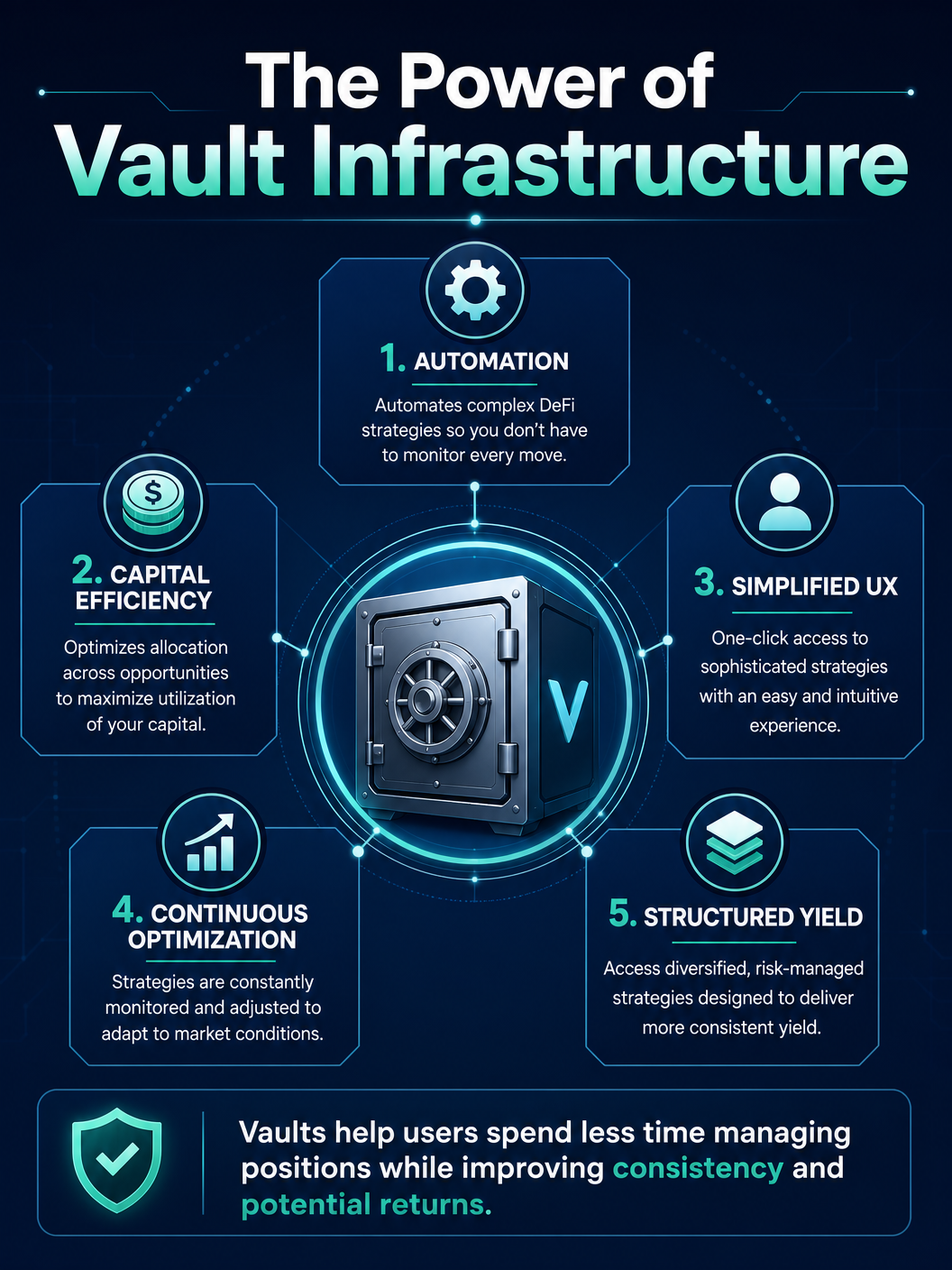
This creates several advantages:
1. Automation
One of the biggest benefits is automated compounding.
Rewards can be harvested and redeployed continuously without requiring users to manage every step themselves.
That means less idle capital and more consistent optimization over time.
2. Capital Efficiency
In traditional manual strategies, assets frequently sit unused during transitions.
Vault systems help coordinate capital more efficiently by keeping deployment active and structured.
This becomes increasingly important as liquidity opportunities move faster across DeFi ecosystems.
3. Simpler User Experience
DeFi can feel overwhelming for newer users.
Managing multiple protocols, wallets, and strategies introduces a lot of operational friction.
Vaults abstract much of that complexity into a more streamlined experience.
Instead of micromanaging positions daily, users can access structured DeFi exposure through a unified system.
4. Continuous Optimization
Markets change constantly.
Yield conditions evolve. Liquidity shifts. Incentives rotate.
Vault infrastructure allows strategies to adapt dynamically rather than relying entirely on manual intervention.
That creates a more sustainable way to participate in modern DeFi environments.
Vaults Are More Than “Yield Wrappers”
A common misconception is that vaults are simply passive yield products.
But advanced systems like Concrete Vaults operate more like coordinated infrastructure layers.
They are designed to:
- coordinate capital deployment
- rebalance positions
- enforce strategy constraints
- adapt to changing conditions
- optimize execution onchain
This creates a more structured approach to participating in DeFi.
Instead of isolated users independently managing fragmented positions, vault architecture introduces coordination.
And coordination becomes extremely valuable as ecosystems grow more complex.
How Concrete Vault Architecture Fits Into This
This is where the design behind Concrete becomes especially interesting.
Concrete Vaults are built around structured systems that aim to improve how capital moves and compounds onchain.
Some of the core components include:
ctAssets
ctAssets help create structured exposure within the Concrete ecosystem.
Rather than forcing users to manually rebuild strategies repeatedly, ctAssets allow capital to interact more efficiently with vault infrastructure and onchain opportunities.
Automated Compounding
Instead of requiring constant user action, Concrete Vaults are designed to automate compounding and repositioning logic where appropriate.
That helps reduce inefficiency caused by fragmented manual workflows.
Onchain Execution
Because execution occurs onchain, vault operations remain transparent and programmable while still enabling structured coordination across strategies.
This combination of automation and transparency is becoming increasingly important for institutional DeFi participation.
Structured Vault Systems
Concrete isn’t just offering isolated yield opportunities.
It’s building systems intended to coordinate capital efficiently across evolving DeFi environments.
That distinction matters.
The future of DeFi likely won’t be defined by who can click between protocols the fastest.
It will be defined by infrastructure that can manage capital more intelligently at scale.
The Bigger Shift Happening in DeFi
DeFi is evolving.
The early era rewarded users who manually farmed incentives across dozens of protocols.
But as ecosystems mature, complexity increases faster than most individuals can realistically manage alone.
Manual strategy management becomes harder to sustain.
Infrastructure begins replacing constant repositioning.
And vault systems increasingly become the default interface for deploying capital onchain.
This shift mirrors what happened in traditional finance long ago.
As markets grew more sophisticated, infrastructure layers emerged to coordinate capital more efficiently.
DeFi appears to be moving in the same direction.
That’s why projects focused on structured DeFi, automated compounding, capital efficiency, and institutional DeFi infrastructure are attracting growing attention.
Because the future may not belong to users refreshing dashboards all day.
It may belong to systems designed to coordinate onchain capital deployment more efficiently than humans can manually achieve alone.
Explore Concrete at Concrete.xyz