--
DeFi Doesn’t Remove Trust — It Rebuilds It Through Infrastructure
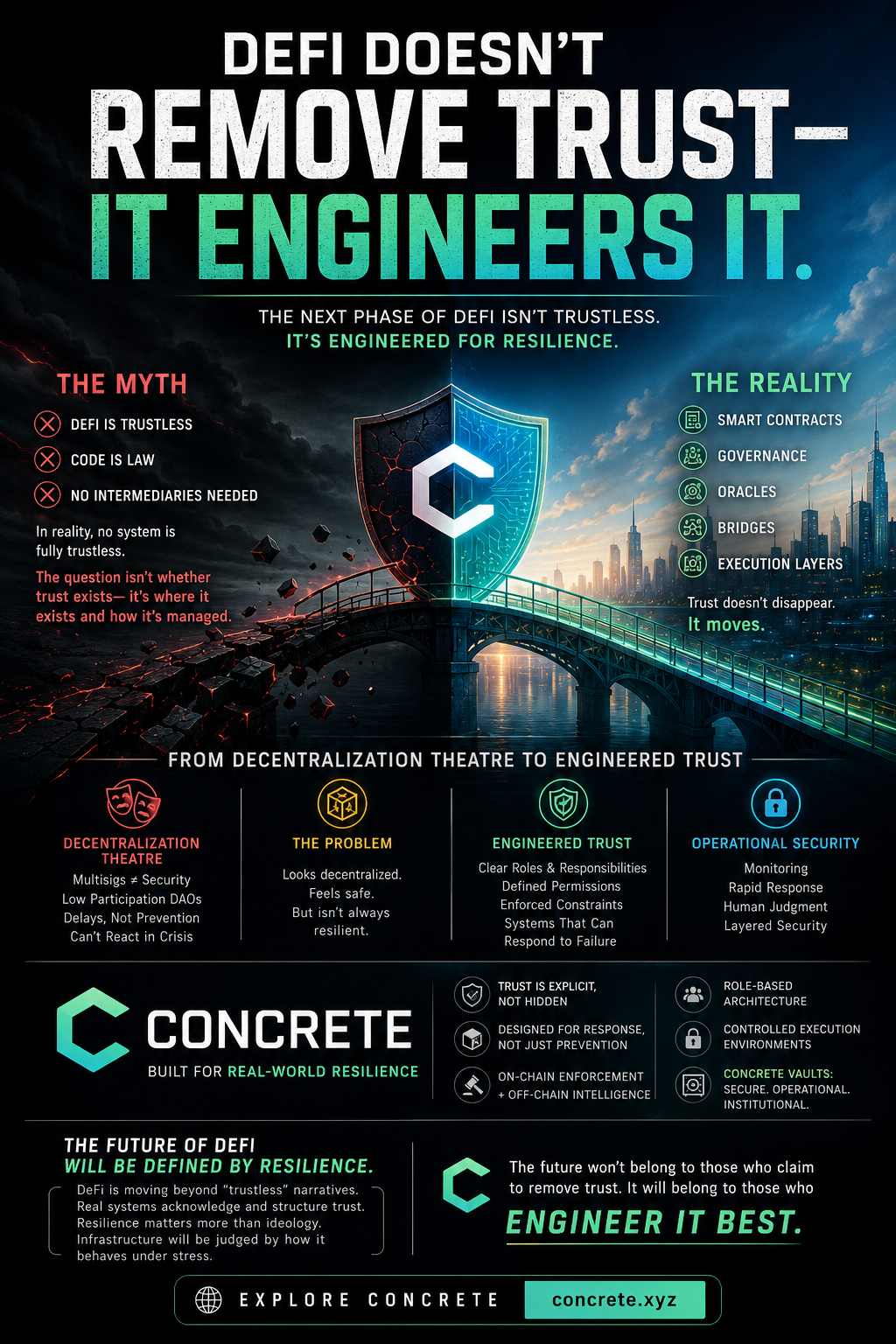
One of the most powerful narratives in early DeFi was the idea of a “trustless” financial system. The promise sounded revolutionary: remove intermediaries, replace institutions with smart contracts, and let code become law. For a time, this framing helped define the identity of decentralized finance. But as DeFi matured, a more uncomfortable reality emerged. Trust never disappeared. It simply moved into new layers of infrastructure.
Every DeFi system still depends on assumptions. Users trust smart contracts to execute correctly. They trust governance systems to make responsible decisions. They trust bridges to secure cross-chain assets and oracles to deliver accurate data. Even supposedly autonomous systems depend on execution layers, validators, multisigs, and monitoring infrastructure. The system is not trustless. It is trust-distributed.
The real issue is that much of this trust remains hidden behind the language of decentralization. Many protocols appear decentralized while still relying on concentrated operational control. Multisigs are often presented as security, even though they may introduce coordination risk. DAOs can exist formally while participation remains extremely low. Timelocks may delay governance actions but cannot always prevent catastrophic outcomes during fast-moving market conditions.
This creates what can be described as decentralization theatre — systems that appear ideologically decentralized without necessarily being operationally resilient. In practice, resilience matters more than appearances. Financial infrastructure must survive stress, volatility, exploits, and unexpected edge cases.
This is where engineered trust becomes important. Mature systems do not pretend trust can be eliminated. Instead, they structure trust deliberately through defined roles, constrained permissions, monitoring systems, and enforceable operational boundaries. Trust becomes visible, auditable, and manageable rather than hidden behind slogans.
Concrete follows this philosophy directly. Concrete vaults are not designed around the illusion that code alone can handle every scenario. Instead, they combine onchain enforcement with operational intelligence. Their architecture introduces clearly defined responsibilities through systems like role-based execution environments, controlled strategy management, and operational safeguards.
This approach acknowledges an important truth: real financial systems require both automation and response capabilities. Smart contracts can enforce rules, but operational security also requires monitoring, layered defenses, and human judgment during exceptional situations.
Concrete prioritizes operational security over decentralization theatre. Its infrastructure is designed to respond under stress, not simply appear decentralized under normal conditions.
The next phase of DeFi will not be defined by who claims to remove trust entirely. It will be defined by which systems engineer trust transparently, responsibly, and resiliently.
Explore Concrete at https://concrete.xyz/