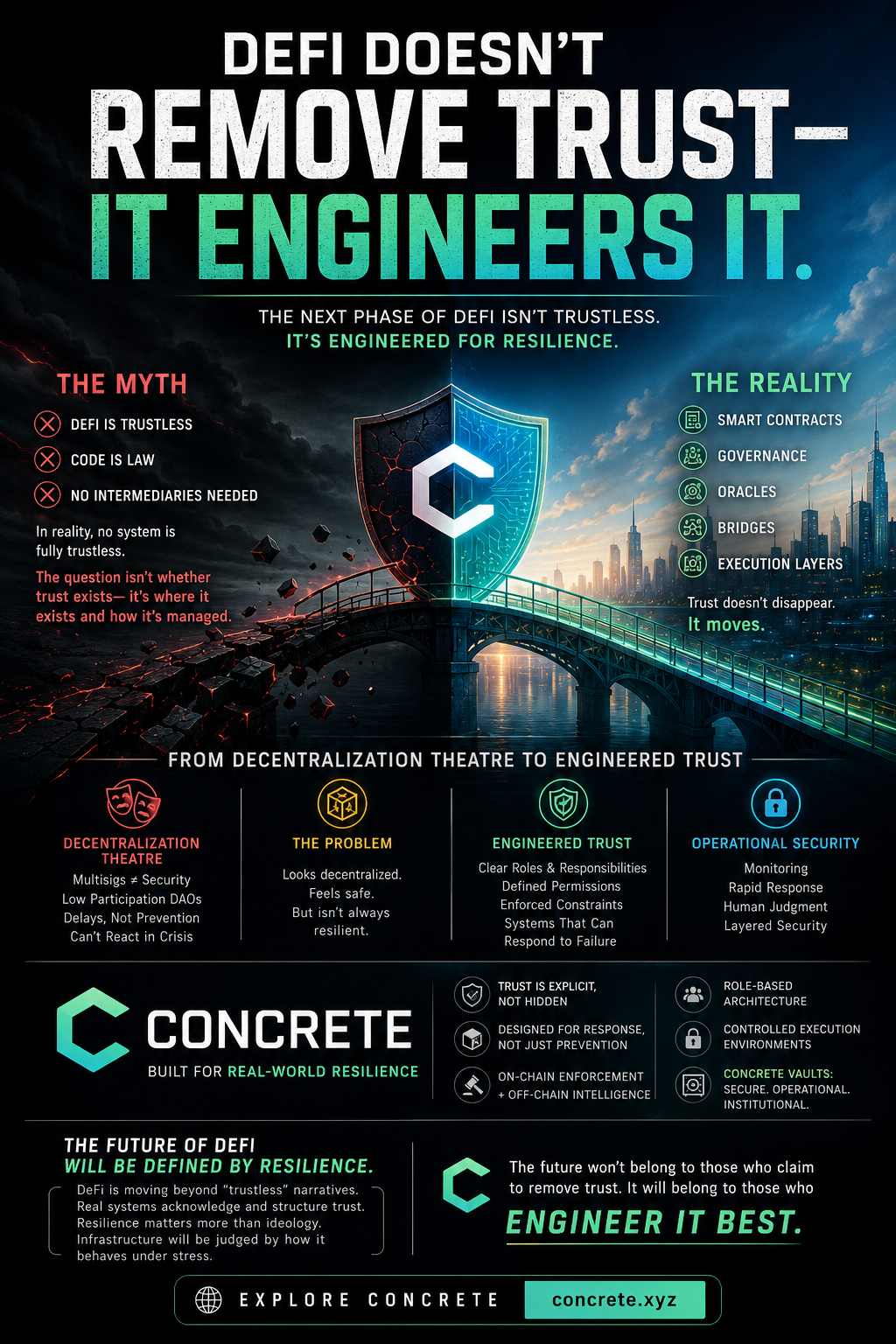
DeFi Doesn’t Remove Trust — It Engineers It
 Frankday5 min read·Just now
--
DeFi was built on a powerful promise:
“Don’t trust people. Trust code.”
It was a compelling idea. No intermediaries. No gatekeepers. No centralized authority deciding who could participate or how capital could move.
For a while, the industry treated this as a complete replacement for trust itself.
But as DeFi matured, reality surfaced through exploits, governance failures, bridge collapses, oracle manipulation, and operational breakdowns.
Trust never disappeared.
It simply moved.
Today, every DeFi participant still trusts something:
- smart contracts
- governance systems
- validators
- oracles
- bridges
- execution infrastructure
- upgrade mechanisms
The industry’s biggest misconception was believing trust could be removed entirely.
In practice, the real challenge is deciding where trust exists, who holds it, and how it is constrained.
The future of DeFi security will not belong to systems pretending trust does not exist.
It will belong to systems that engineer it deliberately.
The Myth of “Trustless” Systems
The phrase “trustless” became one of crypto’s most celebrated slogans.
Code was supposed to replace institutions.
Automation was supposed to replace judgment.
Smart contracts were supposed to eliminate human risk.
But code does not exist in isolation.
Every smart contract depends on assumptions:
- that the code is secure
- that governance won’t act maliciously
- that validators behave honestly
- that oracles deliver accurate data
- that execution environments remain operational
Even immutable systems rely on social coordination during moments of crisis.
When markets become unstable, when exploits emerge, or when infrastructure fails, pure automation quickly encounters its limits.
What DeFi actually created was not a world without trust.
It created a new architecture for distributing it.
Where Trust Actually Lives in DeFi
The deeper DeFi becomes, the more invisible its trust assumptions become.
Smart Contracts
Users trust that contracts were audited correctly and contain no hidden vulnerabilities.
Yet history shows that even heavily audited protocols can fail under unexpected conditions.
Governance
Many protocols market themselves as decentralized, but governance participation is often concentrated among a small group of token holders or insiders.
In practice, critical decisions may still depend on a handful of actors.
Oracles
DeFi protocols rely heavily on external price feeds.
If oracle infrastructure fails or becomes manipulated, otherwise secure systems can collapse instantly.
Bridges
Cross-chain bridges remain one of the largest attack surfaces in crypto.
They often introduce additional custodial, validator, or multisig trust assumptions that users rarely evaluate directly.
Execution Layers
Even transaction ordering and execution environments carry trust assumptions through sequencers, validators, relayers, and infrastructure providers.
The result is not “no trust.”
It is layered trust abstraction.
And abstraction becomes dangerous when users no longer understand where risk actually lives.
The Problem With Decentralization Theatre
One of DeFi’s biggest structural problems is the appearance of decentralization without meaningful resilience.
A protocol may advertise itself as decentralized because it uses:
- multisigs
- DAOs
- governance tokens
- timelocks
- distributed validators
But these mechanisms alone do not guarantee safety.
A multisig may still depend on a small circle of insiders.
A DAO may technically allow participation while only a tiny percentage of users vote.
Timelocks may delay malicious actions while doing little to prevent catastrophic exploits already in motion.
And fully rigid systems can become fragile during emergencies because they lack the ability to respond dynamically.
This creates what many now recognize as decentralization theatre:
systems optimized for ideological optics rather than operational resilience.
True DeFi infrastructure is not measured by how decentralized it appears during normal conditions.
It is measured by how effectively it survives stress.
Engineered Trust: The Next Evolution of DeFi Infrastructure
Mature financial systems do not pretend trust disappears.
They structure it carefully.
Roles are defined.
Permissions are constrained.
Monitoring is continuous.
Response systems exist for failures and edge cases.
This is what engineered trust looks like.
In DeFi, engineered trust means:
- explicit responsibilities
- transparent operational boundaries
- enforceable permissions
- layered security systems
- controlled execution paths
- rapid incident response mechanisms
Rather than hiding trust assumptions, engineered systems expose them clearly and design around them intentionally.
This is particularly important for institutional DeFi, where operational reliability matters far more than ideological purity.
Institutions do not allocate capital based on slogans.
They allocate capital based on resilience.
Why Operational Security Matters More Than Ideology
Purely automated systems sound elegant in theory.
But real-world financial systems encounter unpredictable conditions constantly:
- oracle failures
- market dislocations
- liquidity crises
- governance attacks
- smart contract exploits
- infrastructure outages
Code alone cannot anticipate every scenario.
This is why operational security becomes essential.
Strong DeFi infrastructure requires:
- active monitoring
- layered defense systems
- human oversight in edge cases
- rapid response capabilities
- coordinated execution environments
Security is not simply prevention.
It is the ability to detect, contain, and respond under pressure.
The protocols that survive long term will not necessarily be the most decentralized on paper.
They will be the ones most capable of operating safely in adversarial environments.
How Concrete Engineers Trust Differently
This is where Concrete takes a fundamentally different approach.
Instead of pretending trust can be removed entirely, Concrete designs systems where trust is explicit, structured, and enforceable.
Its architecture prioritizes operational security over decentralization theatre.
Concrete’s approach includes:
- clear role-based architecture
- controlled execution environments
- onchain enforcement mechanisms
- offchain intelligence and monitoring
- systems designed for response as well as prevention
This model recognizes an important reality:
resilience requires coordination.
Rather than relying on vague assumptions about “trustless systems,” Concrete vaults are built around clearly defined operational controls and security boundaries.
The result is infrastructure designed not just to function during ideal conditions, but to remain resilient during volatile and adversarial moments as well.
That distinction becomes increasingly important as institutional DeFi adoption grows.
Institutions need infrastructure capable of managing real operational risk, not simply minimizing visible centralization.
The Future of DeFi Will Be Defined by Resilience
The industry is entering a new phase.
The early obsession with “trustless systems” is giving way to a more mature understanding of how financial infrastructure actually works.
Trust is unavoidable.
The real innovation is not eliminating it.
It is engineering it responsibly.
The next generation of DeFi infrastructure will be judged by:
- how transparently trust assumptions are communicated
- how effectively systems respond to failure
- how resilient protocols remain under stress
- how securely capital can operate at scale
The future belongs to systems that acknowledge operational reality rather than hiding behind ideology.
Because ultimately, DeFi will not be defined by who claims to remove trust.
It will be defined by who engineers it best.
Explore Concrete at concrete.xyz