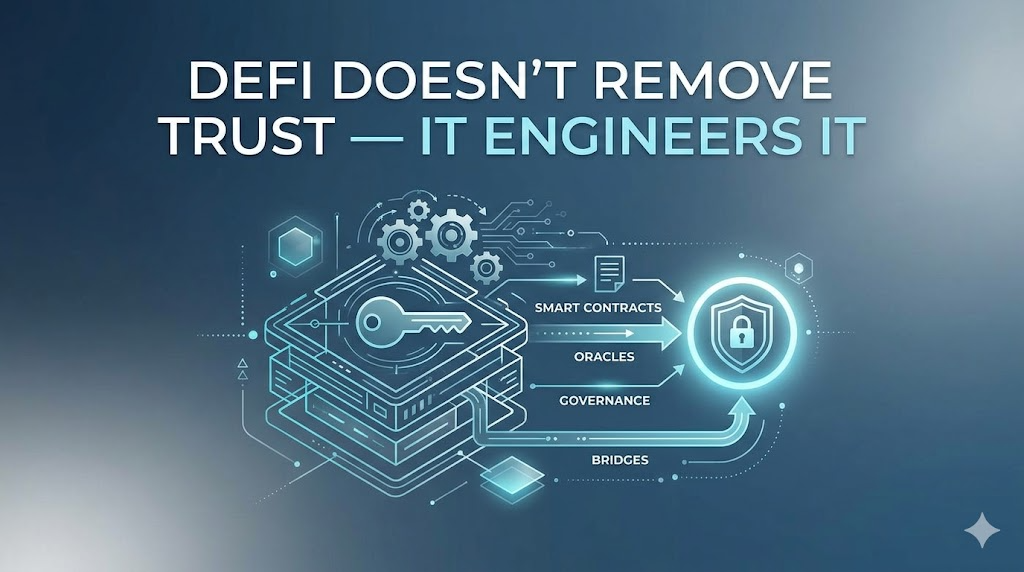
DeFi Doesn’t Remove Trust — It Engineers It
--
DeFi was built on a powerful promise:
“Don’t trust people. Trust code.”
For a time, that idea felt revolutionary. Smart contracts replaced intermediaries. Protocols ran autonomously. “Code is law” became the foundation of trustless systems.
But as DeFi matured, a deeper truth emerged:
trust didn’t disappear — it shifted.
No system is truly trustless. The real question is not whether trust exists, but where it lives and how it is managed.
The Myth of Trustless Systems
The early narrative of DeFi suggested a world free from human dependency:
- No intermediaries
- No discretionary control
- No need for trust
Yet every interaction in DeFi still requires assumptions. You trust that contracts are written correctly. You trust that systems behave as expected under stress. You trust that incentives align with outcomes.
The illusion isn’t that trust is gone — it’s that it’s invisible.
Where Trust Actually Lives in DeFi
Modern DeFi infrastructure is layered with implicit trust:
- Smart contracts: Assumed to be bug-free and secure
- Governance systems: Token holders make rational, aligned decisions
- Oracles: External data feeds remain accurate and manipulation-resistant
- Bridges: Cross-chain systems maintain integrity across ecosystems
- Execution layers: Transactions are processed fairly and predictably
Each layer introduces dependencies. Each dependency introduces risk.
Trust is not removed — it is abstracted.
The Problem With Decentralization Theatre
Many protocols lean into what can be called decentralization theatre — systems that appear decentralized but lack real resilience.
Consider:
- Multisigs acting as centralized control under the guise of safety
- DAOs with low participation, where a few actors dominate decisions
- Timelocks that delay actions but don’t prevent harmful outcomes
- Protocols that cannot react quickly during exploits or market stress
These structures create the appearance of decentralization without delivering true security.
In practice, decentralization without operational capability is fragile.
Engineered Trust: A Better Model
Instead of denying trust, the next evolution of DeFi embraces it — deliberately.
Engineered trust means:
- Clearly defined roles and responsibilities
- Explicit permission structures
- Enforced constraints within systems
- Mechanisms to respond to failures in real time
This is how mature financial systems operate. Trust is not hidden — it is structured, observable, and accountable.
DeFi infrastructure must evolve in the same direction.
Why Operational Security Matters
Code alone cannot anticipate every scenario.
Real-world systems require:
- Continuous monitoring
- Rapid response capabilities
- Human judgment in edge cases
- Layered security models
Pure automation breaks down under uncertainty.
Resilience comes from combining deterministic code with adaptive systems.
This is where DeFi security becomes less about prevention and more about response.
Concrete: Trust Made Explicit
This is the philosophy behind Concrete.
Rather than pretending to eliminate trust, Concrete makes it explicit and enforceable:
- Trust is visible, not hidden behind narratives
- Systems are designed for response, not just prevention
- Onchain enforcement combined with offchain intelligence
- Role-based architecture that defines who can act and when
- Controlled execution environments that reduce uncertainty
Concrete vaults are built with operational security at their core — prioritizing real-world resilience over ideological purity.
This approach aligns with the needs of institutional DeFi, where reliability, accountability, and controlled risk matter more than slogans.
👉 Explore Concrete at https://concrete.xyz/
The Bigger Shift in DeFi
DeFi is moving beyond the “trustless” narrative.
The next phase of the industry will be defined by:
- Systems that acknowledge trust
- Infrastructure that structures and enforces it
- Protocols that perform under stress
- Security models that prioritize outcomes over optics
The future of DeFi won’t belong to those who claim to remove trust.
It will belong to those who engineer it best.