DeFi Doesn’t Remove Trust — It Engineers It
 andrey4 min read·Just now
--
The founding myth of decentralized finance is simple. It tells us that DeFi is trustless. We are told that code is law and that intermediaries have been permanently erased from the equation. In this vision, math replaces the handshake and the ledger replaces the bank. It is a powerful idea that has drawn billions of dollars into the ecosystem.
But the reality is more complex. No financial system is truly trustless. The tension in modern DeFi arises because trust did not actually disappear. It simply moved. The question for the next generation of users is not whether trust exists. The question is where it lives and how it is being managed.
Where Trust Actually Lives
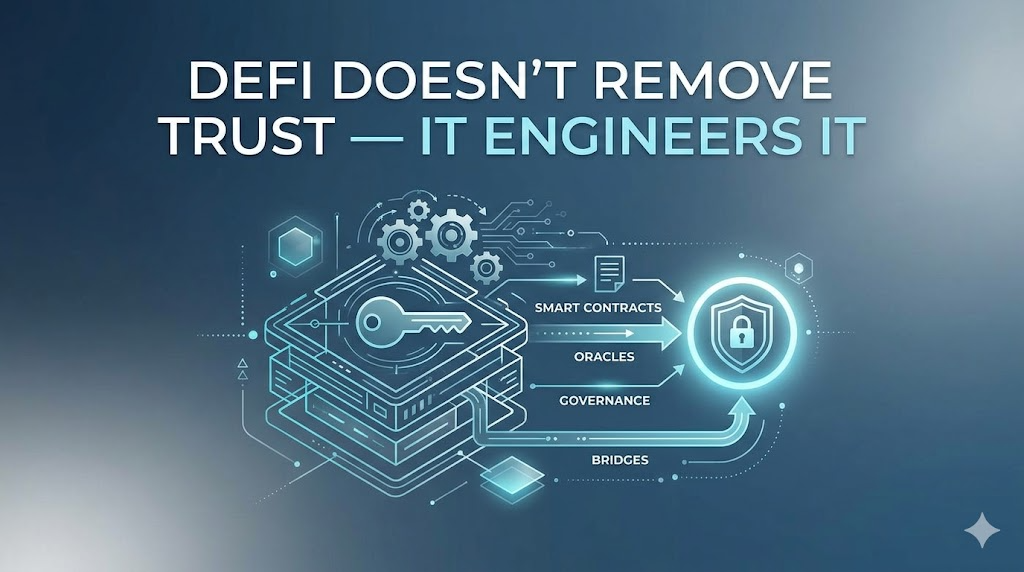
When you interact with a protocol, you are trusting a series of hidden layers. You trust that the smart contract logic is sound and free of bugs. You trust that the oracles providing price data are accurate and haven’t been manipulated. You trust that the bridges moving your assets between chains are secure. You trust that the governance system will not pass a malicious proposal.
In many cases, trust is just abstracted away. It is hidden behind a user interface. This creates a dangerous gap between how safe a user feels and how vulnerable the system actually is.
The Problem With Decentralization Theatre
This gap leads to what many call decentralization theatre. Some systems appear decentralized on the surface but are fragile underneath. A protocol might claim to be governed by a DAO, yet only a handful of wallets participate in voting. Security might rely on a multisig where three out of five people hold all the power.
Even features like timelocks can be misleading. A timelock delays a change, but it does not always prevent a risk if the community cannot react in time. There is a massive difference between the appearance of decentralization and actual safety. When a crisis hits, these systems often lack the ability to respond effectively.
The Concept of Engineered Trust
The industry is moving toward a more mature model called engineered trust. In this model, trust is not ignored. It is designed. Engineered trust means having clear roles and defined permissions. It means setting enforced constraints that prevent the system from behaving in unintended ways.
Mature financial systems operate this way. They acknowledge that failures can happen and build structures to handle them. This is the philosophy behind the architecture at Concrete. Instead of relying on the hope that code will be perfect, the focus shifts to how the system responds to stress.
Operational Security and Response
Code alone cannot handle every scenario. Edge cases and market volatility require more than just static logic. Real systems need active monitoring and rapid response mechanisms. They require a blend of onchain enforcement and offchain intelligence.
This is where human judgment and layered security become vital. A system that can only prevent an error is less resilient than a system that can also recover from one. Operational security recognizes that the world is messy and that infrastructure must be built to survive that messiness.
The Concrete Approach
Concrete takes a different path than many early DeFi projects. Here, trust is explicit rather than hidden. The architecture uses a role-based design and controlled execution environments to ensure that every action is authorized and every risk is bounded.
By combining onchain enforcement with sophisticated offchain monitoring, Concrete ensures that the system is always watching. It prioritizes actual operational security over the optics of decentralization theatre. The goal is to create a vault infrastructure that behaves predictably even when the market does not.
The Shift Toward Resilience
The narrative of DeFi is changing. We are moving beyond the era of trustless myths and into an era of structured resilience. Infrastructure will no longer be judged by how many “decentralized” boxes it ticks. It will be judged by how it performs under pressure.
The future of the industry depends on making trust explicit and enforceable. It will not be defined by those who claim to remove trust entirely. It will be defined by those who engineer it best.
To learn more about this approach, explore Concrete at https://concrete.xyz/