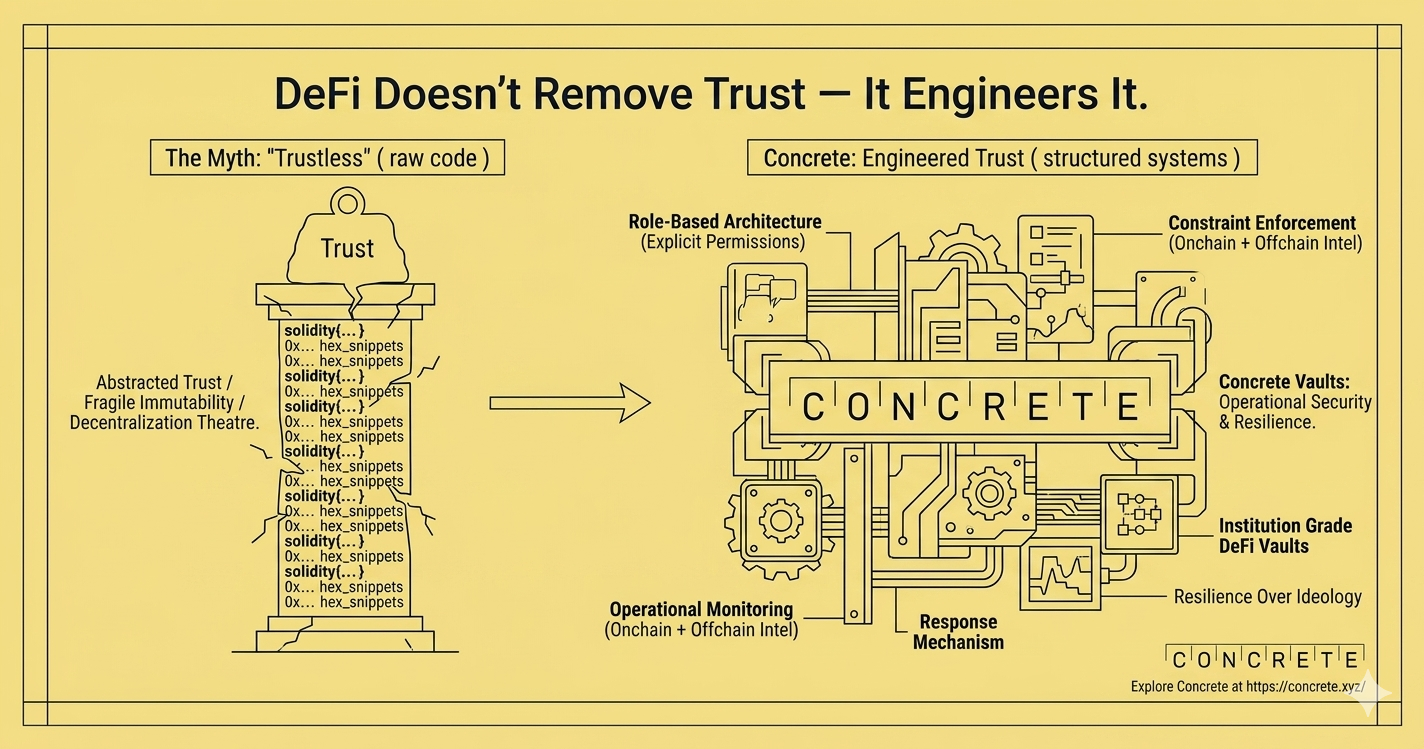
DeFi Doesn’t Remove Trust — It Engineers It
 Solet3 min read·Just now
--
When I first got into DeFi, I bought into the whole idea:
Don’t trust people. Trust code.
It sounded revolutionary.
No banks. No middlemen. Just smart contracts doing exactly what they’re programmed to do.
But the longer I’ve been around, the more I’ve realized something simple:
DeFi isn’t trustless.
It just moves trust to places you don’t always see.
The Trustless Narrative Doesn’t Hold Up
We love saying things like:
- “Code is law”
- “No intermediaries”
- “Trustless systems”
But if you’ve actually used DeFi, you know it’s not that simple.
You’re still trusting a lot of things, just not in the traditional way.
And honestly, that’s fine.
The problem is pretending that trust doesn’t exist at all.
Where You’re Actually Trusting Things
Think about it.
Every time you use a DeFi protocol, you’re trusting:
- Smart contracts → that there are no bugs or hidden exploits
- Governance → that voters (or whales) won’t make bad decisions
- Oracles → that the data feeding the system is correct
- Bridges → that your assets won’t disappear mid-transfer
- Execution layers → that your transactions aren’t manipulated
That’s a lot of trust.
It’s just not obvious, because it’s spread across layers.
The Illusion of Decentralization
This is where things get a bit uncomfortable.
Some projects look decentralized… but aren’t really that safe.
You’ll see things like:
- Multisigs being treated as security
- DAOs where barely anyone votes
- Timelocks that delay problems instead of fixing them
And when something actually goes wrong?
A lot of these systems can’t react fast enough.
So yeah, it might look decentralized on the surface.
But that doesn’t mean it’s resilient.
A Better Way to Think About It
At some point, it clicked for me:
The goal isn’t to remove trust.
It’s to design it properly.
Real systems don’t pretend trust doesn’t exist.
They make it clear:
- Who can do what
- What actions are allowed
- What happens if something breaks
That’s what engineered trust actually means.
Why Code Alone Isn’t Enough
Another thing people don’t like to admit:
Smart contracts can’t handle everything.
You still need:
- Monitoring (to catch issues early)
- Fast response (when things go wrong)
- Human judgment (for weird edge cases)
- Multiple layers of protection
Because markets are unpredictable.
And attackers are creative.
If your system can’t react, it’s only a matter of time.
What I Found Interesting About Concrete
Lately, I’ve been looking into projects that take a different approach and Concrete stood out.
Explore Concrete at https://concrete.xyz/
What I like is that they don’t try to sell the trustless fantasy.
Instead, they actually design for trust.
- Trust is explicit, not hidden
- Systems are built to respond, not just sit there
- There’s a mix of onchain enforcement + off-chain intelligence
- Roles and permissions are clearly defined
- Execution environments are controlled, not chaotic
It feels closer to how real-world systems actually work.
Less ideology. More practicality.
Where DeFi Is Headed
I think this is where things are going.
DeFi is growing up.
We’re moving past slogans and starting to ask harder questions:
- What happens when things break ?
- Who is responsible?
- Can the system adapt under pressure ?
Because in the end, that’s what matters.
Not how trustless something sounds…
…but how well it actually works when it’s tested.
The future of DeFi won’t belong to projects that pretend trust doesn’t exist.
It’ll belong to the ones that engineer it properly.